

父ありてあけぼのみたし青田原 · chichi arite akebono mitashi aotabara · If my father were here, I would want to see the dawn over the green rice fields
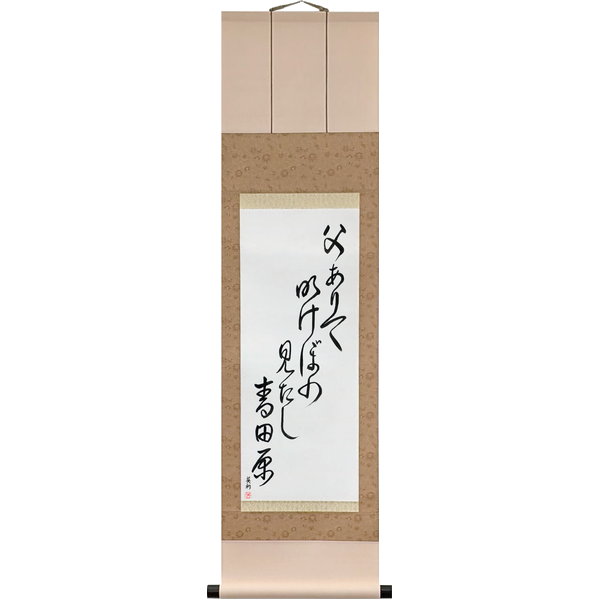
Sold as Were my father here / At dawn we would gaze / Over the green fields, under Issa's name and no translator's · Read chichi arite akebono mitashi aotabara · Oldest witness the poet's own diary of his father's death, 父の終焉日記, written in 1801 and first printed, so far as the archive shows, in 1908 · Sense the wish that cannot be had: if my father were alive I would want to see the dawn over the green paddies with him. It is the last line of the diary, written after the family refused the father's will.
The text as brushed, and its variants
The scroll carries 父ありてあけぼのみたし青田原, with the middle phrase in kana. The diary as the editors print it writes the kanji: 父ありて曙見たし靑田原, in the 1908 全集, the 1927 selection, the two dated editions of 1925 and 1935, the 1909 encyclopedia and the 1916 biography. The kana form of the scroll is what the popular books of 1933 and 1936 print, あけぼの見たし and あけぼのみたし, and what the 1928 index files under チチア. 曙 and あけぼの, 見たし and みたし, 靑 and 青 are one word each in two ages of writing. One witness stands apart. The 1921 全集, read by eye at the diary's close, prints 父ありて曙見たし靑田面, the face of the green paddies, where every other witness prints 原, the plain; the same editor's own index of 1928 reads 原, and no later book follows 面, so it is most likely a compositor's slip and is recorded here as the one variant on the record. The prose before the verse also differs by a word between the two full printings, 其日はやみぬ in 1908 and 其夜は止みぬ in 1921, that day or that night the matter was let rest; nothing in the verse turns on it. The meter is five, seven, five: ち・ち・あ・り・て, あ・け・ぼ・の・み・た・し, あ・お・た・ば・ら.
The attribution, as a dated thread
There is no thread to untangle. The verse is Issa's because it closes Issa's own diary, and every witness that prints it prints it there or names him. 半田良平's two editions of the collected verse arranged by season word and dated, 1925 and 1935, file it under 青田 with the year in brackets, 享和元, the first year of Kyōwa, 1801, the year the father died. The 1936 biography gives Issa's age as thirty-nine that year, which agrees. The diary itself the archive holds only in twentieth-century print; its earliest printing on the desk is the 1908 全集, and the 1921 全集 prints it whole again under the running head みとり日記, the nursing diary, with ーをはりー, the end, set after the verse. The English books that carry the verse, Blyth in 1963 and Hass in 1994, both place it in the diary and neither doubts it. Nobody has ever given this verse to anyone else.
The words
父ありて is if my father were here, ありて the counterfactual, not the narrative my father was there; Blyth's second rendering, with my dead father, is the sense, and Hass's with my father keeps the grammar but drops the death. あけぼのみたし is I would want to see the dawn; たし is the desiderative ending of classical Japanese, the wanting of a thing one cannot have. 青田原 is the plain of green rice fields, the paddies in early summer when the transplanted rice has taken and the whole valley is one green; 半田 files it under the season word 青田, summer. The father died in the fifth month, and the fields outside the sickroom were that green. As words the line says: Were my father here, I would want to see the dawn over the green fields. The English the page sells, Were my father here, at dawn we would gaze over the green fields, is Blyth's and is faithful; it adds only we, where the Japanese has no subject and the wish is the son's.
A history, from the earliest witness
1801. 小林一茶, 父の終焉日記, the diary of his father's last illness, as first printed in 1908 in 俳諧寺可秋's 一茶一代全集. Issa's father fell ill and died in the early summer of 1801, the season the verse's 青田 names; the diary records the illness day by day, the stepmother and half-brother in the house, the father's wish to divide the property, and the quarrel after his death. Its last entry is dated the twenty-eighth and is the seventh-day memorial, 初七日. The family refuses to honor the will, and Issa writes that since the household would have it so, 父の遺言守とありければ母家の人のさしづに任せて其日はやみぬ, since it was said that the father's will would be kept, I left it to the direction of the main house and let the matter rest that day. Then the verse, and the diary ends. In the 1908 print a small circle follows it and a different piece of prose begins. [NDL pid 874846, koma 109, printed pages 198–199, read by eye; text at lab.ndl.go.jp/dl/api/page/874846_109]
1909. 早稲田文学社, 文芸百科全書, an encyclopedia of literature. The article on Issa tells the death and the burial, fighting with the cold people of his native place, he buried his father alone, quotes the verse, and sends him back on the road: 再び流浪の生涯におつた, he fell again into a wandering life. The verse is already the emblem of that year. [NDL pid 871775, koma 936, OCR; text at lab.ndl.go.jp/dl/api/page/871775_936]
1913. 沼波瓊音, 大疑の前, a critic's essays. The verse is set beside 小言いふ相手もあらば今日の月, the moon verse after his wife's death, as evidence of the Issa who was not only spiteful and twisted but tender. [NDL pid 947491, koma 141, OCR; text at lab.ndl.go.jp/dl/api/page/947491_141]
1916. 田中貢太郎, 豪傑快傑, popular biographies. The father named, 彌五兵衞, and his death placed: 彌五兵衞は、それから八日ばかり床にゐて、九月十九日になつて終に死亡した, he lay some eight days more and died at last on the nineteenth of the ninth month, a date of this book's own that the diary as read here does not confirm and the season word does not support; then the verse. [NDL pid 955894, koma 85, OCR; text at lab.ndl.go.jp/dl/api/page/955894_85]
1921. 勝峰晋風, 新選一茶全集, a new collected edition. The diary printed whole under the running head みとり日記, and its close: 母家の人の指圖に任せて其夜は止みぬ, then 父ありて曙見たし靑田面, then ーをはりー, the 靑 in its old form as every print here has it. The last character is 面, not 原, in this printing only. [NDL pid 970100, koma 71, printed pages 98–99, read by eye; text at lab.ndl.go.jp/dl/api/page/970100_71]
1925 and 1935. 半田良平, 一茶俳句集 季題別年代考 and its successor 一茶俳句全集 季題別年代附, the collected verse by season word, dated. Under 靑田: 父ありて曙見たし靑田原(享和元), so printed in both editions. The date is the editor's ruling on the diary's evidence, and it is the one date the record gives. [NDL pid 917542, koma 22, printed page 28, read by eye; text at lab.ndl.go.jp/dl/api/page/917542_22. The 1935 edition at pid 1034501, koma 21, OCR; text at lab.ndl.go.jp/dl/api/page/1034501_21]
1927. 相馬御風, 一茶随筆選集, a selection of Issa's prose. The diary again to its last line, and the editor's judgment of it: 實に一茶が生涯を通じての最長篇の文章 … 一茶前半生の自叙傳, truly the longest piece of writing in Issa's whole life … the autobiography of his first half. [NDL pid 1186719, komas 26–27, OCR; text at lab.ndl.go.jp/dl/api/page/1186719_26]
1928. 勝峰晋風, 日本俳書大系, the index volume. The verse filed by its first syllables with its source and the poet's age: チチア(日記)父ありてあけぼの見たし靑田原(一茶三三), and on the same line a companion verse from the 選抄, 父ありて母ありて花に出ぬ日哉, with a father and a mother, a day I did not go out to the blossoms, another poem and not a variant. The bracketed 一茶三三 is the index's locator into its own Issa volume. [NDL pid 1179400, koma 280, OCR; text at lab.ndl.go.jp/dl/api/page/1179400_280]
1935. 吉田絃二郎, 梅の咲くころ, essays. 父ありて曙見たし靑田原といふ句が最後に加へてある。洵に一茶の眞情を語るものである, the verse is added at the very end; it truly speaks Issa's real feeling. [NDL pid 1232420, koma 26, OCR; text at lab.ndl.go.jp/dl/api/page/1232420_26]
1936. 菊池寛 (supervising editor), 日本英雄伝, lives for young readers. The will's terms as popular biography tells them, half the land and the house and a wife for Issa, refused by the stepmother and the half-brother 仙六, and the verse as what he wrote before swallowing tears of grief and indignation and going up to Edo again, 悲憤の淚を呑んで再び江戶に上つた. The terms are this book's and the account repeats them from it, not from the diary. [NDL pid 1222289, koma 183, OCR; text at lab.ndl.go.jp/dl/api/page/1222289_183]
Today. The kotobank page gives the poet's dates 1763–1828 in デジタル大辞泉 and 日本人名大辞典, and the ブリタニカ国際大百科事典 entry on the same kotobank page writes them 宝暦13(1763).5.5 to 文政10(1827).11.19; Britannica gives the diary's year, 享和1 (1801) 年,父の没後継母子と遺産を争い, in 1801, after his father's death, he disputed the inheritance with his stepmother and her son. The National Diet Library's catalogue search for the diary's title returns a 2021 article, 久保田文, 一茶と「寺の晩鐘」: 『父の終焉日記』における秩序への渇求, Issa and the temple's evening bell: the thirst for order in the Diary of My Father's Last Days, which is where a reader who wants the diary read as literature should go next. [kotobank 小林一茶, read as text; ndlsearch.ndl.go.jp opensearch for 父の終焉日記, 95 results at 2026-09-04]
The sense, across a century
The tradition holds one sense and has never argued it. The verse is the grief of a son who could not keep his father alive and could not keep his father's word alive either, written on the day he gave up the second fight. Every Japanese reader who quotes it quotes it for that: the 1909 encyclopedia as the emblem of the year that sent him wandering again, 沼波 in 1913 as the tender side of a spiteful man, 吉田 in 1935 as the diary's true close, the 1936 biography as the moment before he left for Edo. Blyth in 1963 says the same and adds a reservation about the poet, not the poem: Sometimes Issa has too much sentiment, and falls into the sentimentality. Hass in 1994 lets the diary carry it and adds nothing. The only motion in the reading is what the counterfactual is made to hold. Read as were my father here, it is a wish for the living man; read as Blyth's second version, with my dead father, it is a wish addressed past death. The Japanese ありて allows both and states neither.
What is not a source
The companion verse the 1928 index sets on the same line, 父ありて母ありて花に出ぬ日哉, is another poem from another book and says a different thing about the same house. The will's terms, half the property and a wife, come from the 1936 lives for young readers and the 1916 popular biography, not from the diary as read here; the diary's own account of the quarrel is in its last pages and the account has read only the close. The father's death date in the 1916 biography, the nineteenth of the ninth month, disagrees with the diary and the dated editions and is that book's error. None of these is a source for the verse; the verse's source is the diary.
The verse in English
The bilingual dictionaries of the Meiji shelf were not checked for this verse; a haiku does not travel through them, and the English record on the desk begins with Blyth, in 1963; the shelf carries four later renderings that the s39 search did not open, added below at s92. Miyamori's 1932 anthology, Henderson, Buchanan, Hamill, Keene, Ueda, Sato, Shirane and Reichhold were searched on the shelf and do not carry it.
1963. R. H. Blyth, A History of Haiku, volume 1, Hokuseido Press, Tokyo. Two renderings in one book. The first, in his account of Issa's life: Were my father here, / At dawn we would gaze / Over the green fields, with the note This was written after his father's death; his feelings are expressed in Chichi no Shuen Nikki, and the reservation about sentimentality quoted above. The second, later, comparing Issa with another poet: With my dead father / I would look at the dawn / Over the green fields, with the judgment Both poets were deeply filial, and their love of nature was an extension of this piety. Poetry, like charity, begins at home. His romaji is chichi arite akebono mitashi aotabara at the first and aotahara at the second, a slip of his or his printer's. The first rendering is the one the house page prints, to the word, without his punctuation and without his name. [docs/research/papers, Blyth 1963 vol. 1, read as text; the file carries no page markers and the printed pages are not confirmed; no ASIN collected]
1968. Richard Lewis, Of This World: A Poet's Life in Poetry, Dial Press. Blyth's first rendering reprinted word for word, Were my father here, / At dawn we would gaze / Over the green fields. [docs/research/papers, Lewis 1968, read as text; the text layer carries no page number at the verse]
1984. Lewis Mackenzie, The Autumn Wind, a selection of Issa, Kodansha International. If he were here, my father, / We'd watch once again the day break / Over green meadows, no. 46, with the romaji Chichi arite akebono mitashi aotabara in the notes, placed after the passage naming 父の終焉日記. [docs/research/papers, Mackenzie 1984, page 33 by the text layer's marker, read as text]
1994. Robert Hass, The Essential Haiku: Versions of Bashō, Buson, and Issa, Ecco Press. Twice: among the selected verses, I / With my father / would watch dawn / over green fields, page 189; and inside his translation of the diary itself, after the family's decision, Thereupon I decided to follow the instructions of the family and pursued the matter no further that day. I / With my father / would look out at dawn / over green fields, page 216. Hass keeps the grammar of ありて and the wish, and drops the death, which the diary around it supplies. [docs/research/papers, Hass 1994, pages 189 and 216 by the file's page numbers, read as text; no ASIN collected]
Today. The house English is Blyth's first rendering, uncredited. A rendering of this line has to keep the counterfactual and the wish, ありて and たし, and to keep the fields green and the hour dawn; it need not say the father is dead, because the diary says it, but a scroll has no diary beside it, and a page that sells the verse should say in one sentence where it comes from. Blyth's second version, with my dead father, is the truer of his two for a reader who will never see the diary.
2003. Cid Corman, One Man's Moon, Gnomon Press. Were my father here / at dawn we'd be out looking / at the green rice fields, page 88. [docs/research/papers, Corman 2003, read as text]
2007. G. Brian Karas, Today and Today, Scholastic Press. A picture book of Issa for children, the translator unnamed in the text layer: With my father / I would watch dawn / over green fields, which is Hass's 1994 line without its first word. [docs/research/papers, Karas 2007, read as text; no page number in the text layer at the verse]
A reading
I read this verse as the plainest thing on the scroll shelf and the heaviest. It is not an image and hardly a poem; it is a sentence a man writes at the bottom of a page when there is nothing more to write, and the poem is that he wrote it in seventeen syllables anyway, with a season word, because that was the form his grief knew. The diary's last prose sentence is about property, and the verse that follows is about a dawn he will not see with the one person he wanted to see it with. That turn, from the will to the fields, is the whole of it, and no rendering can carry it without the diary. So my reading is that the page should carry the diary in one line: the last line of Issa's diary of his father's death, 1801, written the day the family refused the will. The text, the attribution and the romaji stand, and the scroll needs no change; the one variant on the record, the 1921 全集's 面, is a compositor's and does not touch the brushed text. Signed, 典, 2026-09-05.
How this was read
By eye at width 3600: the 1908 全集 at the diary's close, pages 198–199; the 1921 全集 at the same, pages 98–99, where 面 was read; the 1925 dated edition at 青田, page 28, where 享和元 was read. By OCR from the archive's text layer: the 1909 encyclopedia, the 1913 essays, the 1916 biography, the 1921 diary selection of 小池, the 1927 selection, the 1928 index, the 1933 and 1935 books, the 1936 lives, the 1935 dated edition. By text layer from the shelf: Blyth's two passages and Hass's two pages; the kotobank entry; the catalogue search. Not opened: the diary in Issa's hand, or any print of it before 1908, none being in the archive; a modern annotated edition of the diary at its close, which would give the day and the words the editors' 語釈; the 1936 book's source for the will's terms; the 2021 article on the diary; Blyth's printed pages, which the text layer does not number. A bracket of the form pid P, koma N resolves as text at lab.ndl.go.jp/dl/api/page/P_N and as an image at dl.ndl.go.jp/api/iiif/P/R<N, seven digits>/full/3600,/0/default.jpg; the three leaves read by eye were fetched at that address. The full apparatus, with every address, is in the account.
Supersession 2026-09-14 (s92)
A read-only worker resolved every address in this account against the koma text files and the shelf (citation_checks_2026-09-14/history_chichi_arite_267_2026-09-05.check.md): all twelve NDL koma citations and both Blyth and Hass quotations resolve verbatim. Corrected above: the Britannica sentence now carries its address (the kotobank page); four English renderings on the shelf that the s39 search did not open are added in § The verse in English (Lewis 1968, Mackenzie 1984, Corman 2003, Karas 2007) — the house title remains Blyth's line, which Lewis reprints. Not opened by the worker and standing on the s39 reading: the three printed page numbers read from the images; 相馬御風 1927 at pid 1186719 koma 27, which I re-opened this turn (最長篇の文章 and 一茶前半生の自叙傳 both on koma 27, so the s39 address komas 26–27 narrows to 27); kotobank and the NDL search, which are live addresses. Not yet read by a person.
References
Each witness is cited in the account above, at the frame or entry where it was read. A linked list follows when the record for this text is completed.