


Jiun · 自運 · VD4B
Jiun (自運) is the calligrapher's word for writing from one's own invention. As a Shihan, Master Takase has a hand of her own, and these designs are that hand: she draws freely on the classic scripts to create exactly the look she wants.
父ありて
あけぼのみたし
青田原
chichi arite
akebono mitashi
aotabara
issa 一茶
Were my father here
At dawn we would gaze
Over the green fields
Were my father here, I would want to see the dawn over the green fields.
Master Takase creates this beautiful scroll when your order is placed, personally preparing the ink and brushing your art, which proudly bears her signature and seal. This is an original work of art.
Description
Were my father here
At dawn we would gaze
Over the green fields [1]
|
chichi arite akebono mitashi aotabara |
父ありて あけぼのみたし 青田原 |
| issa | 一茶 |
父ありてあけぼのみたし青田原 (chichi arite akebono mitashi aotabara): were my father here, I would want to see the dawn over the green fields.
Kobayashi Issa's verse is grief said as plainly as it can be. A son names the one thing he wants and cannot have, and then says nothing more.
In the Japanese, 父ありて means if my father were here, so the whole line is a wish. 青田原 is the plain of green rice fields in early summer, when the planted rice has taken and a valley is all one green. Some designs write あけぼの with the kanji 明, and one writes 見たし with the kanji 見. The words are the same.
Calligraphy Notes:
1) From a visual perspective this poem is great as it is mostly kana with the last line all in kanji. This gives an interesting balance to the design.
2) Other sources write the haiku 父ありて明ぼの見たし青田原 with the reading chichi arite akebono mitashi aotahara. Using "aotahara" rather than "aotabara" or "aodabara".
Translation Notes:
1) 父 (chichi) meaning "father".
2) ありて (arite) meaning "exist; be present". This is from the verb ある (aru) meaning "to be; to exist; to live".
3) あけぼの (akebono) meaning "dawn." This is also commonly written with the kanji 曙.
4) みたし (mitashi) meaning "to watch; to see". From the verb 見る (miru) with the same meaning. The ending tashi indicates "wanting to watch; wanting to see".
5) 青田原 (aotabara though several sources use the reading aodabara). This is composed of 青田 (aota) meaning "green (rice) paddy" and 原 (hara) meaning "field".
References:
[1] Translation by R. H. Blyth, A History of Haiku, vol. 1 (Hokuseido Press, 1963), p. 410.
The verse closes the diary Issa kept of his father's last illness and death in the early summer of 1801, a manuscript he left untitled and is thought to have finished in 1807 or 1808, at the seventh-day memorial where the family agreed to keep the father's will.
We want you to be as happy with the meaning as you are with Master Takase's art. To learn more, visit Philology of 父ありてあけぼのみたし青田原.
Delivery
Your scroll is brushed when you order it and completed within 1 to 3 business days. It ships by USPS Priority Mail from Master Takase's studio in Washington State, boxed and ready to hang, with a printed page giving the art's English, romaji and Japanese.
Sending it as a gift? Add your message at checkout and we will include it.
Shipping is calculated at checkout from your address; within the United States it is $13 to $23. We ship worldwide, and any import charges for your country are shown at checkout before you pay.
Every order is covered by our 30-day money-back guarantee. If your scroll arrives damaged, or we made an error, we replace it or refund you in full, including shipping. Refund policy
About Our Scrolls
Master Japanese Calligrapher Eri Takase brushes your scroll by hand when you order it. Each scroll bears her red seal, 英利, and her signature.
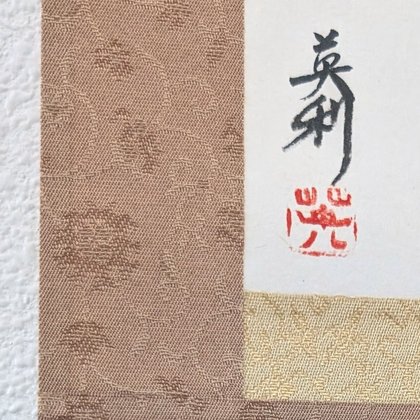
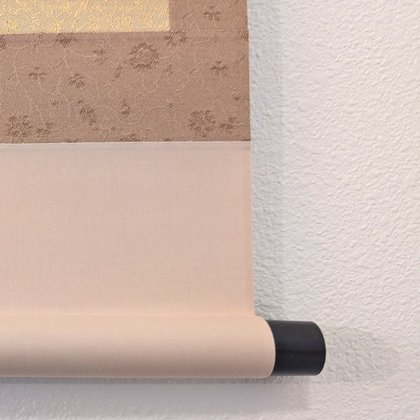
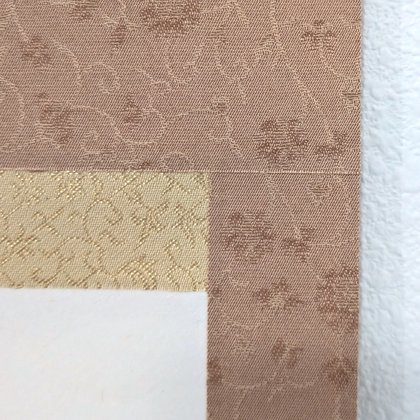
The scrolls are 12 1/4" W × 43" H (31 × 109 cm), with woven damask borders and layered Japanese paper, designed to last generations. The scrolls themselves are made by a scroll maker in Gifu, Japan, and we have worked with them for over two decades.
Eri Takase was born and raised in Osaka, Japan, and holds the rank of Shihan, the highest rank in Japanese calligraphy, from the Bokuteki-kai and the Bunka-shodo. About Master Takase
Related products

Issa - This dewdrop world, is a dewdrop world, and yet露の世は露の世ながらさりながらtsuyu no yo wa tsuyu no yo nagara sari nagara

Issa - Snail, ever so slowly climb, Mt Fuji蝸牛そろそろ登れ富士の山katatsuburi sorosoro nobore fuji no yama

Issa - The bitter part, eaten by the mother, mountain persimmon澁いとこ母が喰ひけり山の柿shibui toko haha ga kui keri yama no kaki
