

雨にも負けず風にも負けず · ame ni mo makezu kaze ni mo makezu · Not beaten by the rain, not beaten by the wind
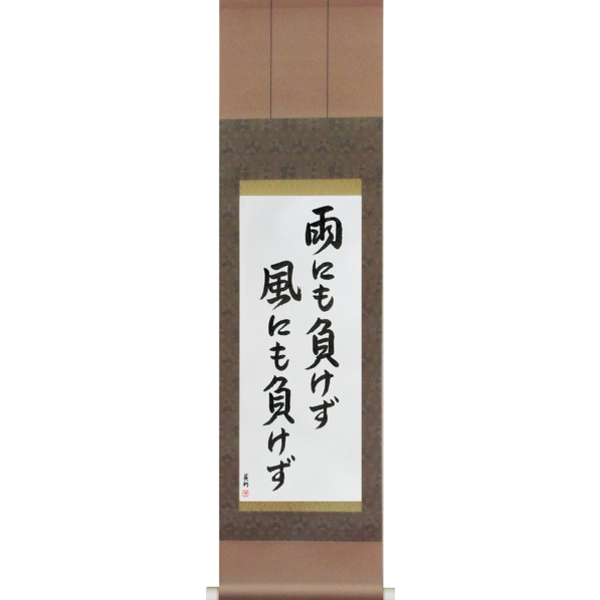
Sold as Be Not Defeated by the Wind, Be Not Defeated by the Rain · Read ame ni mo makezu kaze ni mo makezu · Oldest witness a black notebook, in pencil, dated by the poet's own hand to 3 November 1931, two years before his death; first printed in 1934; the earliest printing in the public domain is 1941 · Sense the first two lines of a poem that is one sentence long, describing the person the poet wants to become. Not a proverb, and not a command.
The words
雨, ame, is rain; 風, kaze, is wind; にも, ni mo, is even to, even by; 負けず, makezu, is the classical negative of 負ける, makeru, to lose, to be beaten. Not beaten even by rain, not beaten even by wind. The page's grammar note gets two things wrong. It names the verb as 負かす, makasu, which is the transitive verb, to defeat someone; the poem's verb is 負ける, to be beaten. And it calls the form an imperative negative, do not be defeated; ず is the negative in its continuative form, and the clause is not a command but a description that runs on. The poem is a single sentence thirty lines long, and its main verb is the last line, サウイフモノニ / ワタシハナリタイ, such a person is what I want to become. Every line before it, including the two sold here, describes that person. The page also glosses 風 as rain; a slip.
The poem was written in katakana and every printing keeps it so; the design writes the two lines in kanji and hiragana, which is how the phrase is quoted in ordinary Japanese prose (a government pamphlet of 1942: 雨にも負けず、風にも負けず、大地を耕す) and not how the poem is written. That is a script choice, made by the calligrapher, not a variant of the text. The reading is ame ni mo makezu kaze ni mo makezu; there is no other.
A history, from the earliest witness
3 November 1931. 宮沢賢治's notebook, pages 51 to 59, in pencil. The poet, thirty-five and ill with the tuberculosis he did not recover from, wrote the poem in a small black notebook and dated it in blue pencil, 11.3. It was not written for print, and it was not published in his lifetime. The text, as the 1997 critical edition prints it from photographs of the notebook: 雨ニモマケズ / 風ニモマケズ / 雪ニモ夏ノ暑サニモマケヌ / 丈夫ナカラダヲモチ / 慾ハナク / 決シテ瞋ラズ / イツモシヅカニワラッテヰル / 一日ニ玄米四合ト / 味噌ト少シノ野菜ヲタベ / アラユルコトヲ / ジブンヲカンジョウニ入レズニ / ヨクミキキシワカリ / ソシテワスレズ / 野原ノ松ノ林ノ蔭ノ (the edition's glyph is a variant of 蔭 that Aozora carries as an image, JIS 第4水準 2-86-78) / 小サナ萓ブキノ小屋ニヰテ / 東ニ病気ノコドモアレバ / 行ッテ看病シテヤリ / 西ニツカレタ母アレバ / 行ッテソノ稲ノ朿ヲ負ヒ / 南ニ死ニサウナ人アレバ / 行ッテコハガラナクテモイヽトイヒ / 北ニケンクヮヤソショウガアレバ / ツマラナイカラヤメロトイヒ / ヒドリノトキハナミダヲナガシ / サムサノナツハオロオロアルキ / ミンナニデクノボートヨバレ / ホメラレモセズ / クニモサレズ / サウイフモノニ / ワタシハナリタイ. Not beaten by the rain, not beaten by the wind, not beaten by the snow or the summer's heat; with a strong body, without greed, never angry, always smiling quietly; eating four bowls of brown rice a day with miso and a few vegetables; taking everything in without counting himself, watching and listening well and understanding, and not forgetting; living in a small thatched hut in the shade of the pines on the moor; if there is a sick child in the east, going to nurse it; a tired mother in the west, going to carry her sheaves of rice; someone dying in the south, going to say there is nothing to fear; a quarrel or a lawsuit in the north, saying it is not worth it, stop; weeping in a drought, walking distraught in a cold summer; called a good-for-nothing by everyone, neither praised nor troubled over: such a person is what I want to become. On the facing page, page 60, he wrote seven lines of Nichiren invocation with 南無妙法蓮華経 in the center and larger; the poem is a vow written before the 題目. [aozora.gr.jp card 45630, the text of 【新】校本宮澤賢治全集 第十三巻(上), 1997, text; the notebook itself not opened; the date and the pages reported from the Japanese Wikipedia article and not checked against the edition's apparatus]
1934. The notebook shown, and the poem first printed. The poet's brother 清六 brought the poet's leather trunk to a memorial gathering in Tokyo on 16 February 1934, and someone there took the notebook out of its pocket and passed it round, and the 岩手日報 printed the poem on 21 September 1934 as 遺作(最後のノートから), a posthumous work, from the last notebook. 山本有三's anthology for children carried it in 1936. [reported from ja.wikipedia.org/wiki/雨ニモマケズ, text; none of the three opened]
1935 or 1936. The stone. A poem-stone was raised at the site of the poet's farmhouse school outside Hanamaki, its text cut from the notebook in the hand of the sculptor-poet 高村光太郎. A Hanamaki memoir of 1941 gives the stone's date as 25 November 1935, its size, its calligrapher, and its text: 高さ十一尺、巾四尺五寸、厚さ一尺五寸ぐらゐの水成岩で、碑文は賢治の晩年所持してゐた手帳に走り書きをしてゐた覺え書から拔いたもので … 文字は高村光太郎先生が書かれた, then eight lines beginning 野原ノ林ノ蔭ノ小サナ萱ブキノ小屋ニヰテ. The stone starts not with the rain but with the hut, and its first line drops 松ノ, the pines, an omission the calligrapher corrected on the stone itself in 1946. Wikipedia dates the stone 21 November 1936; the 1941 memoir says 1935; this history does not settle it. [dl.ndl.go.jp/pid/1130403 koma 53, pages 86–87, by eye; lab.ndl.go.jp/dl/api/page/1130403_53, text, where the stone's dropped 松ノ is confirmed]
1941. The poem as frontispiece to a children's book, 羽田書店's グスコーブドリの伝記. The earliest printing of the poem in the public domain, on pages 2 and 3, in katakana, with furigana on 味噌, 野菜 and 萱: 雨ニモマケズ / 風ニモマケズ / 雪ニモ夏ノ暑サニモマケヌ … 野原ノ松ノ林ノ蔭ノ … 稻ノ束ヲ負ヒ … ヒデリノトキハナミダヲナガシ … デクノボウトヨバレ … ワタシハナリタイ, without the invocation. The illustrator 横井弘三's afterword calls it that famous poem of the teacher's own, eight years after his death. [dl.ndl.go.jp/pid/1720627 koma 5, by eye at width 3600; lab.ndl.go.jp/dl/api/page/1720627_5, text; koma 129, OCR]
1942 and 1943. The two lines alone. A pamphlet from the Ministry of Education's 教学局, 大東亜戦争とわれら, quotes the opening as a farmer's motto: 雨にも負けず、風にも負けず、大地を耕す一鍬々々が國を支へる力で, not beaten by rain, not beaten by wind, every stroke of the hoe that tills the earth is the strength that holds up the nation, in kanji and hiragana, which is the form the design descends from. A girls' novel of 1943 has a child recite the poem; a Kagoshima teachers' report of the same year quotes it whole. [the National Diet Library's full-text search, 雨にも負けず and 雨ニモマケズ, OCR]
1946. 宮沢賢治名作選, volume 2, 羽田書店, pages 560 and 561. After the poet's essay on farmers' art, a heading, 手帖より, from the notebook, and the poem, with 瞋 glossed イカ. The book's chronology adds the provenance in one line: 昭和六年九月十九日 出京ト同時ニ再ビ發病歸宅。(三十六歲)「詩碑」ニ刻マレタ詩「雨ニモマケズ風ニモマケズ」ハ十一月三日附デ手帖ニ記サレテアル, 19 September 1931, fell ill again on arriving in Tokyo and went home; the poem carved on the stone is written in the notebook under the date 3 November. [dl.ndl.go.jp/pid/1244737 komas 66 and 74, by eye at width 3600; lab.ndl.go.jp/dl/api/page/1244737_66, text]
1997. The 新校本 全集, the critical edition. Prints the notebook as written: ヒドリ where every printing from 1934 to 1949 had ヒデリ, drought; 朿 for 束, kept as the poet's slip; デクノボー for the printings' デクノボウ; and the seven lines of invocation after the last line. The editors argue in the notes that ヒデリ is what he meant, since he elsewhere wrote ひど and corrected it to ひでり, since the line pairs with the cold summer that follows, and since drought is in his other work; a claim of the 1980s that ヒドリ means day-labor is not accepted. The text is what he wrote, the sense is what he meant, and the edition keeps both. [aozora.gr.jp, the edition's text; the notes reported from Wikipedia, not opened]
Today. No dictionary of proverbs carries the line, because it is not one; kotobank has no entry for it. The National Diet Library's public-domain books carry the poem's opening in twenty-six books from 1941 on, and the two lines in kanji and hiragana in six, the first a 1928 school magazine describing a football match played 降りしきる雨にも負けず, three years before the poem. [lab.ndl.go.jp full-text search, 雨ニモマケズ 26, 雨にも負けず 6, 雨ニモマケズ風ニモマケズ 6, ヒデリノトキハ 7, ヒドリノトキハ 0; derived 2026-09-03 and the saved counts re-checked 2026-09-05]
The sense across time
Within the poem the two lines are a portrait: not the weather but the man, whose body is strong and whose wants are few, and who goes east and west and south and north when he is needed. That is how the first readers took it. The illustrator in 1941 calls it the teacher's own famous poem; the Hanamaki memoirist says as this poem says, he spent his whole life for others alone; the stone, which begins with the hut and the sick child, keeps the portrait and leaves the weather off. The wartime state in 1942 took the first two lines out and made them a motto of endurance for farmers, and that is the sense the design sells: two lines about weathering things. The critical edition reads the notebook, not the motto, and finds a vow written before a prayer. The page reads the lines as an imperative addressed to the buyer, which the grammar does not carry, and reverses them.
What is not a source
The seven lines of invocation on page 60 are a text of their own, the 題目 sold separately in this catalogue, and not part of the poem. The stone is a witness to the poem's reception and not to its text; it drops a word and begins in the middle. The ヒドリ question belongs to the twenty-fourth line, not to the two lines sold. And nearly everything said above about the years 1931 to 1936 is reported from the Japanese Wikipedia article, whose claims were checked against that article one by one but not against the edition's apparatus; the printings of 1941 and 1946 and the memoir of 1941 are read.
The text in English
No English rendering is quoted here. The poem has been translated many times since the 1960s, by Hiroaki Sato, Roger Pulvers, Arthur Binard and others, and all of those are in copyright; none was opened, and this history does not quote translations from memory. What can be said from the Japanese: the poem's English title in general use puts rain first, as the Japanese does; the house title puts wind first. The page's grammar, the imperative negative of 負かす, is no translator's. Neither of the two American proverb collections on the shelf carries the lines, which is right, since they are not a proverb. [Buchanan 1965 and Galef 2012, text layers]
Today. The house title, Be Not Defeated by the Wind, Be Not Defeated by the Rain, reverses the lines and reads them as a command. What a rendering must keep: rain first, then wind; beaten or defeated as something that happens to the person, not something they do; and the fact that the lines describe someone rather than instruct anyone.
A reading
The two lines are sound as a design, the romaji is sound, and the choice of kanji and hiragana for a katakana poem is the calligrapher's to make. The page has three faults: the title reverses the lines; the grammar names the wrong verb and calls it imperative; 風 is glossed rain. The story the page could tell in a paragraph is better than the motto it sells: a dying man's vow in a notebook, in pencil, dated, not meant for print, one sentence long, ending that is what I want to become, with a prayer written on the facing page. A buyer who takes the first two lines should know they are the beginning of a sentence whose verb is at the end, and that the person in the sentence is not beaten by rain because he is out in it, walking to someone who needs him. Signed, 典, 2026-09-05.
How this was read
By eye: the 1941 frontispiece, the 1946 selected works at the poem and at the chronology, each at the National Diet Library's page image at width 3600 on the day of writing; the 1941 Hanamaki memoir at the stone's text. By text at the address: the critical edition's text of the notebook through Aozora Bunko, decoded from Shift_JIS by hand; the library's page API for the three leaves; the OCR layer for the 1941 afterword, the 1942 pamphlet, the 1943 witnesses and the counts; the Japanese Wikipedia article for the years 1931 to 1936 and the ヒドリ dispute, claim by claim; the National Diet Library catalogue for the 1934–35 collected works; the two live pages; the text layers of Buchanan and Galef. Every address was re-opened by a reader before writing and every one agreed with the account. Not opened: the notebook or its facsimile; the 岩手日報 of 21 September 1934; the collected works of 1934–35 and 1939–44; the 1936 anthology; the edition's notes on ヒドリ at their page; 永瀬清子's account of the night the notebook was shown; any English translation; the 1943 novel and report beyond their highlights. The account beneath this history carries every address, the raw OCR beside each reading, and the page-image addresses for the leaves read by eye.
References
- The notebook (手帳), pp. 51–59, pencil (1931-11-03) — reported; the 新校本 1997 prints it from the photographs
- 岩手日報, evening edition (1934-09-21) — reported (Wikipedia), not opened
- 『グスコーブドリの伝記』羽田書店, frontispiece (1941) — pid 1720627 pp. 2–3, by eye
- The stone at the 羅須地人協会 site, 高村光太郎's hand, as 関登久也 transcribes it (1936 (関: 昭和十年十一月廿五日)) — pid 1130403 pp. 86–87, by eye
- 『宮沢賢治名作選』下巻, 羽田書店 (1946) — pid 1244737 pp. 560–561, by eye
- 【新】校本宮澤賢治全集 第十三巻(上) (1997) — Aozora card 45630, decoded
- The catalogue and the scroll page (2026) — cultural_works.csv:355