

知者は惑わず · 仁者は憂えず · 勇者は懼れず · chisha wa madowazu · jinsha wa ureezu · yūsha wa osorezu · The wise are not perplexed, the humane are not anxious, the brave are not afraid
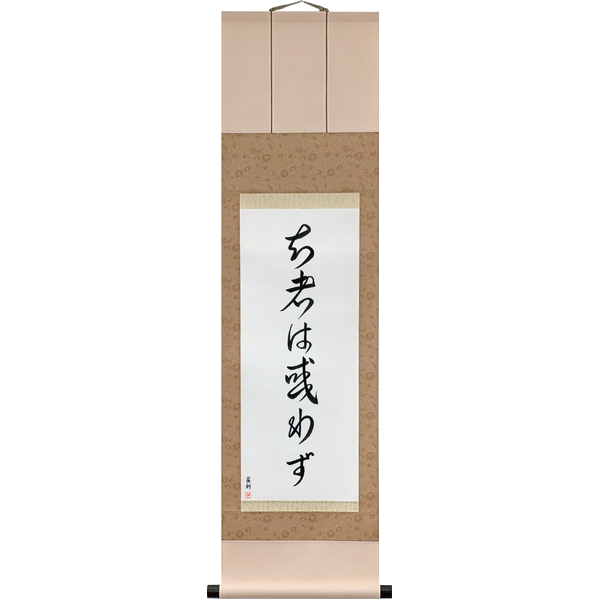
Sold as three scrolls, The Wise Have No Delusions, The Benevolent Have No Worries and The Brave Have No Fears · Read chisha wa madowazu, jinsha wa ureezu, yūsha wa osorezu · Oldest witness the Analects of Confucius, book nine, where the three clauses stand bare as a saying, and again in book fourteen, in another order, as the Master's confession of what he cannot do · Sense three virtues, each named by the one thing it frees a person from; in Japan the three clauses have been quoted one or two at a time since the fourteenth century, which is what the three scrolls do.
The words
Nine Chinese characters in three clauses of three, 知者不惑,仁者不憂,勇者不懼, and a Japanese sentence that reads each clause aloud with a subject, a particle and a negative verb. 知者 is the one who knows: 字通 glosses it 道理を知る人, the person who knows the way things are, and 大辞泉 道理に通じた者. It is not the wise of a proverb but the one with understanding, and the Japanese dictionaries also spell it 智者. 仁者 is the one who has 仁, humaneness, the first Confucian virtue, which Legge renders virtuous here and benevolent elsewhere, and Waley really Good with a capital. 勇者 is the one with courage; the older Japanese reading was ようしゃ, which one dictionary still keeps beside ゆうしゃ. The three verbs: 惑う is to be at a loss, to waver among alternatives; 憂う is to be anxious, to sorrow; 懼る is to fear, and the scrolls keep the canon's character 懼 rather than the everyday 恐. One trap in the first verb. In Buddhist Japanese 惑 is delusion, the first of the three in 惑・業・苦, and that is where the scroll's English delusions comes from; Confucius wrote the ordinary word, perplexity, and every dictionary and translator reads it so. The scrolls write the modern forms, 惑わず and 憂えず; every witness before 1946 writes 惑はず and 憂へず, the same words in older spelling. The line as words: the one who knows is not at a loss; the humane one is not anxious; the brave one is not afraid.
A history, from the earliest witness
The Analects, book nine (子罕). The three clauses stand alone, as a saying: 子曰:「知者不惑,仁者不憂,勇者不懼。」 James Legge, whose 1861 translation is printed beside the Chinese at the Chinese Text Project: The Master said, "The wise are free from perplexities; the virtuous from anxiety; and the bold from fear." This is the order the Japanese dictionaries cite as the source of all three proverbs, and the order the three scrolls are numbered in. [ctext.org/analects/zi-han, section 29; text]
The Analects, book fourteen (憲問). The same three clauses, framed and in a different order: 子曰:「君子道者三,我無能焉:仁者不憂,知者不惑,勇者不懼。」子貢曰:「夫子自道也。」 Legge: The Master said, "The way of the superior man is threefold, but I am not equal to it. Virtuous, he is free from anxieties; wise, he is free from perplexities; bold, he is free from fear." Zi Gong said, "Master, that is what you yourself say." Here humaneness comes first and the Master says he manages none of the three; his disciple answers that he has just described himself. [ctext.org/analects/xian-wen, section 28; text]
Fourteenth century. The Tale of the Soga Brothers (曾我物語), book one. The dictionaries' first citation for the line as a Japanese sentence, and it is already a saying: 知者はまどはず、しんしゃはうれゑず、勇者(よふしゃ)はおそれずと申せども, though they say the one who knows does not waver, the humane one does not grieve, the brave one does not fear. All three clauses, the verbs in kana, and と申せども, though it is said, which is how a proverb is quoted. [12]
About 1430. The Noh play Yashima (八島). The dictionaries' first citation for the 智者 spelling, and the first witness that quotes the line in pieces: 智者は惑はす、勇者は懼れずの、彌猛心(やたけごころ)の梓弓, the wise do not waver, the brave do not fear: the fierce heart, the catalpa bow. The middle clause is dropped and the third is turned into a pivot on the warrior's heart. [5]
1907. 大江文城, The Confucian Scriptures (儒教聖典), a Meiji canon in Japanese. Both passages as a Meiji reader met them, a vernacular reading followed by the original and the chapter name. Book nine: 子のたまはく、知者は惑はず、仁者は憂へず、勇者は懼れず。〔原文〕子曰、知者不惑、仁者不憂、勇者不懼。((子罕)). Book fourteen: 君子の道三あるも我は能くするものなし。仁者は憂へず、知者は惑はず、勇者は懼れずと。子貢曰く、夫子自ら道ひ玉ふなりと。 The reading is the one the scrolls carry, character for character but for the kana. [6]
1911 to 1935. Four books on Confucius. A 1911 study of Confucius and his teaching quotes the book-fourteen form and names its chapter; a 1922 study numbers the book-nine line among the Master's sayings; a 1928 vernacular Analects prints it; and a 1935 memorial volume for a teacher reads the book-nine order as a ranking: 孔子は、「知者は惑はず」と第一に知をおき、それから「仁者は憂へず。勇者は懼れず。」と、知仁勇の三德を述べました, Confucius put knowledge first, "the one who knows does not waver," and then set out the three virtues of knowledge, humaneness and courage. Between 1907 and 1946 the line is in some 149 books the National Diet Library has digitized. [7][8][9][10]
Today. デジタル大辞泉 has two headwords, both marked 《「論語」子罕から》: 仁者は憂えず, glossed 仁者は心がおおらかで天命に安んじているから、何事にも心配することがない, the humane are large-hearted and at peace with Heaven's decree, so nothing worries them; and the pair 知者は惑わず勇者は懼れず, glossed 道理に通じた者は、事をなすにあたって迷いがなく、勇気ある者はどのような事態にも臆することがない, one who understands the way of things does not hesitate in acting, and one with courage does not flinch at any situation. 精選版日国 gives the same two headwords with the 智 spelling and the two first citations above. 字通 quotes the canon under 知者 and drops the third subject as the page prints it. No dictionary has 知者は惑わず or 勇者は懼れず as a headword on its own. [12]
The sense across time
The tradition holds one sense and adds one thing to it. The sense is the line's own: each virtue is named by what it removes. The addition is the because that the Japanese dictionaries read in, 天命に安んじているから, because they rest in Heaven's decree, which is the commentary tradition's reason for the humane one's calm and not a word of the line. What varies is the order and the framing, and the two places in the Analects disagree with each other: book nine puts knowledge first and gives the clauses bare; book fourteen puts humaneness first and gives them as the three things the Master says he cannot do. Arthur Waley, in 1938, called the book-nine order a mere slip corrected by book fourteen; the 1935 Japanese lecturer took the same order as Confucius putting knowledge first. The Japanese tradition prints both places as they stand and cites book nine as the source. From 1911 the three virtues are a fixed phrase in Japanese moral writing, 知仁勇の三徳, and any scroll that carries one clause is understood to imply the other two.
What is not a source
Nothing has been set beside this line in the sources opened; it is a canon line with an author, not a folk saying with parallels. The Buddhist 惑, delusion, is a different sense of the same character and not a source for the scroll's English; it is where that English came from, which is not the same thing. The two places in the Analects are one text at two addresses, not two sources.
The text in English
The Meiji bilingual dictionaries were not checked for this line; the English begins with Legge.
1861. James Legge, The Chinese Classics, volume 1, the Analects, book IX. The wise are free from perplexities; the virtuous from anxiety; and the bold from fear. Three subjects, three abstract nouns; perplexities for 惑 is the reading every later translator keeps. [as the Chinese Text Project prints it beside the Chinese; text; the printed volume not opened]
1938. Arthur Waley, The Analects of Confucius, book IX, section 28. The Master said, he that is really Good can never be unhappy. He that is really wise can never be perplexed. He that is really brave is never afraid. Waley silently restores the book-fourteen order, Goodness first, and says why in his footnote: In the original the first two clauses have become transposed. This is, however, a mere slip, as is shown by comparison with the parallel passage, XIV, 30, adding that Confucius always ranks courage below wisdom and wisdom below Goodness. At book XIV, section 30, he gives the framed form: The Master said, the Ways of the true gentleman are three. I myself have met with success in none of them. For he that is really Good is never unhappy, he that is really wise is never perplexed, he that is really brave is never afraid, Tzu-kung said, That, Master, is your own Way! [archive.org in.ernet.dli.2015.174971, OCR text layer, not checked against the page; no ASIN collected]
Not opened. D. C. Lau (Penguin, 1979), Edward Slingerland (Hackett, 2003), and Ames and Rosemont (Ballantine, 1998): the modern lineage after Waley. A search snippet gives Slingerland's as One who understands the Way is free of confusion, one who possesses ren is free of worries, and one who is courageous is free of fear, and that snippet was not verified against the book.
Today. The house sells the three clauses under three titles: The Wise Have No Delusions, The Benevolent Have No Worries, The Brave Have No Fears. Benevolent for 仁者 is Legge's tradition and fair; worries for 憂 is the dictionaries' 心配 and fair. Delusions for 惑 is the one word to weigh: it is the Buddhist sense of the character, and the Confucian line means perplexity, being at a loss, which is what Legge, Waley, 大辞泉 and 字通 all say. It is not wrong as English for 惑 in Japanese; it is a different 惑 from the one Confucius wrote. What a rendering of any one clause must keep is the shape all three share: one kind of person, and the one thing that person is free of.
A reading
One line, three scrolls, and the three are right to sell it in pieces. The Japanese have been quoting these clauses one or two at a time for six centuries: the Soga tale takes all three, the Noh play takes the first and the third, and a scroll on a wall takes one. The order question belongs to the history and not to the wall; the scroll numbering follows book nine, which is the source the Japanese dictionaries name, and that is enough. On the English, I would read 知者は惑わず as The wise are not perplexed or The wise do not waver, since delusions carries the Buddhist 惑 into a Confucian sentence; that is a note for the page, not a defect the sources compel, and the other two titles stand. Signed, 典, 2026-09-05.
How this was read
By text, at the address: both Analects passages with Legge at the Chinese Text Project; the four dictionary entries at kotobank; the 1907 canon at two scans of the NDL page API; Waley at the archive.org text layer; the three catalogue rows. By search snippet only, not opened at the page: the four books of 1911 to 1935, and the count of some 149 books. Quoted from a dictionary, the text itself not opened: the Soga tale and the Noh play. Not opened: any Edo commentary on books nine and fourteen; Lau, Slingerland, and Ames and Rosemont; the Meiji bilingual dictionaries; the three live product pages; the remaining four pages of the National Diet Library search. Every address in this history is a text address except Waley's print and the three unopened translators, and a reader's AI can open the rest. The full apparatus, with every address, is in the account.
References
- The three scrolls (ours) (—) — S0022SSVB5A · S0024SSVB5A · S0026SSVB5A
- 論語 子罕 (canon) — ctext.org/analects/zi-han §29 (TEXT)
- 論語 憲問 (canon) — ctext.org/analects/xian-wen §28 (TEXT)
- 曾我物語 一 (南北朝頃) — 精選版日国, 初出の実例 under 仁者は憂えず (kotobank 537672); the text not opened
- 謡曲 八島 (1430頃) — 精選版日国, 初出の実例 under 智者は惑わず勇者は懼れず (kotobank 565814); the play not opened ↩
- 大江文城 編『儒教聖典』 (1907) — NDL pid 753280, koma 124 and 53, page API, OCR (the OCR runs the book's running head 儒教聖典 into 懼れず on koma 124) ↩
- 『孔子及孔子教』 (1911) — NDL pid 753240 koma 133, search snippet, OCR ↩
- 『孔子と其思想及教義』 (1922) — NDL pid 969299 koma 136, search snippet, OCR ↩
- 『国訳論語』 (1928) — NDL pid 1188562 koma 105, search snippet, OCR (the snippet's order may be the OCR's) ↩
- 『留送余影:川合信水先生』 (1935) — NDL pid 1281290 koma 57, search snippet, OCR ↩
- デジタル大辞泉 (current) — kotobank 537672 · 3228315
- 精選版 日本国語大辞典 (current) — kotobank 537672 · 565814 ↩
- 普及版 字通, 知者 (current) — kotobank 565743 (the third subject dropped as the page prints it)