Japanese Buddhism
Tourist Library 21
Japanese Buddhism
by Daisetz Teitaro Suzuki (鈴木大拙)
Tourist Library 21
Board of Tourist Industry, Japanese Government Railways, 1938
TOURIST LIBRARY
Volumes already published
1. TEA CULT OF JAPAN By Y. Hukukita, A. B.
2. JAPANESE NOH PLAYS By Prof. T. Nogami
3. SAKURA (Japanese Cherry) By M. Miyosi, D. Sc.
4. JAPANESE GARDENS By Prof. M. Tatui
5. HIROSIGE AND JAPANESE LANDSCAPES By Prof. Yone Noguti
6. JAPANESE DRAMA By B. T. I.
7. JAPANESE ARCHITECTURE By Prof. H. Kisida, D. Sc.
8. WHAT IS SINTO? By Prof. G. Katō, D. Litt.
9. CASTLES IN JAPAN By Prof. S. Ōrui, D. Litt. and Prof. M. Toba
10. HOT SPRINGS IN JAPAN By Prof. K. Huzinami, M. D.
11. FLORAL ART OF JAPAN By Issōtei Nisikawa
12. CHILDREN’S DAYS IN JAPAN By T. Iwadō, M. A.
13. KIMONO (Japanese Dress) By Keniti Kawakatu
14. JAPANESE FOOD By Prof. Kaneko Tezuka
15. JAPANESE MUSIC By Katumi Sunaga
16. ZYUDO (ZYUZYUTU) By Prof. Zigorō Kanō
17. FAMILY LIFE IN JAPAN By Syunkiti Akimoto
18. SCENERY OF JAPAN By T. Tamura, D. Sc.
19. JAPANESE EDUCATION By Prof. K. Yosida, D. Litt. and Prof. T. Kaigo
20. FLORAL CALENDAR OF JAPAN By T. Makino, D. Sc. and Genzirō Oka
21. JAPANESE BUDDHISM By Prof. D. T. Suzuki, D. Litt.
Volumes in preparation
ODORI (Japanese Dance) By Kasyō Matida
KABUKI DRAMA By Syūtarō Miyake
JAPANESE WOOD-BLOCK PRINTS By Prof. S. Huzikake, D. Litt.
JAPANESE FOLK-TOYS By Tekiho Nisizawa
JAPANESE HISTORY By Prof. T. Nakamura, D. Litt.
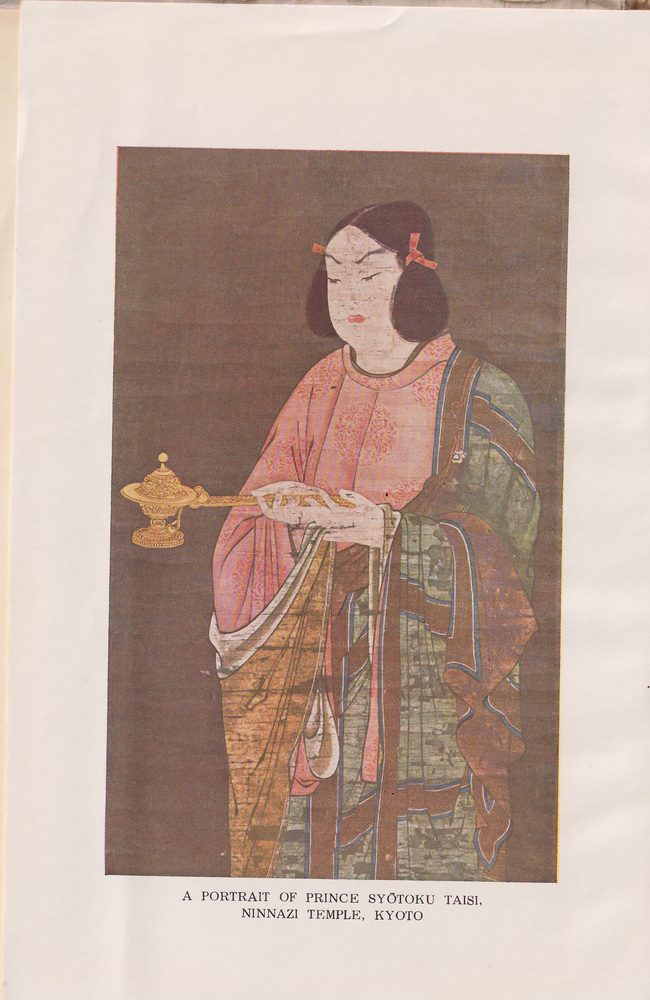
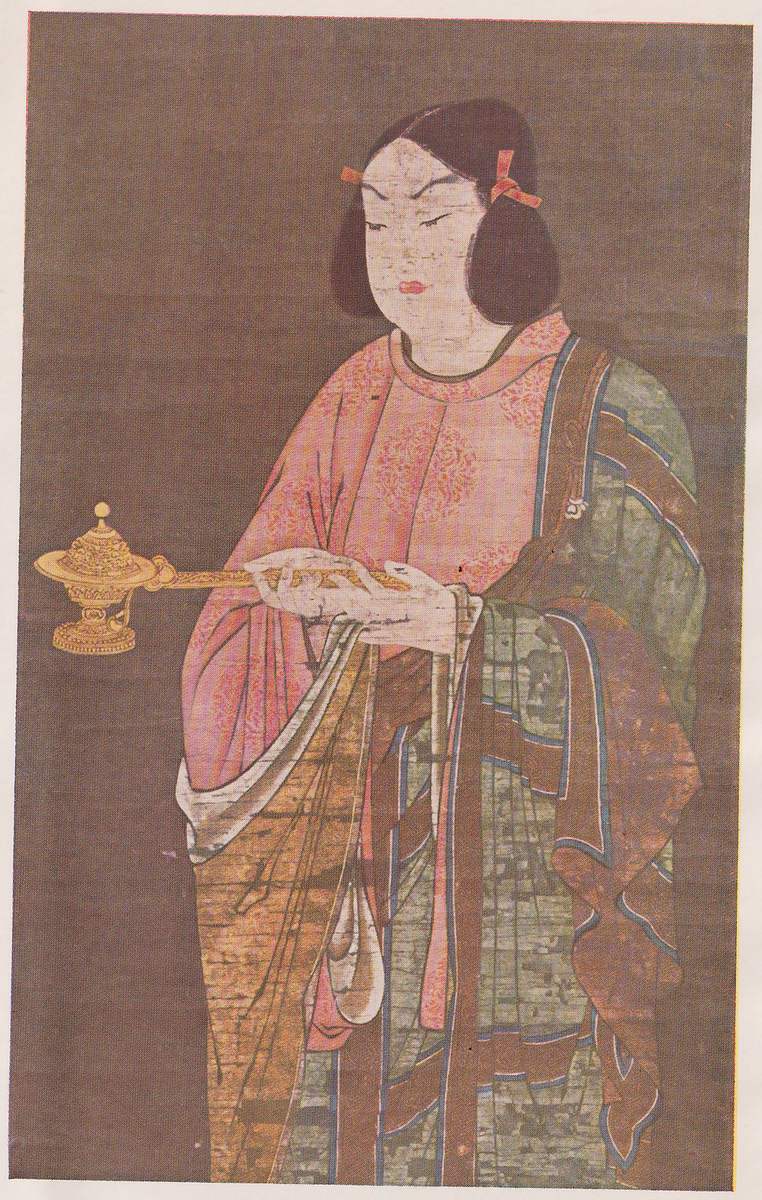
NINNAZI TEMPLE, KYOTO
JAPANESE BUDDHISM
BY
Prof. DAISETZ TEITARO SUZUKI, D. Litt
BOARD OF TOURIST INDUSTRY
JAPANESE GOVERNMENT RAILWAYS

COPYRIGHT 1938
EDITORIAL NOTE
It is a common desire among tourists to learn something of the culture of the countries they visit, as well as to see their beautiful scenery. To see is naturally easier than to learn, but flying visits merely for sightseeing furnish neither the time nor opportunity for more than a passing acquaintance with the culture of any foreign people. This is specially true of Japan and her people.
The Board of Tourist Industry recognizes both the obligation and the difficulty of providing foreign tourists with accurate information regarding the various phases of Japan’s culture. It is, therefore, endeavouring to meet this obligation, as far as possible, by publishing this series of brochures.
The present series will, when completed, consist of more than a hundred volumes, each dealing with a different subject, but all co-ordinated. By studying the entire series, the foreign student of Japan will gain an adequate knowledge of the unique culture that has evolved in this country through the ages.
For those who wish to follow up these studies with a closer investigation of more erudite works, we append bibliographies, which we can recommend as authoritative guides for study.
Board of Tourist Industry,
Japanese Government Railways.
INTRODUCTION
No thoughtful foreign visitors to this country will be satisfied with mere sightseeing. They would naturally like to see into the moral background of Japanese life and culture—which means to get acquainted with Buddhism. For Buddhism has really given to Japan, besides the spiritual outlook, arts, philosophy, literature, architecture, morality, and many other things.
The best way to see the influence of Buddhism on Japanese culture in its various manifestations, is to wipe out all the Buddhist temples together with their treasures, libraries, gardens, incidents, tales, and romances of various sorts, and see what would be left in the history of Japan, in the present life of the people. First of all, there would be no paintings, no sculptures, no architectural works, even no music, and no dramas. Following this, all the minor branches of art would also disappear such as landscape gardening, tea-cult, flower-arrangement, fencing, and printing. The industrial arts to which Buddhism gave its first impetus would also vanish. The Prince Syōtoku Taisi (574–622) is still worshipped by carpenters and architects as their patron-saint; for it is a well-known fact that anything approaching architecture in Japan dates from the erection of Hōryūzi in the year 607 of the Christian era.
The origin of Japanese education is traceable to the colleges established in connection with Hōryūzi and Kō-
fukuzi while plans for general education were worked out for the first time in Japan by Kōbō Daisi (774–835) when he founded his school known as “Syugei Syuti-In” in 828. Various social service undertakings including the hospital, the bath-house, the botanical garden, herb hunting, and other activities owe their origin to the efforts of the early Buddhists in the seventh century and after.
It was again due to the initiative of those indefatigable Buddhist monks who travelled throughout Japan in the early days of Buddhism for the propagation of their faith that the mountains were climbed, the rivers bridged, the roads built, the fields tilled, the wells dug, the hot springs explored, the trees planted, and the canals opened for irrigation. Travellers in Japan, even in the remotest parts of the country, come across some legends in which Buddhist names are connected with old ponds, or aged trees surrounded with the sacred straw ropes, or some curiously-shaped stones, etc. The names of Gyōgi Bosatu and Kōbō Daisi are to be especially mentioned in this connection.
All these facts are unanimously recognised by writers on the cultural history of Japan. The knowledge of Buddhism is, therefore, just as essential as the geographical knowledge of the country to all foreign visitors, however short their stay may be.
D. T. Suzuki
Kyoto, March, 1938.
NOTE
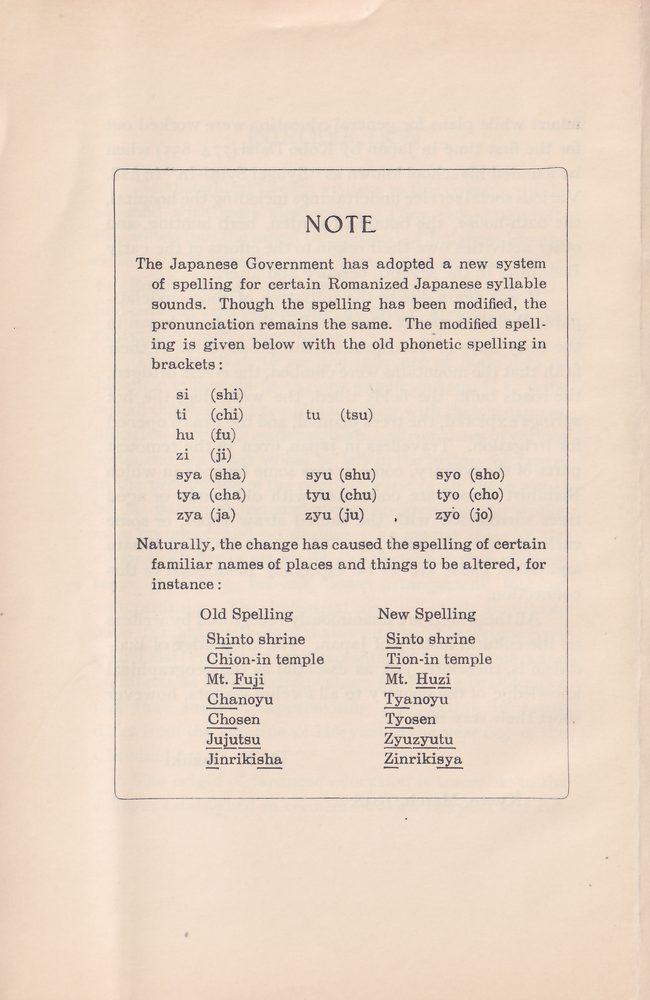
The Japanese Government has adopted a new system of spelling for certain Romanized Japanese syllable sounds. Though the spelling has been modified, the pronunciation remains the same. The modified spelling is given below with the old phonetic spelling in brackets:
| si | (shi) | ||||
| ti | (chi) | tu | (tsu) | ||
| hu | (fu) | ||||
| zi | (ji) | ||||
| sya | (sha) | syu | (shu) | syo | (sho) |
| tya | (cha) | tyu | (chu) | tyo | (cho) |
| zya | (ja) | zyu | (ju) | zyo | (jo) |
Naturally, the change has caused the spelling of certain familiar names of places and things to be altered, for instance:
| Old Spelling | New Spelling |
|---|---|
| Shinto shrine | Sinto shrine |
| Chion-in temple | Tion-in temple |
| Mt. Fuji | Mt. Huzi |
| Chanoyu | Tyanoyu |
| Chosen | Tyosen |
| Jujutsu | Zyuzyutu |
| Jinrikisha | Zinrikisya |
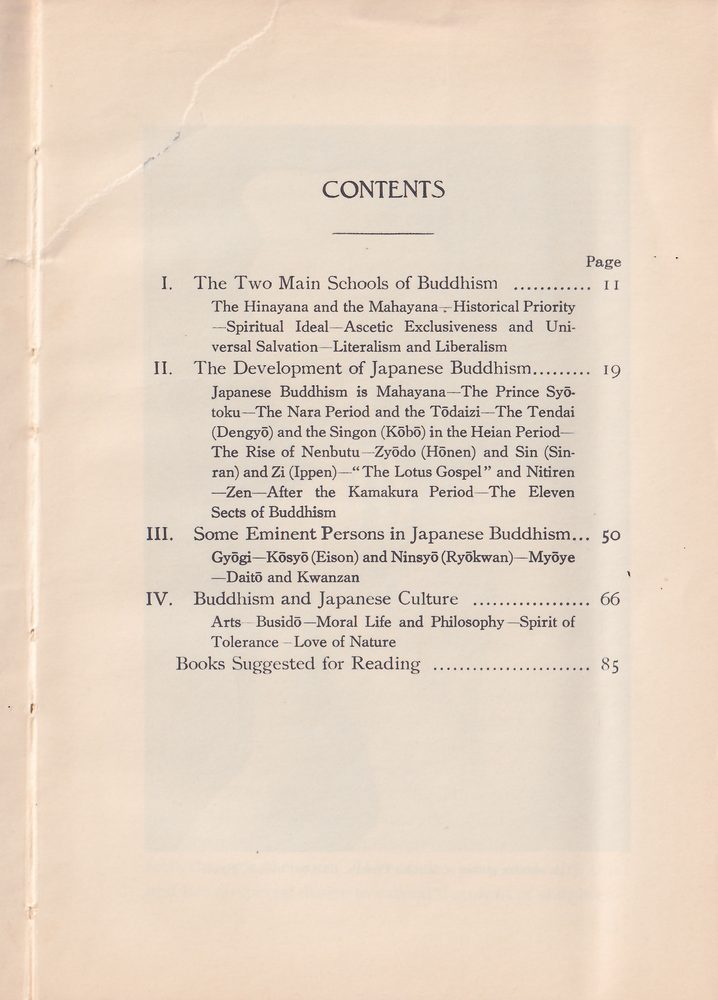
CONTENTS
Page
I. The Two Main Schools of Buddhism .............. 11
The Hinayana and the Mahayana—Historical Priority—Spiritual Ideal—Ascetic Exclusiveness and Universal Salvation—Literalism and Liberalism
II. The Development of Japanese Buddhism .............. 19
Japanese Buddhism is Mahayana—The Prince Syōtoku—The Nara Period and the Tōdaizi—The Tendai (Dengyō) and the Singon (Kōbō) in the Heian Period—The Rise of Nenbutu—Zyōdo (Hōnen) and Sin (Sinran) and Zi (Ippen)—“The Lotus Gospel” and Nitiren—Zen—After the Kamakura Period—The Eleven Sects of Buddhism
III. Some Eminent Persons in Japanese Buddhism .............. 50
Gyōgi—Kōsyō (Eison) and Ninsyō (Ryōkwan)—Myōye—Daitō and Kwanzan
IV. Buddhism and Japanese Culture .............. 66
Arts—Busidō—Moral Life and Philosophy—Spirit of Tolerance—Love of Nature
Books Suggested for Reading .............. 85