
III. SOME EMINENT PERSONS IN JAPANESE BUDDHISM
The worth of a religion is judged by the highest personalities it produces; they are generally above the institutions whose creators they once were. When such institutions pass a stage of maturity and become a secular or political power, they degenerate and turn into a nursery of paupers and charlatans and the whole thing becomes a mockery. No religion is to be judged by this. Beside the founders of sects already mentioned in the preceding chapter, the following Buddhists among many others deserve special mention here.
Gyōgi Bosatu (670–749)
While the Emperor Syōmu (reigned, 724–749) was mobilising all his economic and political and religious forces towards the erection of the Tōdaizi and provincial temples, and while the Buddhist doctors and philosophers were busily occupied with the study and exposition of the texts brought by their brother monks from China, there were some Buddhists who might not have been so brilliant in scholarly attainment but who really took to heart the practical demonstration of the teaching of their predecessors in the faith. Among such, Gyōgi was the most prominent. He himself was a great scholar of the Vijnānamātra school of Mahayana Buddhism, but he was by no means satisfied with an achievement of this sort. He wished to propagate or rather practise his Buddhism among
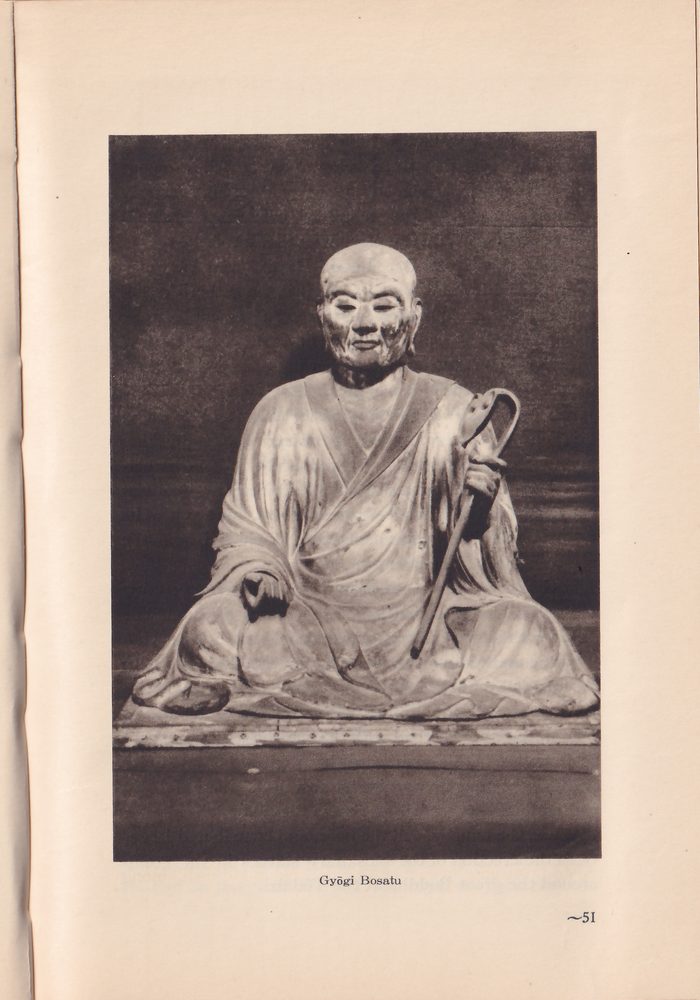
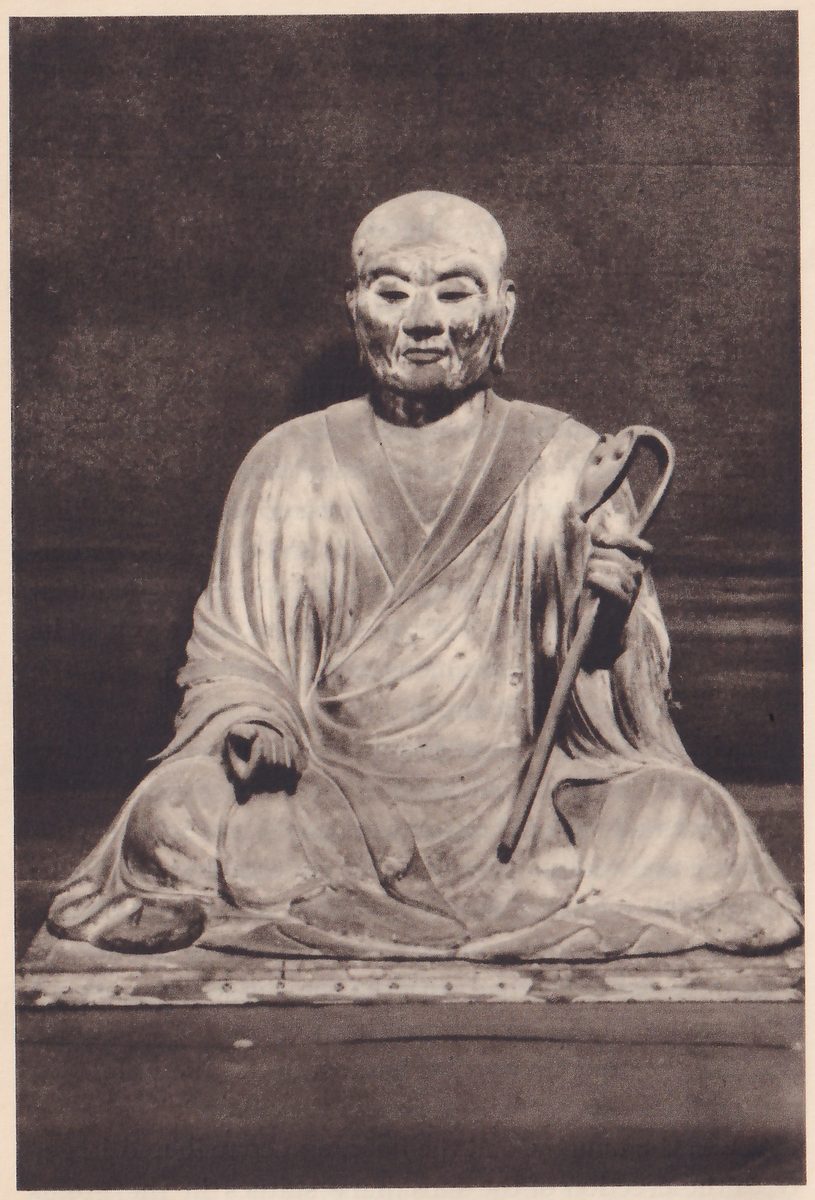
the masses; he wanted them to share his spiritual attainments whatever they were. He wanted his fellow-beings who were not fortunate enough as he and his scholarly friends, to master all the technical intricacies of the Buddhist doctrine. With this in view he seems to have taught them in the faith of a Pure Land. His followers increased so rapidly in number and power that the authorities became somewhat apprehensive of the movement as they thought it might lead to political or social complications. This was, however, an altogether unnecessary worry on the part of the officialdom of the time. Gyōgi went all over Japan helping the people in practical ways: by building bridges, opening highways and hot-springs, establishing ports for seafarers, by digging wells and canals, constructing burial grounds, erecting temples where the Buddhist images carved by himself were enshrined, and so on. His memory still lives even among the people living in the remoter parts of the country.
Gyōgi was also a great spiritual help in the erection of the Tōdaizi designed by the Emperor Syōmu. The latter with all his political powers could not bring such a gigantic and really epoch-making undertaking as this to a successful termination without some one spiritually inspiring not only to the Emperor himself but to the masses who were also concerned with the enterprise. It must not be forgotten in this connection that women too were quite active in keeping up popular interest in the affair and also in Buddhism generally; for it was they who looked after the sick, the hungry, and the poor, and contributed largely to the erection of the subsidiary statues in the group around the great Buddha at the Tōdaizi.
Kōsyō Bosatu, or Eison (1202–1290), and
Ninsyō Bosatu, or Ryōkwan (1217–1303)
These two monks belonging to the Vinaya school of Buddhism may be mentioned together. They are both titled “Bosatu”, i. e., Bodhisattva, which was the title given by the Court because of their philanthropic undertakings and exhibitions of the truly Buddhist spirit. Ninsyō was ordained by Kōsyō, and it is very probable that the latter inspired the former in his Dāna-pāramitā activities.
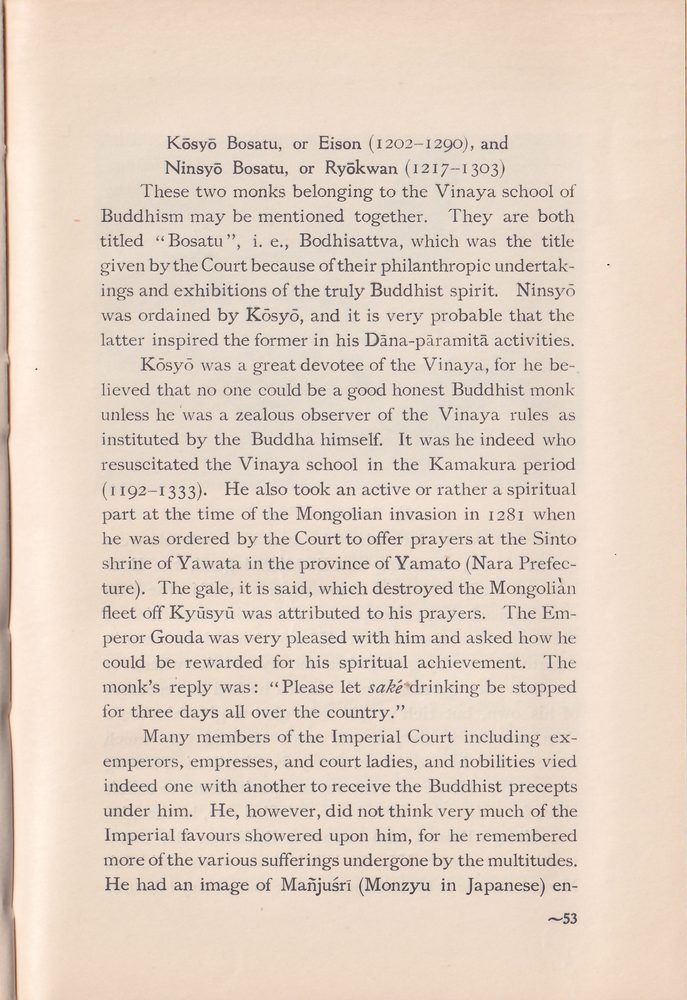
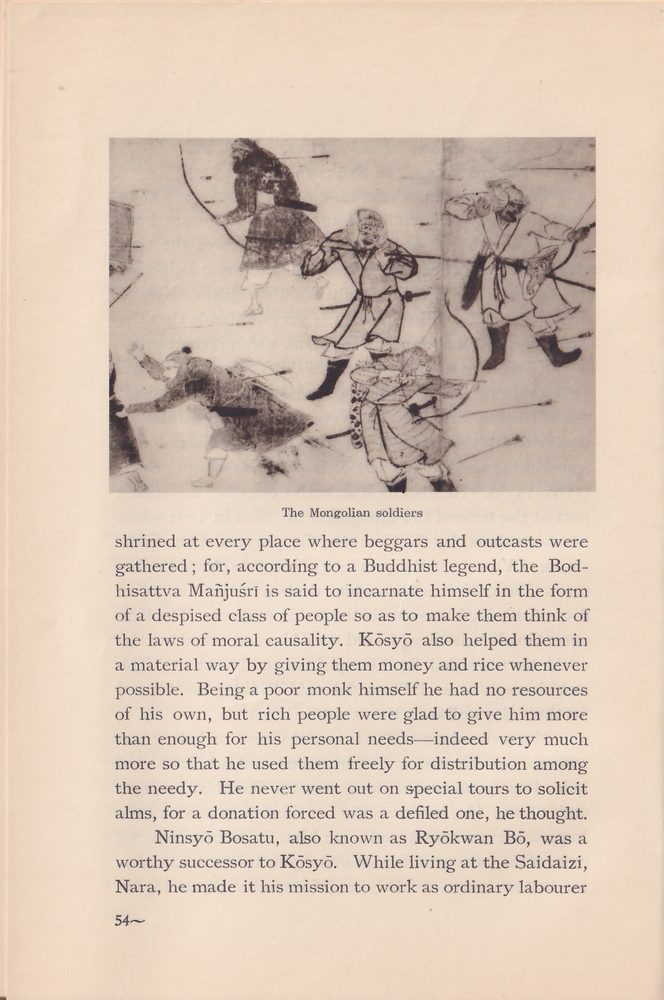
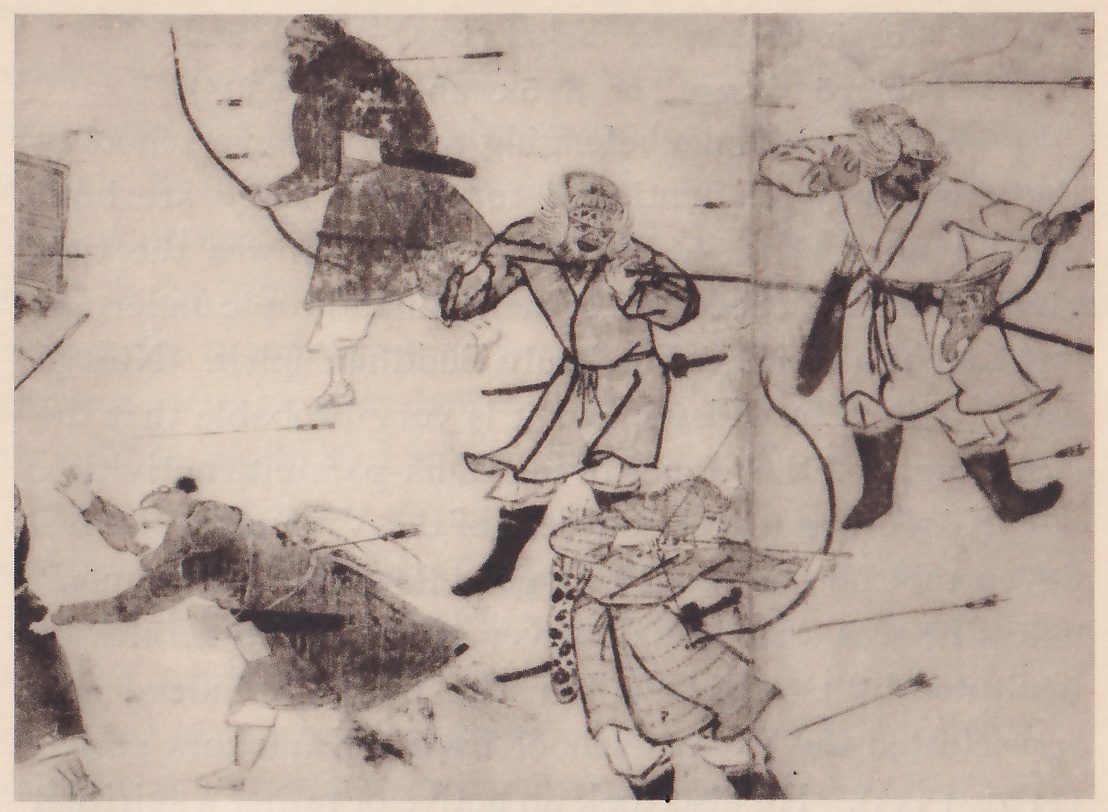
Kōsyō was a great devotee of the Vinaya, for he believed that no one could be a good honest Buddhist monk unless he was a zealous observer of the Vinaya rules as instituted by the Buddha himself. It was he indeed who resuscitated the Vinaya school in the Kamakura period (1192–1333). He also took an active or rather a spiritual part at the time of the Mongolian invasion in 1281 when he was ordered by the Court to offer prayers at the Sinto shrine of Yawata in the province of Yamato (Nara Prefecture). The gale, it is said, which destroyed the Mongolian fleet off Kyūsyū was attributed to his prayers. The Emperor Gouda was very pleased with him and asked how he could be rewarded for his spiritual achievement. The monk’s reply was: “Please let saké drinking be stopped for three days all over the country.”
Many members of the Imperial Court including ex-emperors, empresses, and court ladies, and nobilities vied indeed one with another to receive the Buddhist precepts under him. He, however, did not think very much of the Imperial favours showered upon him, for he remembered more of the various sufferings undergone by the multitudes. He had an image of Mañjuśrī (Monzyu in Japanese) en-
shrined at every place where beggars and outcasts were gathered; for, according to a Buddhist legend, the Bodhisattva Mañjuśrī is said to incarnate himself in the form of a despised class of people so as to make them think of the laws of moral causality. Kōsyō also helped them in a material way by giving them money and rice whenever possible. Being a poor monk himself he had no resources of his own, but rich people were glad to give him more than enough for his personal needs—indeed very much more so that he used them freely for distribution among the needy. He never went out on special tours to solicit alms, for a donation forced was a defiled one, he thought.
Ninsyō Bosatu, also known as Ryōkwan Bō, was a worthy successor to Kōsyō. While living at the Saidaizi, Nara, he made it his mission to work as ordinary labourer
at the laundry and lavatory belonging to the monastery. He also had a dispensary and other charitable establishments in good order where the unfortunate ones were cared for. In 1252 he went to Kamakura where a scion of the Hōzyō family had their family temple (called Gokurakuzi) renovated for the residence of Ninsyō who stayed there for a long time. According to record, he built 189 bridges, opened 71 highways, dug 33 wells, established 5 bath-houses for the needy, and also had a hospital in Kamakura where during his twenty years of charitable activity it is recorded that the number of the inmates cared for amounted to 57,250, of whom 46,800 left the establishment restored in health. He as well as Kōsyō was a good care-taker of the animals, building hospitals for sick horses and kennels for dogs. People followed him as the god of medicine.
The establishment of bath-houses was generally one of the Buddhist practical activities. At the temples a warm bath was made twice a month and all the monks bathed in it. The Zen monasteries have a bath-house among their regular establishments. The bath-house at Tōzi, of Kyoto, is one of the special structures under the national protection. The Empress Kōmyō of the Nara period, according to a Buddhist history called “Genkō Syakusyo,” built a bath-house where she vowed she would personally wash one thousand beggars. The last one who came to be looked after by the Imperial bathroom attendant was a terribly looking leper. She hesitated, but thinking of her vow, she went on with her self-imposed work.
After accomplishing the most disagreeable deed, she
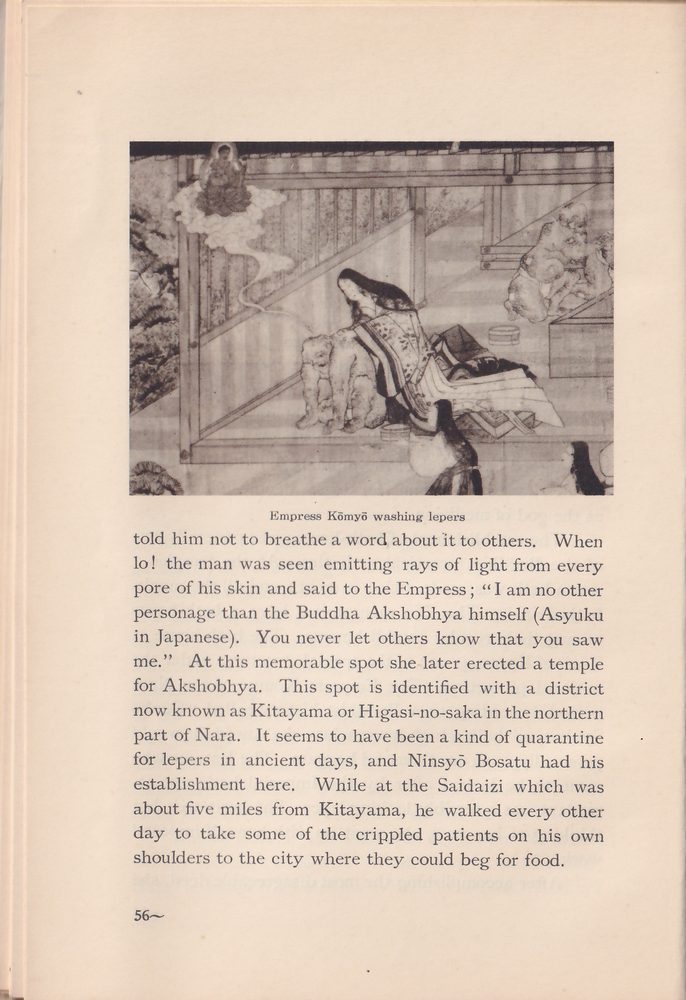
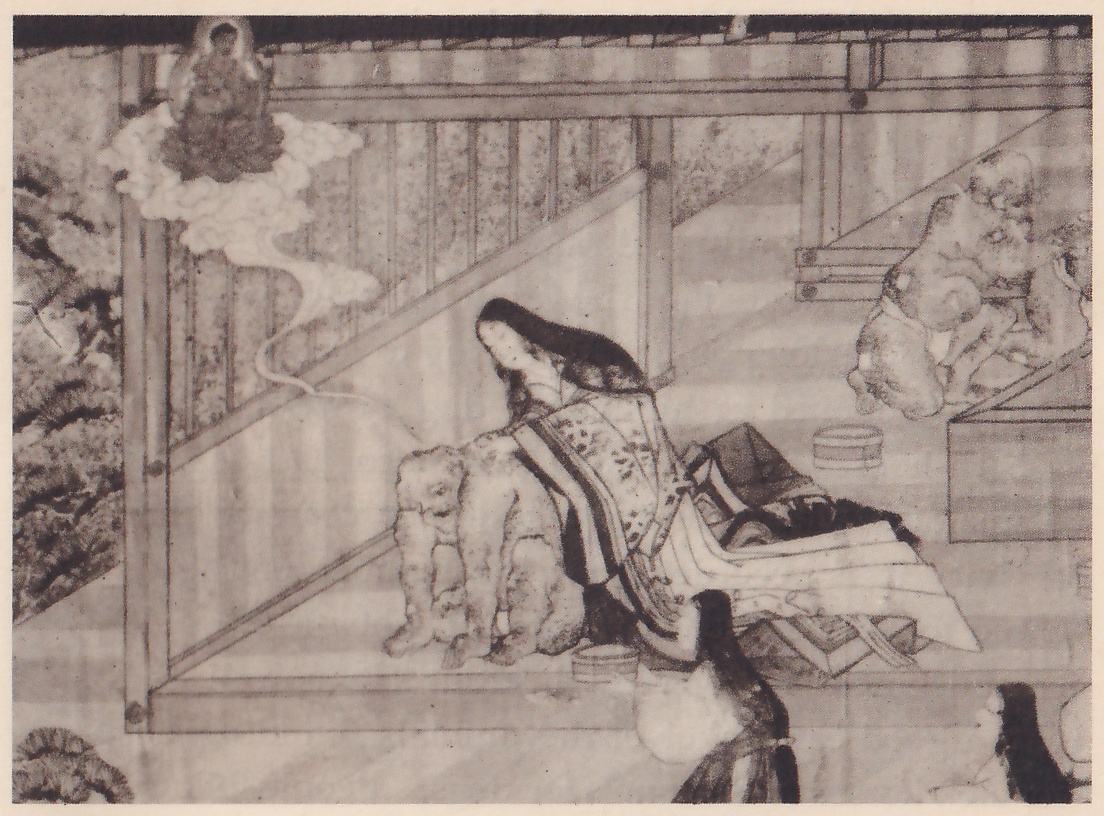
told him not to breathe a word about it to others. When lo! the man was seen emitting rays of light from every pore of his skin and said to the Empress; “I am no other personage than the Buddha Akshobhya himself (Asyuku in Japanese). You never let others know that you saw me.” At this memorable spot she later erected a temple for Akshobhya. This spot is identified with a district now known as Kitayama or Higasi-no-saka in the northern part of Nara. It seems to have been a kind of quarantine for lepers in ancient days, and Ninsyō Bosatu had his establishment here. While at the Saidaizi which was about five miles from Kitayama, he walked every other day to take some of the crippled patients on his own shoulders to the city where they could beg for food.
Myōe Syōnin (1163–1232)
Another illuminating star composing the galaxy of Buddhists of the Kamakura period was Myōe. He was a great friend and teacher of Hōzyō-Yasutoki who was an influential power in the government at the time. That the Hōzyō régime is noted for its wise administration is recognised by all historians to be due to the spiritual advice given to Yasutoki by Myōe Syōnin.
The temple where he spent most of his time and in fact passed his last moments was the Kōzanzi, which is still in existence—one of the sights most reputed for maple tints in the vicinity of Kyoto. When his fame reached the Court, the Empress Kenreimon-In wished to receive the Precepts from the Syōnin. He was invited to the Imperial palace. The Empress sat behind the screen on a higher seat at a distance and requested him to perform the Precepts-giving Ceremony for her. This was in opposition to his idea of the spiritual dignity of a Buddhist monk. He said, “As a subject of the Emperor I am of a low birth; but here I stand to your Majesty as a spiritual teacher whose life has been devoted to the understanding and practice of things not of this world. Mine is not to bow even before the gods. If my seat is lower than yours in my capacity of the performer of the Precepts-giving Rite, both you and I shall be committing a grave offence against the spiritual law. I say this for the sake of things far higher than any worldly consideration.” So saying, the Syōnin began to leave the room. The Empress was taken aback and coming out from behind the screen asked for his forgiveness. This incident is said
to have cemented their spiritual friendship till the end of his life.
In his ordinary life, however, Myōe’s attitude towards all things was friendliness itself. According to his biography, he cherished the Avatamsaka idea that all beings were endowed with the Buddha-nature, including the ants, beasts, birds, and all other higher animals. When he passed by a dog lying or a horse or an ox at work, he would greet it kindly, bowing to it as if it were a good friend of his.
When Hōzyō-Yasutoki came up to Kyoto as commander of his army, some of the Kyoto forces who fought against him fled from the capital and were reported to have found a refuge at Kōzanzi, the temple of Myōe Syōnin. One of Yasutoki’s generals arrested the latter and brought him before the commander for examination. When Yasutoki saw the Syōnin and listened to the announcement of the general, he hastily came down from his seat and respectfully requested the Syōnin to take the seat of honour. The Syōnin then said that, from his Buddhist point of view, both friends and foes were equally objects of reverence and kindly considerations, and that whenever they came to him for protection he was ready to help them regardless of their political allegiance, and that if this went against the policy of the commander of the Hōzyō forces, he was prepared at any moment to surrender himself into the hands of the prosecutor.
Yasutoki was greatly impressed with the humanitarian feelings and the noble attitude of this really saintly Buddhist monk, and sincerely apologised to him for the thoughtlessness of his general. He then expressed his
deep regrets for not having had a good opportunity before this for an interview with Myōe in more appropriate surroundings; but he was glad that he had now made his acquaintance anyhow and would look for another occasion to see him again when he was relieved of the pressing business at hand. It was in this way that his friendship with the Syōnin started and was kept up ever afterwards. He was truly a great and worthy disciple of this remarkable Buddhist monk who flourished in the earlier part of the Hōzyō régime.
I may add one more anecdote in the life of Myōe Syōnin which illustrates his view of prayer. When some one asked him to offer to the Buddha a special prayer for his own benefit, the Syōnin said: “I pray every morning and every evening for the sake of all beings and I am sure you are also included among them as one of sentient beings. There is no special need to offer a prayer for one single particular person. If your wish were something to be granted in the general scheme of things it would most assuredly be granted; but if not, even with the power of the Buddha, nothing could be done for you.”
Kwanzan Kokusi (1277–1360)
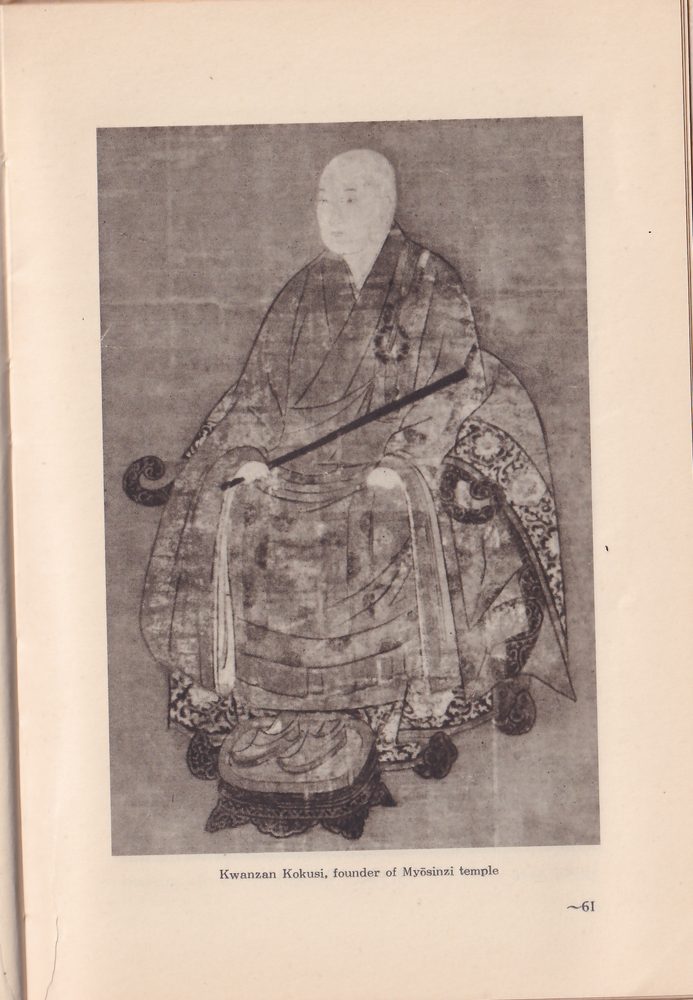
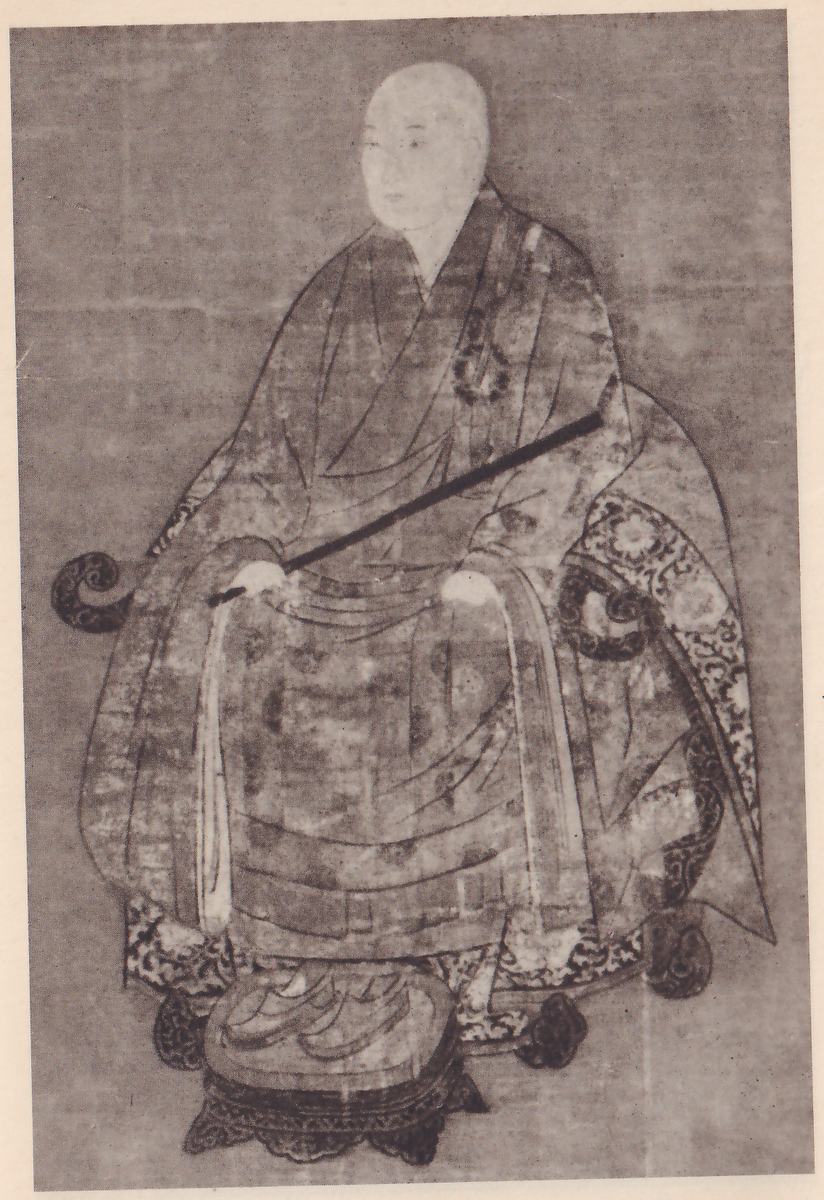
He is the founder of the Myōsinzi which is one of the Zen headquarters in Kyoto. His personality presents quite another aspect of Buddhist monkhood than what we have already seen. He studied Zen under Daitō Kokusi, founder of the Daitokuzi, also in Kyoto. He was first ordained at Kentyozi, of Kamakura, and until he was thirty years old he did not show any very marked personality as a Zen monk. One day when he learned that there
was a great Zen master at Daitokuzi, he could not wait even for another day, and he started right off for Kyoto, and it is said that on the way along the Tōkaidō highway he never once stopped to look at Mt. Huzi though it must have taken him at least two or three days to pass the sight of the most beautiful mountain of Japan. When he reached Daitokuzi, the master Daitō Kokusi demanded an introduction letter of him, but to this he defiantly replied, “Every great teacher of Zen knows who his visitors are as soon as they cross the threshold of his room, and you as one ought to be able to recognise what kind of man I am.”
Daitō Kokusi (1282–1337)
Daitō Kokusi, Kwanzan’s teacher, was patronised and revered by the Emperor Godaigo, for the Emperor himself was a great student of Zen. When the Kokusi had his first audience with the Emperor, the latter remarked, “Wonderful that a Buddhist monk stands before an Imperial personage!” Kokusi lost no time in replying, “Wonderful that an Imperial personage stands before a Buddhist monk!” Another time the Emperor asked, “Who is he who finds no companionship among all beings?” The Kokusi moving the fan in his hand said, “The Imperial breeze like the fan gently moves over all beings [to make them grow].” The Buddhist scholars of the time much given to the intellectual understandingPrinted: undertanding of the Sutras did not like the way the Zen masters were in favour at the Court, and proposed to have an open discussion with them in the presence of the Emperor. This was granted on the condition that those who were vanquished
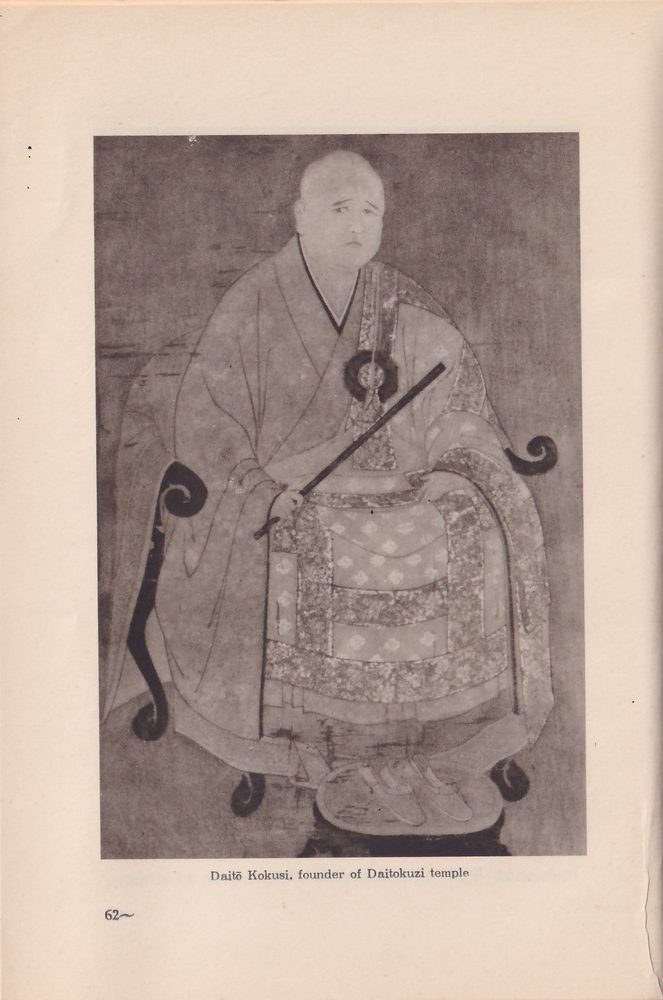
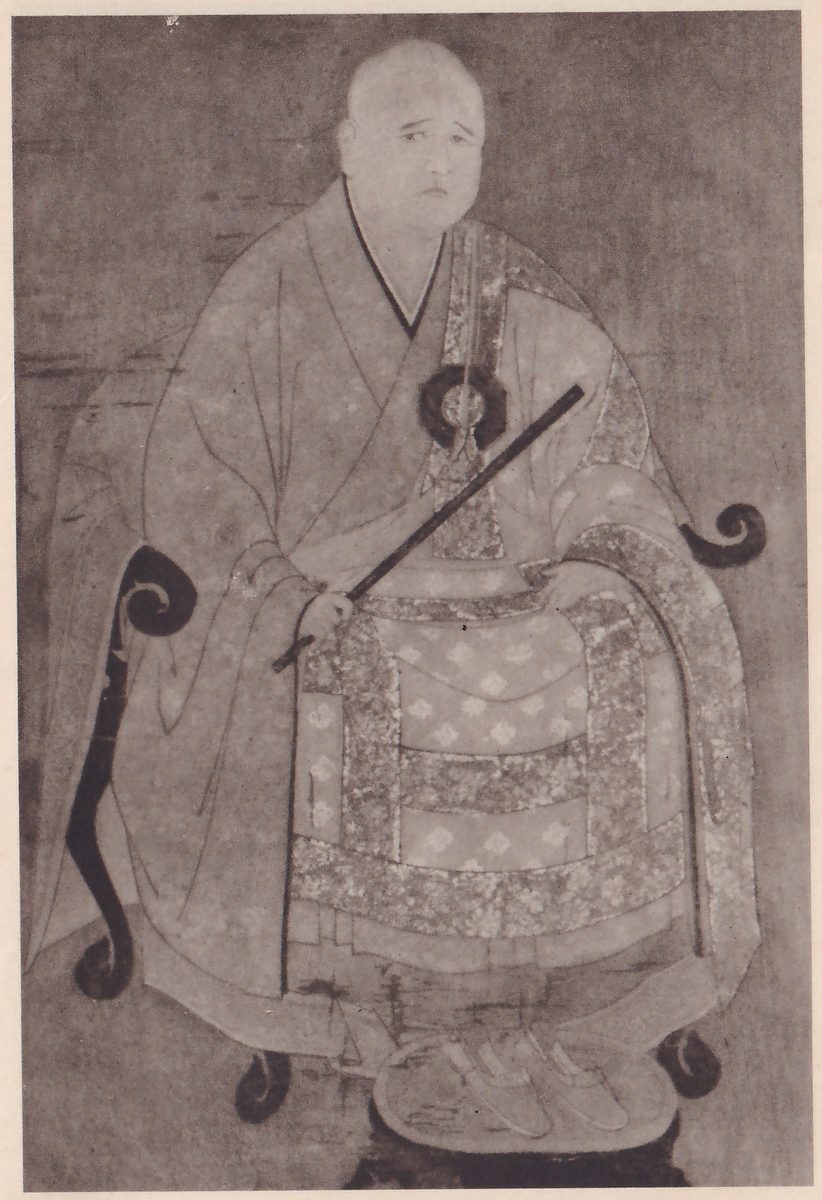
would become disciples to the victor. When the day came a scholar of great reputation appeared and opened the forum: “What is Zen that claims a special transmission outside the scriptural teaching? To this Daito Kokusi answered, “An hexagonal grind-stone runs through a vacuity.” The questioner was nonplussed. Another learned doctor came forward with a box. Seeing it, Daitō asked, “What is your box!” The doctor answered, “This is the box in which the whole universe is packed up.” The Kokusi raised the short stick which was in his hand and struck the box breaking it to pieces. He said, “How would it be when the universe is broken up?” The doctor did not know what to do with this Zen monk whose language and behaviour were more than they could cope with.
When Daitō was about to pass away in 1337, the Emperor asked him about his successor, and he recommended Kwanzan as a worthy one, but he added that being an extraordinary character Kwanzan might be difficult to locate and be persuaded to appear in the world, and that if, however, he was told of Daitō’s death he might be induced to come to the capital. After many vain searches, Kwanzan was finally discovered in the province of Mino far away from a crowded town and among the poor peasants driving their oxen or pulling their carts. At first he refused to betray his identity, but the Imperial messenger finally succeeded in getting him out from the villagers, by telling him about the passing of his teacher Daitō Kokusi.
Kwanzan now became the founder of Myōsinzi, which is at present one of the most flourishing temples in Japan. In the beginning, however, it was far from being
a presentable structure although it was one of the Imperial detached palaces. He had no idea of improving it. When he was not occupied with interviewing his pupils he was found himself sweeping the temple grounds. One of his lay relatives once paid him a visit and seeing how badly his residence needed repairs, he proposed to pay the expenses for them. This irritated the master very much, who roared, “This worldly fellow! It is none of your business to be concerned with my house. When you have finished seeing me about things you wanted to be enlightened about, make haste and be gone!”
His temple apparently required a renovation. When the roof leaked badly, he called out his attendants to bring something for the dripping rain. One of them hurriedly ran out and brought him a bamboo basket, which pleased him greatly, while another monk who spent some time in finding and bringing a proper vessel, was strongly reprimanded. The Kokusi’s way of dealing with his pupils was thus always characterised with the straightforwardness of Zen. When there was no more fuel to make a bath for a visitor, he ordered a part of his temple to be destroyed till enough fuel was gathered for the purpose.
When he knew that he was about to die, he said to his chief disciple, “I am going to travel presently, and am all ready; please get me my travelling hat.” With this, he took the disciple with him as far as under a tree by the pond, where he bade farewell: “You are the only person who knows of my departure. After me, you will exercise yourself for the cultivation of the Zen spirit in this country.” Resting himself on the staff he carried, he passed away.
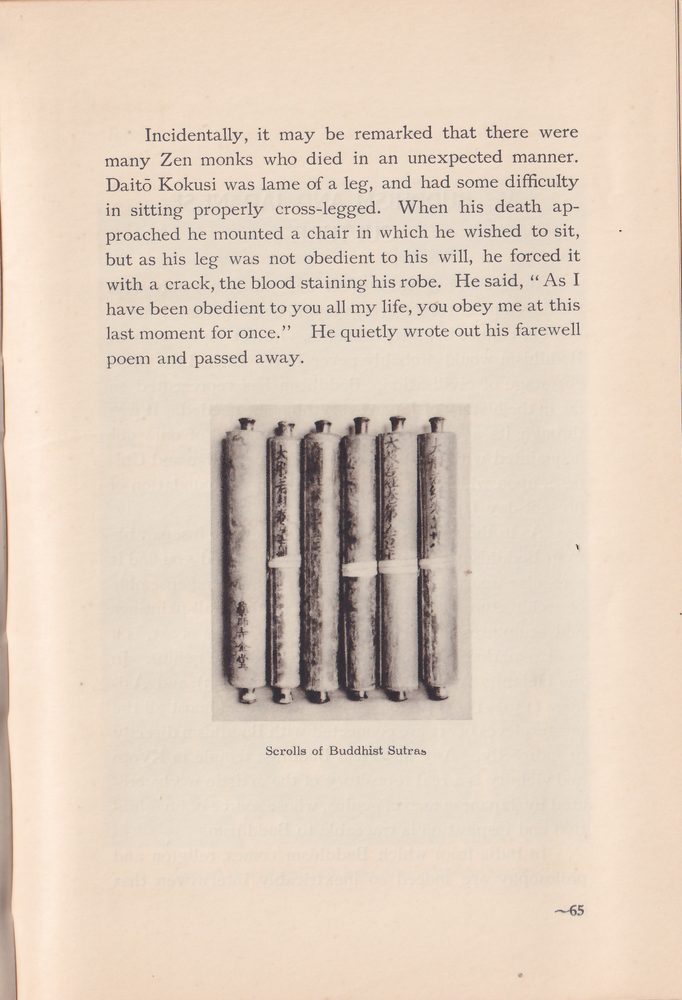
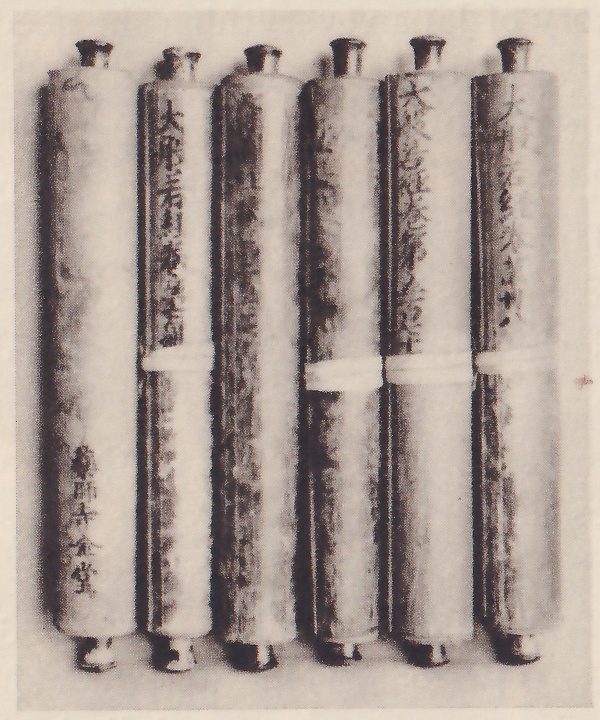
Incidentally, it may be remarked that there were many Zen monks who died in an unexpected manner. Daitō Kokusi was lame of a leg, and had some difficulty in sitting properly cross-legged. When his death approached he mounted a chair in which he wished to sit, but as his leg was not obedient to his will, he forced it with a crack, the blood staining his robe. He said, “As I have been obedient to you all my life, you obey me at this last moment for once.” He quietly wrote out his farewell poem and passed away.