
I. THE TWO MAIN SCHOOLS OF BUDDHISM
Buddhism is divisible into two main schools: Hinayana or “smaller vehicle” and Mahayana or “greater vehicle”; and Japanese Buddhism belongs to the latter school. Some of the major differences between the Hinayana and the Mahayana are:
(1) Historically, the Hinayana is older than the Mahayana though this does not mean that the former represents more faithfully the teaching of the founder. On the contrary, the Hinayana more or less failed to develop the most important aspects of the original teaching and was inclined to uphold the formal and literal and scholastic interpretation of it. The result was the ossification of the spirit of the Buddha. The Mahayana was not at all satisfied with this. It began to assert itself within one hundred years after the passing of the Buddha, until its movements became strong enough in the first century before Christ to call itself “the Mahayana school” in contradistinction to the earlier one which the later Buddhists designated as “the Hinayana.” By this they meant that their teaching was more far-reaching and all-embracing than that of their older fellow-believers.
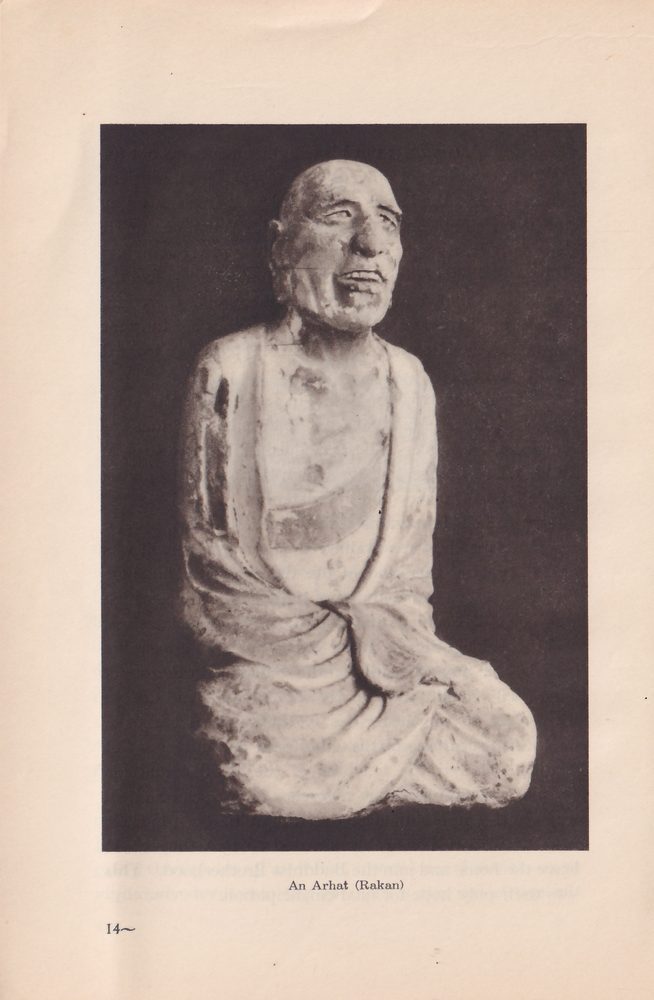
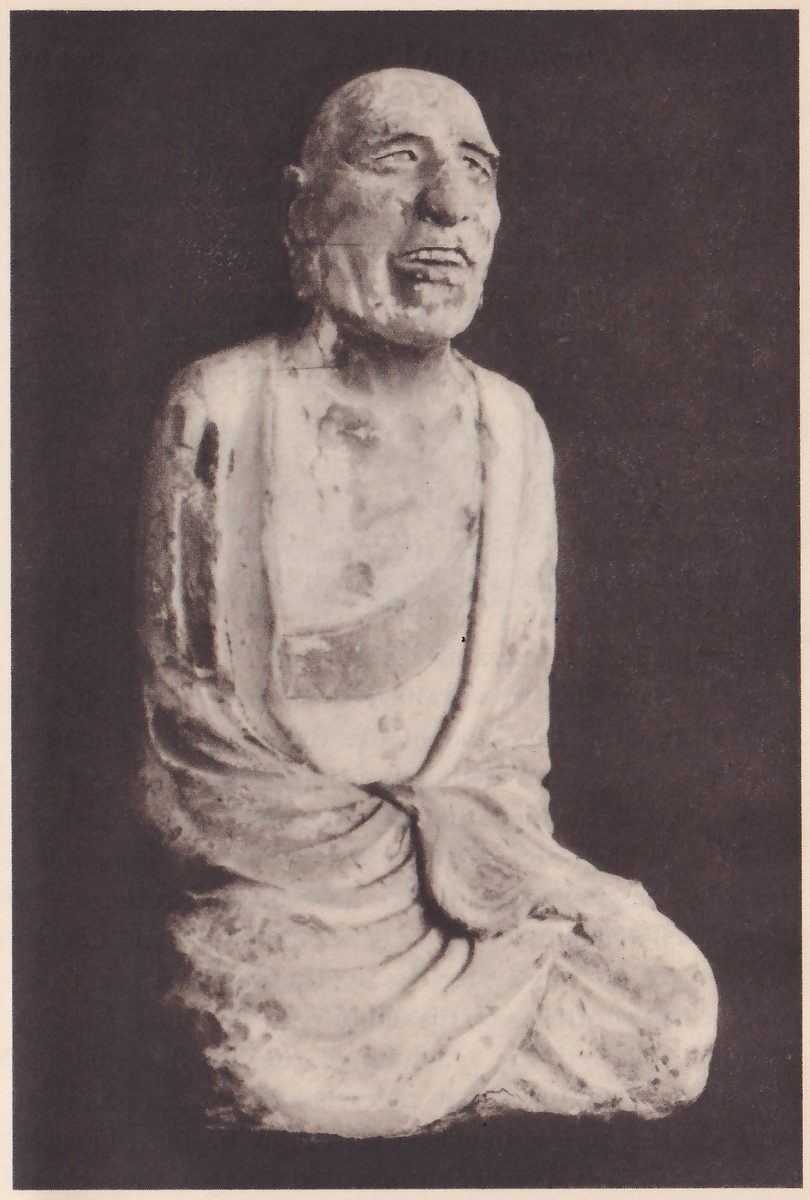
(2) The ideal person of the Hinayana teaching is called Arhat, or Rakan in Japanese. He is the one who has attained the state of enlightenment by his moral efforts through the eons. He remains contented with this and has no special desire to extend the merit of enlighten-
ment towards his fellow-beings. For he thinks that each individual is to look after his own salvation, and that all that one can do for others is persuasion or exhortation, beyond which nothing can be done. The Arhat is a rigid upholder of spiritual individualism. Unless a man works for his own enlightenment and emancipation, he cannot reach the other shore of Nirvana; others however sympathetic cannot help him to cross the stream of birth and death. The Arhat is, therefore, also a strong advocate of intellectualism.
The Mahayanists did not think that this strict individualism was in strict accord with the spirit of the Buddha. It is true that he attained his enlightenment after going through many a rebirth, every one of which was vigorously devoted to the exercise of the six virtues of
perfection (pāramitā); but his enlightenment was not for his individual benefit only, it was meant for all sentient beings; unless the latter too shared in it in some ways, it had no significance for the world. Whatever merit there is in it, it ought to be universally spread out among all beings. This is the way we as human beings feel towards our fellow-beings. In the Mahayana, therefore, love all-inclusive and all-penetrating comes out in great contrast to the Hinayanist’s unequivocal tendency toward intellectualism.
The Bodhisattva, or Bosatu in Japanese, is the ideal personage of the Mahayana, who starts his religious career from his “never-to-be-extinguished” desire to save all his fellow-beings, and for which he would devote his whole life to the very end of existence.
(3) The Hinayanists were adherents of ascetic rigorism, for they maintained that unless a person was able to practise this kind of life there was no hope for him to achieve the final end of the Buddhist life, which was a complete subjugation of all the passions and desires, and this subjugation or rather extinction was impossible outside the monastic life of the Sangha Brotherhood. Those who could not leave their family life and devote themselves to the austerities of the spiritual life were doomed to recurring births full of pain and misery. But if they followed the teaching of the Buddha and his Brotherhood and paid due reverence in various practical ways to the ascetic monks, they might be born in their next lives more favourably situated so that they could leave the home and join the Buddhist Brotherhood. This was their only hope for final emancipation.
The Mahayanists naturally revolted against this idea of salvation for the élite. If a religion means, they thought, to benefit us spiritually, this benefit must have a universal character. The Buddha’s idea was to save all beings by having them believe in the truth which was discovered by him and which is also discoverable by all who would follow him. Ultimate enlightenment did not consist in extinguishing all the passions and desires shared by all humanity, i. e., by all sentient beings, it was to detach them from their selfish origin and encumbrances, so that they could be made available for the establishment of a universal brotherhood. The householders ought to be able to attain enlightenment just as well as the homeless ones, if they only had an intuitive understanding of the truth. The Mahayanists with this view compiled many scriptures.
(4) As the Hinayanists were strict interpreters of the rules of morality called Vinaya (kairitu in Japanese) they failed to spread their teaching to other countries where the climate was not adapted to the maintenancePrinted: maintenace of their way of living. Buddhism did not begin to propagate itself beyond the borders of its birth-land until the rise of the Mahayana—I mean to the northern countries where a more rigorous climate prevailed necessitating modifications in the life of the Buddhist monks. This naturally meant change in the doctrinal interpretation of so-called original or primitive Buddhism. A liberal spirit was to be emphasised at the expense of formalism, that is, the conservative upholding of the letter of the Vinaya rules had to go. Thus, the Mahayana came to be identified with the spirit of progress, freedom, and liberalism generally.
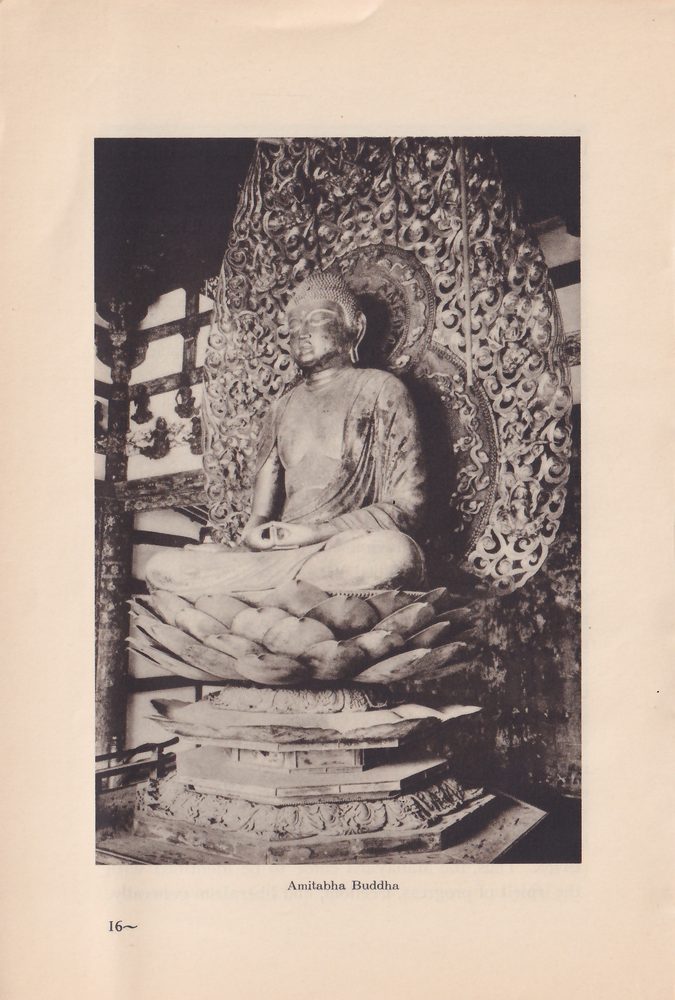
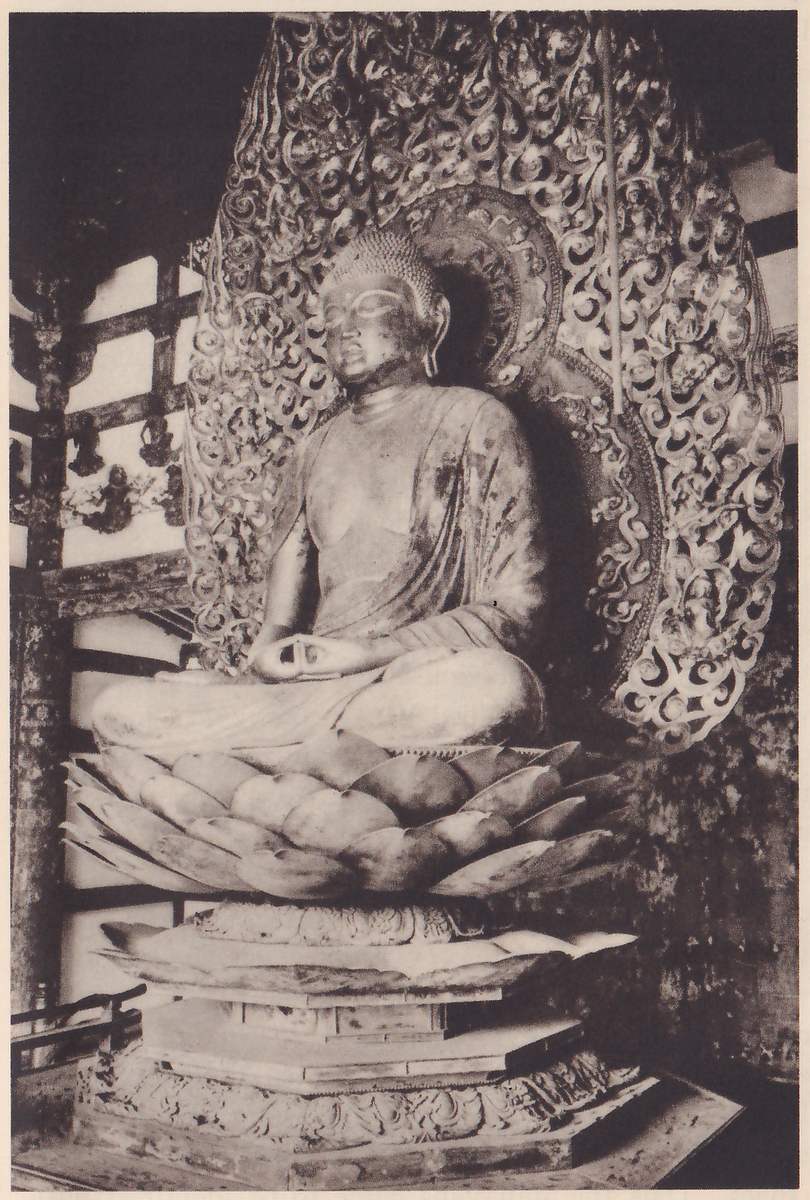
It was one of the manifestations of this spirit on the part of the Mahayanists that the Buddha now came to assume a double aspect, historical and metaphysical or spiritual. To the Mahayanists the Buddha is not only a being naturally and historically unlimited, but one who goes beyond all forms of determination, and who, therefore, is able to assume any form of determination. The Mahayanists hold this point as one of the strongest positions in their system of philosophy.
(5) The Mahayana idea of “skilful means” (upaya in Sanskrit), according to which supreme Buddhahood incarnates itself in a variety of forms in order to save all beings from ignorance and misery, has produced a number of Buddhas and Bodhisattvas and even “supernatural beings” in the Buddhist scheme of cosmology. This is the reason why the Mahayana is sometimes regarded as polytheistic. The Mahayanist reasoning, however, is that salvation is to be achieved in conformity with the mentality of beings, that is, with their intellectual capacity to grasp the truth. What a child wants is a mechanical toy and not the real engine which demands a great deal of technical knowledge to handle. As long as our mental and spiritual endowments are severally graded—in fact, subject to infinite gradation—the doctrine of “skilful means” which distinguishes the Mahayana from the Hinayana must be said to be in agreement with the facts of human experience. For this reason we see many varieties of Buddhist figures enshrined in the Mahayana temples of the Far East. They are really different virtues and powers of the One Buddha.
(6) In a word, the Mahayanists are more broad-
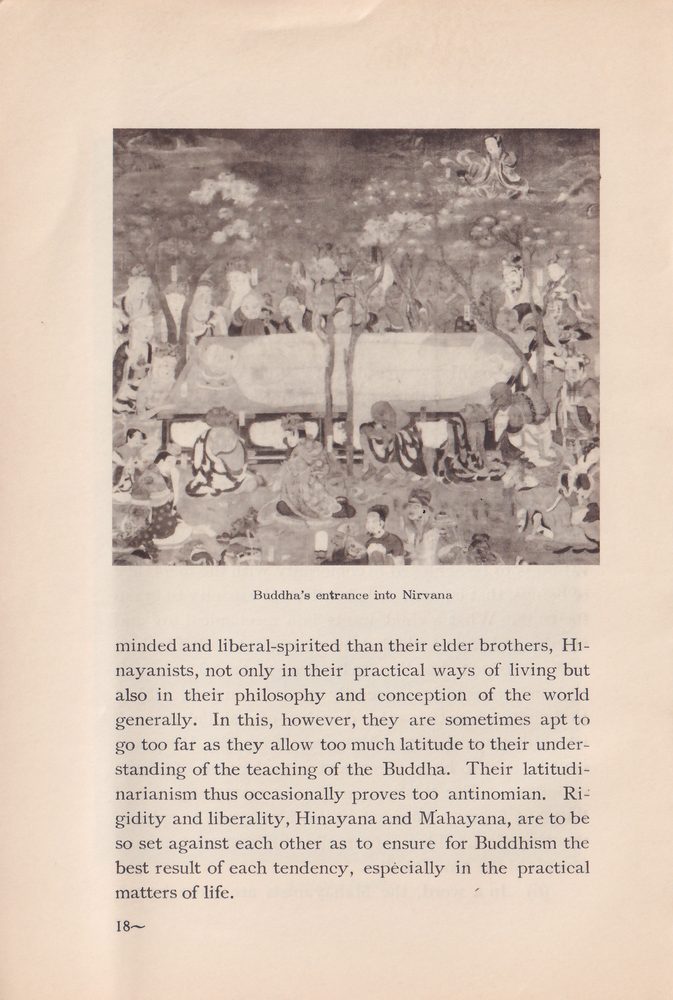
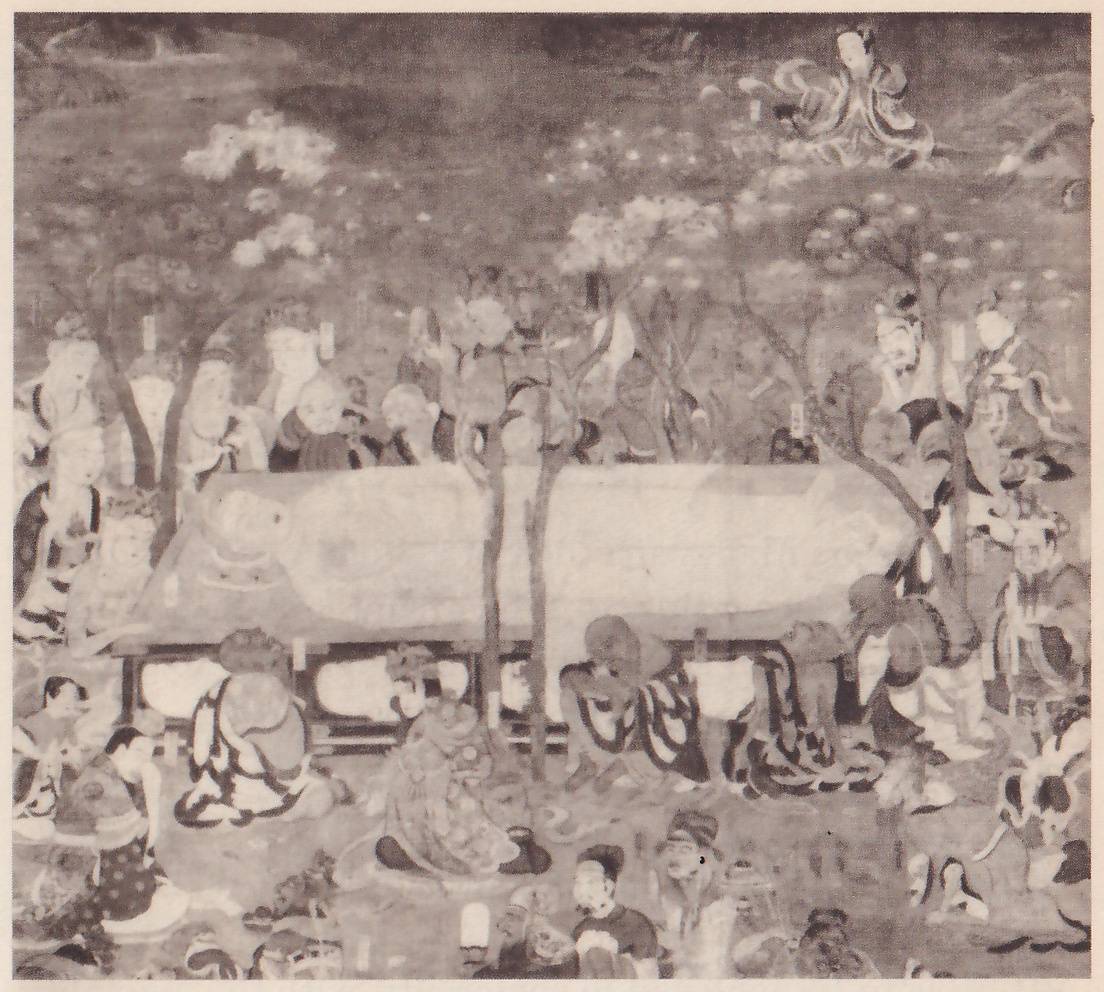
minded and liberal-spirited than their elder brothers, Hinayanists, not only in their practical ways of living but also in their philosophy and conception of the world generally. In this, however, they are sometimes apt to go too far as they allow too much latitude to their understanding of the teaching of the Buddha. Their latitudinarianism thus occasionally proves too antinomian. Rigidity and liberality, Hinayana and Mahayana, are to be so set against each other as to ensure for Buddhism the best result of each tendency, especially in the practical matters of life.