

Lesson 5
自 ji · Self
1. The character
In this lesson we are going to work on the hidarihane, tensetsu and yokoga.
In this video you will note that the character is not well centered. In creating this video, Takase Sensei was seated in a position that was convenient for the camera but not for calligraphy. The result is that the character is not centered. This may be a good time for you to revisit lesson one and check your posture and position. To re-iterate:
Proper posture and position are critical.
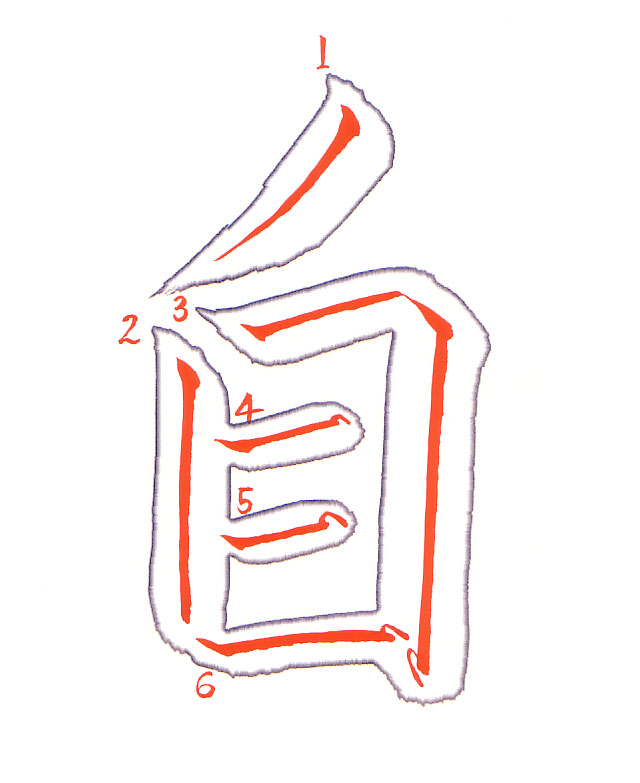
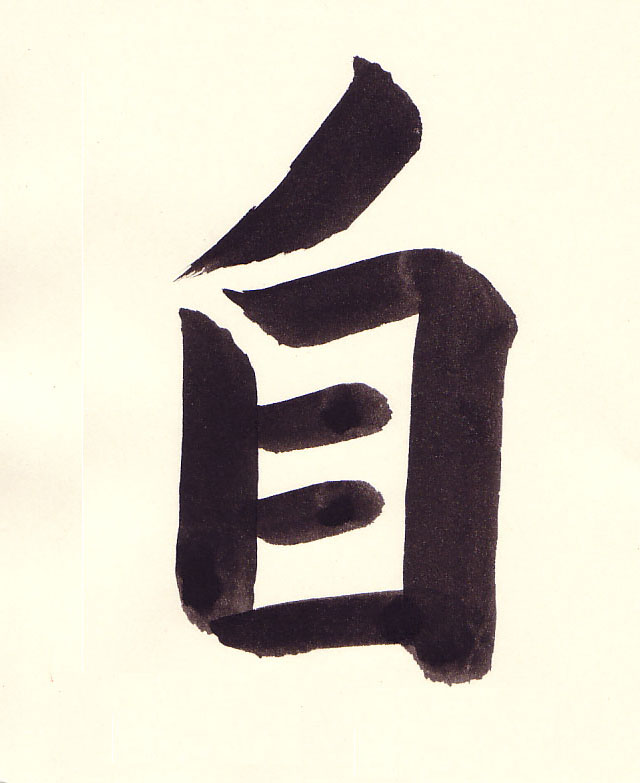
- 0:04 The brush is applied to the paper at a 45 degree angle.
- 0:06 The hidarihane is quicker than the harai strokes. While the hidarihane is not a sharp movement, it still requires a large arm movement.
- 0:10 To start this tatega 縦画 (Vertical Line) called chū 柱 (Pillar), apply the brush to the paper at a 45 degree angle just below the tail of the hidarihane 左撥ね (Left Flick Stroke). Then press down slightly on the brush.
- 0:11 Rotate the hand slightly clockwise to bring the thick part of the brush to face downward (towards the bottom of the page) and slightly to the right. Use the arm to draw the line and keep even pressure on the brush to ensure a consistent line width.
- 0:14 To end the chū, release the pressure on the brush a bit, the brush tip is moved up and to the left, then, as pressure is reapplied, bring the brush downward. The line is finished by bringing the brush up and off the paper.
- 0:18 For the tensetsu (Continued Line), apply the brush to the paper at a 45 degree angle. Press down very slightly on the brush.
- 0:20 Then rotate the brush counterclockwise so the thick part of the brush is facing to the right and is angled slightly upward towards the top of the paper. Also the brush is tilted by bringing the end of the brush to the left. The tip of the brush is now well to the right of the end of the brush and because of the curve of the brush the bristles are in good contact with the paper.
- 0:20 Using the entire arm and consistent pressure, push the brush in a straight line that is angled slightly upward.
- 0:22 The hand is rotated clockwise and a short 45 degree angle line is drawn.
- 0:26 The tensetsu is finished by bringing the brush up and off the paper.
- 0:29 Note that the tensetsu is about a brush width longer than the tatega on the left.
- 0:32 The yokoga will divide the rectangle into even sections. The placement of the first line is important.
- 0:34 The second line in the middle is an even distance from the first line.
- 0:41 The yokoga are evenly spaced.
- 0:44 The final yokoga is of the same width and spacing as the other two.
- 0:46 Notice that the vertical lines are thicker than the horizontal lines. Also notice that the tail of the tensetsu protrudes a bit.
2. How students did
A student’s 自
The student’s video, without corrections
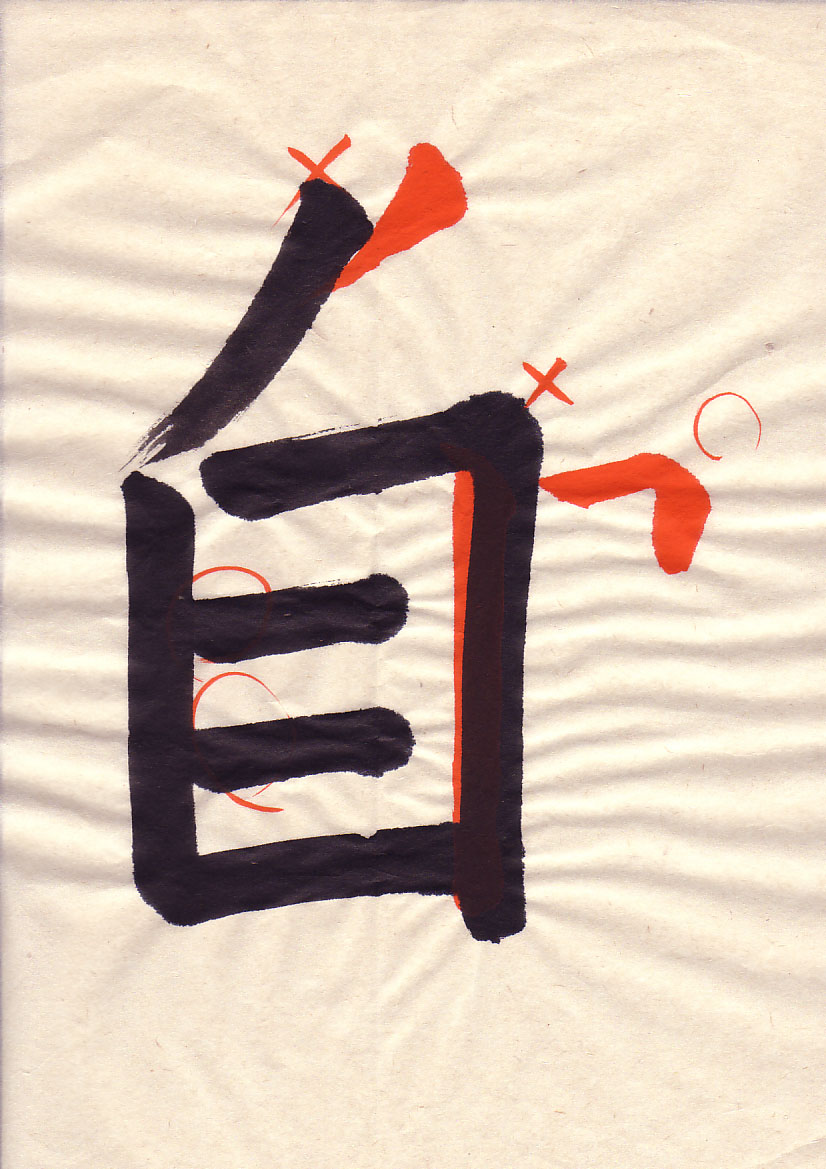
- 0:04 The hidarihane should start by applying the brush at a 45 degree angle. There is a slight pause here as the brush is readjusted so that the thick part of the brush is facing the stroke direction.
- 0:15 Here the student did not draw the 45 degree transition line.
- 0:18 The corner of the student's tensetsu does not have a nice angled edge. This is because the student went directly from the horizontal line to the vertical line without creating the 45 degree angle transition line.
- 0:18 At the end of the horizontal component, pause briefly to rotate the brush clockwise so the thick part of the brush is facing down and to the right. Then draw a very short 45 degree angle line.
- 0:19 After the 45 degree angle line, the brush is rotated clockwise once again to face downward and slightly to the left. From this position the vertical line component can be drawn.
- 0:22 Notice the difference in the corners between the two tensetsu.
- 0:35 The vertical component of the tensetsu must be straight and should angle inward slightly to the left.
- 0:39 Another view of the end result.
Another student’s 自
The student’s video, without corrections
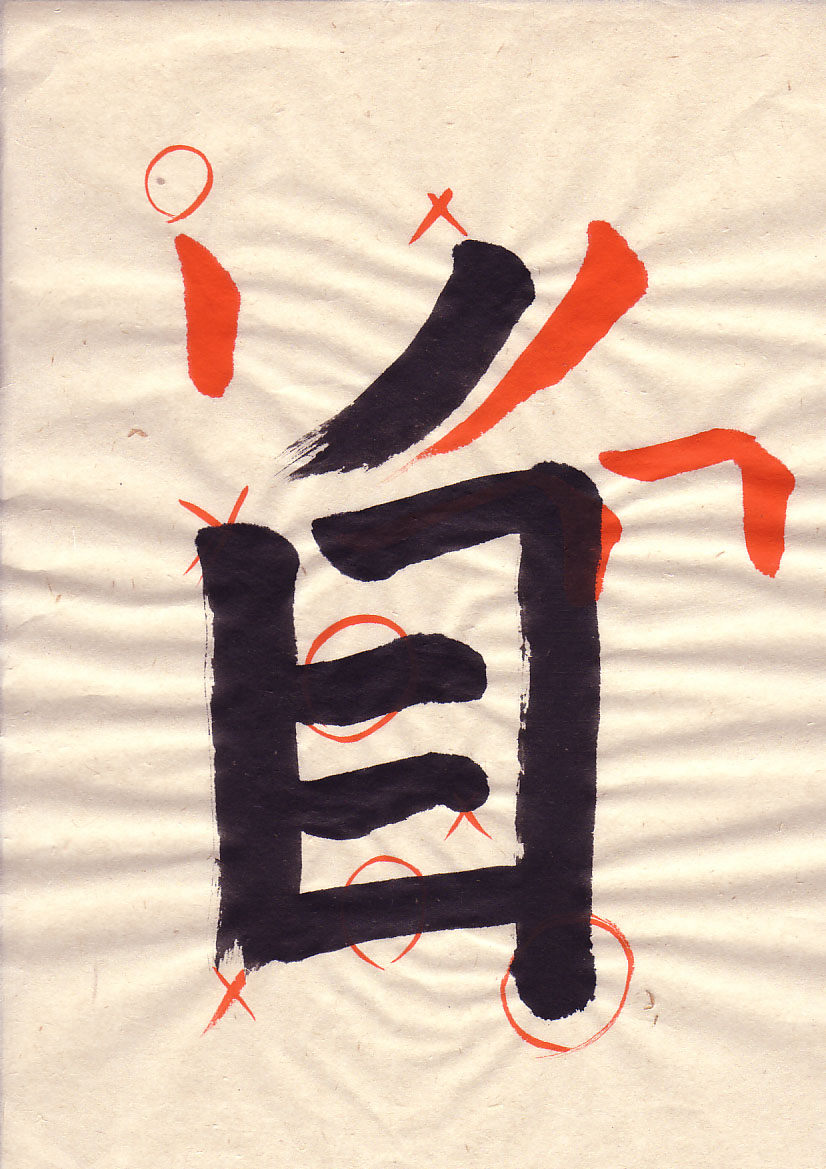
- 0:06 The brush was not applied at a 45 degree angle.
- 0:07 Apply the brush at a 45 degree angle, rotate the brush so the thick part of the brush is in the direction of the stroke which is down and to the left.
- 0:09 In a large movement complete the hidarihane.
- 0:13 For the tatega the brush was not started at a 45 degree angle.
- 0:19 Also notice the crisp finish to the stroke in red as compared to the jagged ending of the student's stroke in black.
- 0:26 The tatega on the left has a jagged edge which is not a nice look.
- 0:35 The first yokoga is not quite right, but it starts fine.
- 0:38 The second yokoga has a strange ending.
- 0:43 For the tensetsu the brush is applied at a 45 degree angle. The brush is then rotated clockwise so the thick part of the brush is facing the stroke direction.
- 0:44 After even pressure is used to create the horizontal component, the hand is rotated and a short 45 degree line is drawn.
- 0:46 A final rotation of the hand and the vertical component can be drawn.
- 0:53 Note the nice 45 degree angle to the corner.
HINT: It may be helpful to lightly fold the practice paper in half top to bottom and then in half again left to right. When unfolded these slight creases will help in centering the character and give visual references for relative lengths.
Vocabulary
| Romaji | Kana | Kanji | English | Audio |
|---|---|---|---|---|
| chū | ちゅう | 柱 | Pillar Vertical Line | audio |
| hidarihane | ひだりはね | 左撥ね | Left Flick Stroke | audio |
| ji | じ | 自 | Self | audio |
| tatega | たてが | 縦画 | Vertical Stroke | audio |
| tensetsu | てんせつ | 転折 | Continued Line | audio |
| yokoga | よこが | 横画 | Horizontal Line | audio |