
Lesson 16
国 kuni · Country
1. The character
kuni 国 means country and is also read koku. Combined with kome (also read bei) from the previous lesson, it gives 米国 which is read beikoku and is one way to write America in Japanese.
Another way to write America is in katakana as アメリカ, which is pronounced as it is spelled in English. We have information on katakana in the library. We will also discuss katakana and how to write katakana in detail in Section 5. katakana is used for writing non-Japanese names, words, and sometimes scientific terms in Japanese.
kuni (Country) 国 — sensei video
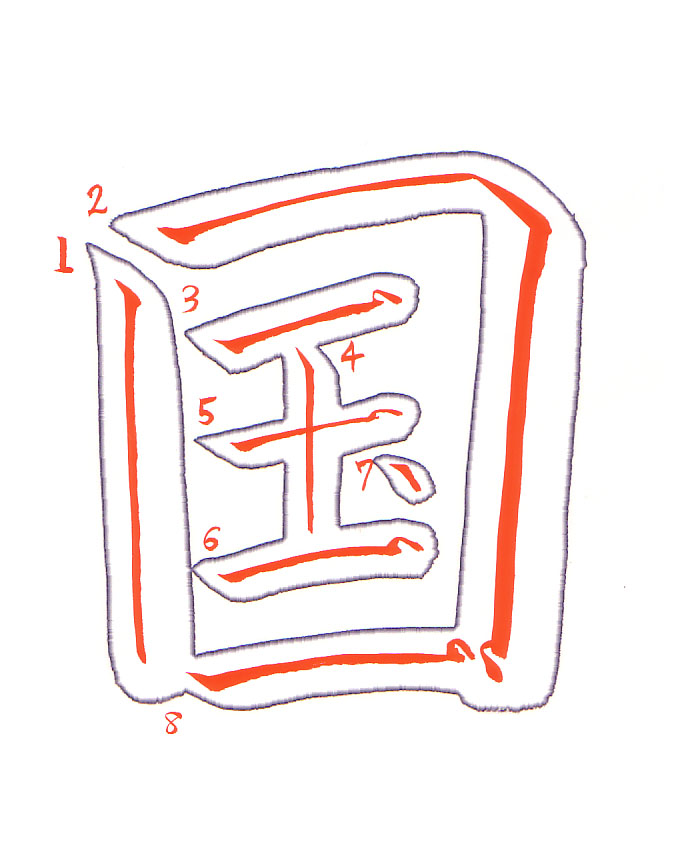
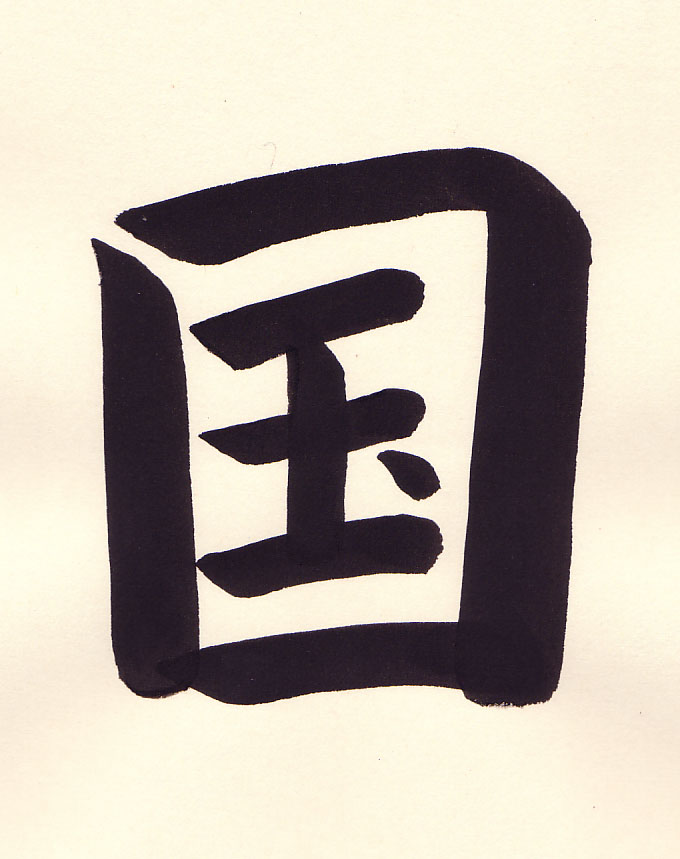
- 0:06 For the ro style tatega, start the line by applying the brush to the paper at a 45 degree angle.
- 0:07 Press down gently on the brush and come back up a little.
- 0:08 The brush is then rotated clockwise so the thick part of the curve of the brush is facing downward. The brush is also tilted so the tip of the brush is well below (towards the bottom of the page) the end of the brush.
- 0:09 Then push the brush straight down using your arm to draw the line.
- 0:10 To end the stroke, the brush is lifted a bit and reapplied very briefly.
- 0:11 Finally the brush is lifted in an upward stroke (towards the top of the paper) and off of the paper. This is performed in a large motion. This motion gives the end of the stroke a dewdrop like appearance.
- 0:13 Begin this tensetsu by applying the brush at a 45 degree angle.
- 0:14 Press down gently on the brush and come back up.
- 0:15 Then the brush is rotated counterclockwise so the thick part of the brush is to the right and slightly upward. The brush is also tilted so the tip of the brush is well to the right of the end of the brush.
- 0:15 In the corner the brush is not brought straight down. Rather at the end of the horizontal stroke, create a small 45 degree angle line.
- 0:16 The brush is then rotated again clockwise to bring the thick part of the brush facing downward towards the bottom of the paper.
- 0:17 Note how the hand position is changed to bring the thick end of the brush in line with the direction of the line to be drawn. The vertical component of the tensetsu is not straight down, but is angled slightly to the left.
- 0:20 To end the stroke, the brush is lifted a bit and reapplied very briefly.
- 0:21 Finally the brush is lifted in an upward stroke (towards the top of the paper) and off of the paper. This is performed in a large motion. This motion gives the end of the stroke a dewdrop like appearance.
- 0:24 For the internal yokoga, apply the brush to the paper at a 45 degree angle.
- 0:24 Press down slightly and then release.
- 0:24 Then rotate the brush counterclockwise so the thick part of the brush is facing to the right.
- 0:26 Bring the brush straight across the paper keeping consistent downward pressure on the brush to ensure that the line width is the same for the entire line. Finally the brush is lifted off the paper and to the left.
- 0:28 Draw a ro style tatega.
- 0:31 To finish the tatega, lift the brush in an upward stroke (towards the top of the paper) and off of the paper. This is performed in a large motion. This motion gives the end of the stroke a dewdrop like appearance.
- 0:35 The second internal yokoga is shorter than the first yokoga. The lines are equally spaced.
- 0:38 The final internal yokoga is longer than the other two.
- 0:41 Finish the yokoga.
- 0:43 To draw the ten, apply the brush at a 45 degree angle.
- 0:44 Press down slightly on the brush and pull it down slightly to the right. Then lift the brush up and off the paper.
- 0:46 For the final yokoga, apply the brush at a 45 degree angle in the middle and below the tatega.
- 0:47 Keep even pressure on the brush and use your entire arm to draw the line.
- 0:49 To finish the line the brush is taken up and off the paper to the left.
2. How students did
A student’s 国
The student’s video, without corrections
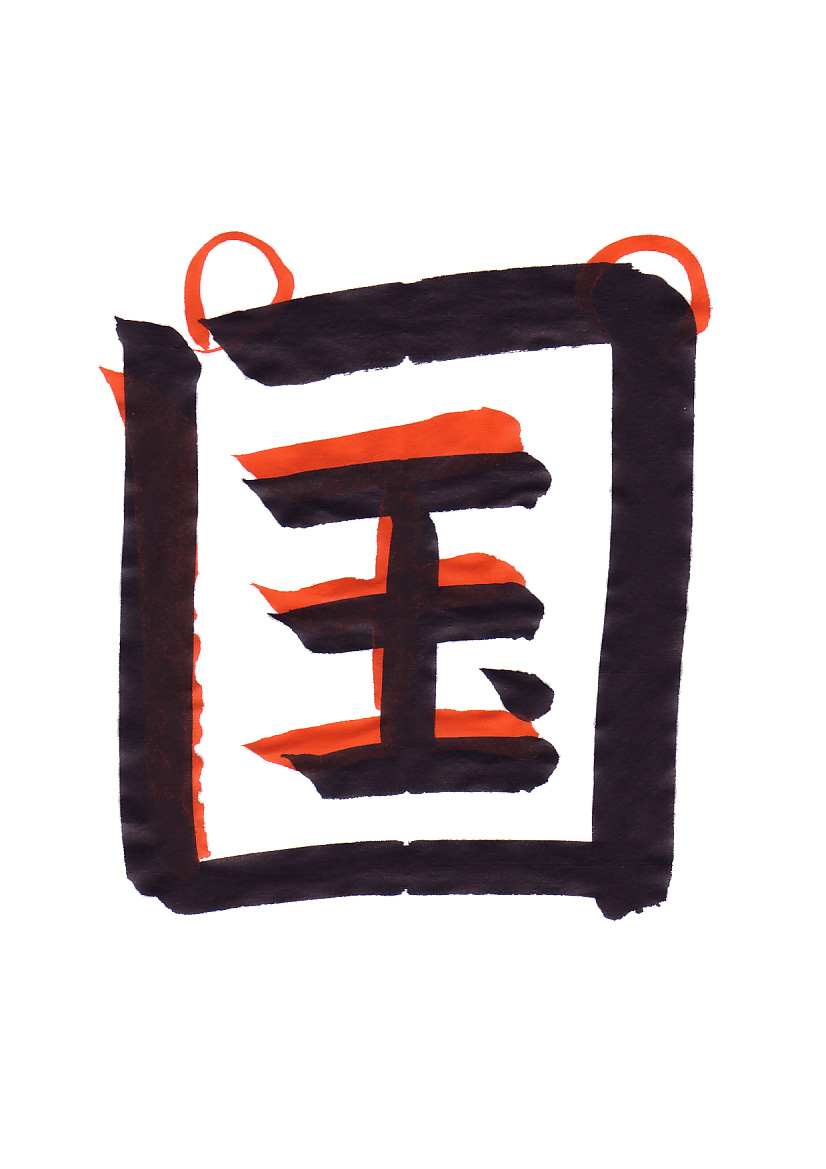
- 0:02 The tatega should angle slightly to the left and should have been started just a little lower. The start is also not as nice as it should be. Apply the brush to the paper at a 45 degree angle.
- 0:03 Press down gently on the brush and come back up a little.
- 0:04 Rotate the brush clockwise so the thick part of the brush is towards the bottom of the page. The brush is also tilted so the tip of the brush is well below (towards the bottom of the page) the end of the brush.
- 0:07 Then push the brush straight down using your arm to draw the line. Keep an even pressure on the brush and use your arm to draw the line. To end the stroke, the brush is lifted a bit and reapplied very briefly.
- 0:08 Finally the brush is lifted in an upward stroke (towards the top of the paper) and off of the paper.
- 0:11 The start of the tensetsu is fine.
- 0:12 The corner has a 45 degree angle.
- 0:19 The inner yokoga leaves too much space and should have been placed higher. Also the yokoga should slant slightly upward.
- 0:25 The middle yokoga should also slant slightly upward.
- 0:34 The final internal yokoga should have been longer. This is the longest of the three internal yokoga.
Another student’s 国
The student’s video, without corrections
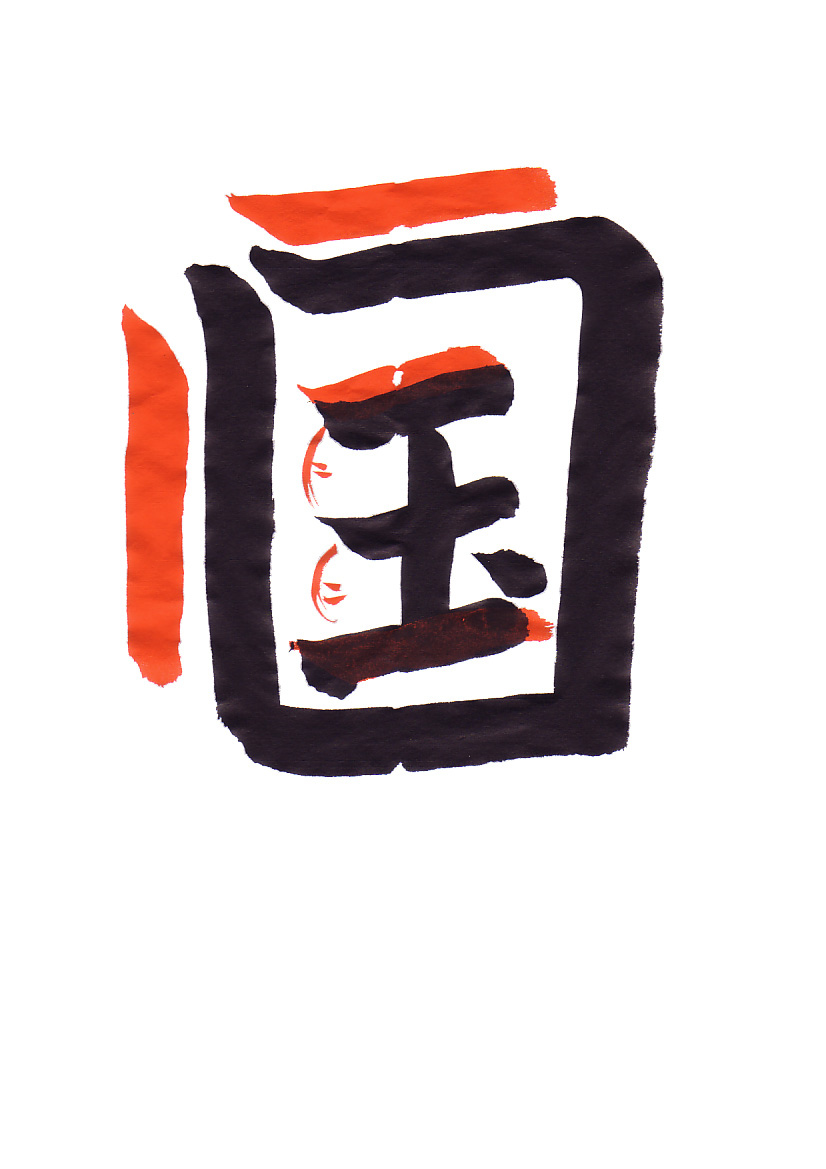
- 0:07 The tatega does not have a nice form. The start should have a nice taper and the line should be straight and should slant slightly to the left.
- 0:09 The horizontal component of the tensetsu does not have a nice look. To get a nice taper to the beginning of the stroke, the brush is applied to the paper at a 45 degree angle.
- 0:10 Press down gently on the brush and come back up a little.
- 0:11 Then rotate the brush counterclockwise so the thick part of the brush is to the right and slightly upward. The brush is also tilted so the tip of the brush is to the right.
- 0:12 Using the entire arm and even pressure push the brush to the right.
- 0:21 The first inner yokoga should be higher.
- 0:26 The bottom inner yokoga should be the longest of the three yokoga.
- 0:36 The space between the three yokoga should be equal.
Vocabulary
| Romaji | Kana | Kanji | English | Audio |
|---|---|---|---|---|
| katakana | かたかな | 片仮名 | Block Syllabary | audio |
| kuni | くに | 国 | Country | audio |
| tatega | たてが | 縦画 | Vertical Stroke | audio |
| ten | てん | 点 | Dot Stroke | audio |
| tensetsu | てんせつ | 転折 | Continued Lines | audio |
| yokoga | よこが | 横画 | Horizontal Line | audio |