

How to Write Names in Katakana
Katakana is how Japanese writes a foreign name, by how it is said. Michael shows it. Said MY-kul, it is マイケル (maikeru). Said mee-ka-EL, it is ミカエル (mikaeru). Said mee-SHEL, it is ミシェル (misheru), or ミッシェル (missheru) with the sh held. Said mee-HYL, it is ミハイル (mihairu). One spelling has several Japanese names, and each is right for the person who says it that way.
Katakana is the standard script for foreign names: it is how Japanese newspapers and magazines write them. After World War II, the 1946 reform that limited the kanji in everyday use directed that loanwords and foreign place and personal names, Chinese names excepted, be written in kana, and the 1952 guide for government writing specified katakana. The basis in use today is the government's 1991 guideline for writing foreign words. It lists the katakana for foreign sounds, and it says itself that it does not bind each person's own writing or the personal names that cannot follow it. Katakana is what Master Takase recommends for most customers who want their name in Japanese.
For an overview of all four methods of writing names in Japanese, see How to Write Names in Japanese.
What Is Katakana?
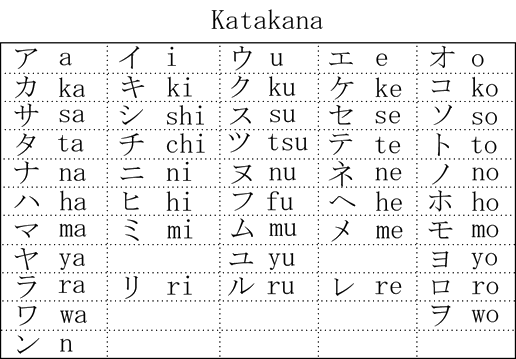
Katakana 片仮名 is a syllabary: each character represents a sound, not a letter, and has no meaning of its own. The strokes are angular and crisp, giving katakana a modern, assertive appearance.
Each katakana character is a shortened form of a kanji. Katakana took shape in the early ninth century among Buddhist scholar-monks, who wrote shortened kanji beside Chinese scriptures as reading aids; the earliest dated example is from 828. An old story credits the scholar Kibi no Makibi (695–775), but historians reject it. Katakana was later used for grammatical elements, as hiragana is today. In modern Japanese, katakana is reserved for foreign words, names, and technical terms.
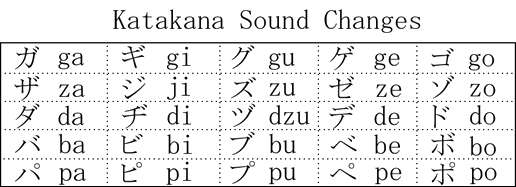
Sound Changes: Dakuten and Handakuten
Along with the basic characters, katakana uses two modifiers to create additional sounds.
The dakuten 濁点 looks like a double quotation mark and voices the consonant. The handakuten 半濁点 looks like a small circle. For example, ハ (ha) with dakuten becomes バ (ba), and with handakuten becomes パ (pa).
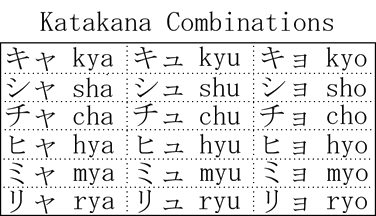
Combinations and Small Characters
Several modifiers called shōji 小字 (small characters) create new sounds. The small ya, yu, and yo, called yōon 拗音, join the character before them into a single beat: キャ (kya) is one beat, not two.
The small tsu, called sokuon 促音, holds the consonant that follows it for a beat of its own. In a name it comes after a short vowel, before a final consonant: Philip, said with the p held, is フィリップ (firippu). After a long vowel there is none: Duke, said DOOK, is ドゥーク (dūku).
Extended Katakana for Foreign Sounds
This is where katakana truly distinguishes itself from hiragana. Katakana has been extended with combinations, written with a small ァ, ィ, ゥ, ェ or ォ, for sounds that native Japanese does not have:
| Kana | Example |
|---|---|
| ティ ti | Tiffany ティファニー tifanī |
| ディ di | Dylan ディラン diran |
| ファ fa | Fatima ファティマ fatima |
| フィ fi | Fiona フィオナ fiona |
| ヴ vu | Steve スティーヴ sutīvu |
| ヴァ va | Valerie ヴァレリー varerī |
| ヴィ vi | Vivian ヴィヴィアン vivian |
| ウィ wi | William ウィリアム wiriamu |
| ウェ we | Wesley ウェスリー wesurī |
| ウォ wo | Walter ウォルター worutā |
The government's 1991 guideline lists these combinations for foreign sounds and leaves rarer sounds free. They are why katakana comes closer to a foreign name's sound than any other way of writing it.
Long Vowels: The Chōonpu
The chōonpu 長音符 is a dash-like mark (ー) that extends the vowel sound of the character before it. In romaji, a long vowel takes a line over it instead. For example, Kelly ends with a long "ee" sound: ケリー (kerī). The ー stretches the "i" sound of リ.
A long vowel follows the vowel, not the stress. An r after a vowel becomes length rather than a sound of its own: Carly is カーリー (kārī), and Arthur is アーサー (āsā).
The chōonpu is the only Japanese character that changes orientation depending on whether the text is written horizontally or vertically:
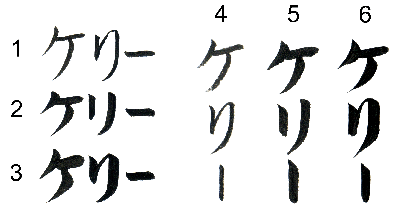
Kelly written in katakana horizontally from left to right and vertically from top to bottom.
How Your Name Adapts
Japanese counts time in beats, and each beat ends in a vowel, or is ン, ッ or ー. So a foreign name is rebuilt from Japanese beats. Here is what happens:
Consonant clusters split apart
Japanese does not put two consonants in a row, except for the held consonant (ッ). Each consonant gains its own vowel, usually "u," though after T and D it is "o." Brian and Christine have two syllables in English and Smith has one:
| Name | Japanese | Beats |
|---|---|---|
| Brian | ブライアン buraian | 5 |
| Smith | スミス sumisu | 3 |
| Christine | クリスティン kurisutin | 5 |
Final consonants gain vowels
English names often end on a consonant. A Japanese beat ends in a vowel, or is the syllabic n. So final consonants gain a following vowel. The "t" of Grant and the "d" of Brad take "o" (Brad's "d" is also held), and the "v" of Steve takes "u":
| Name | Japanese |
|---|---|
| Grant | グラント guranto |
| Brad | ブラッド buraddo |
| Steve | スティーヴ sutīvu |
Some sounds substitute
Sounds that do not exist in Japanese take a neighbor:
- L and R both use the R-column kana (ラ, リ, ル, レ, ロ). The Japanese sound is a light tap of the tongue, somewhere between an English L and R. Lena and Rena are both レナ (rena).
- TH without voice, as in Catherine, becomes S: キャサリン (kyasarin). Before an "ee" sound it becomes shi: Timothy is ティモシー (timoshī). TH with voice, as in the word mother, becomes Z: マザー (mazā).
- The vowel of "cat" after K becomes kya: Catherine キャサリン, Kathy キャシー (kyashī).
- V is written two ways in Japanese, and both are current. The 1991 guideline gives ヴァ, ヴィ, ヴ, ヴェ, ヴォ for the V sound and adds that バ, ビ, ブ, ベ, ボ may be used. Victoria is written both ヴィクトリア (vikutoria) and ビクトリア (bikutoria). We write a V sound with ヴ, as the guideline allows for names. Japanese also writes V with the B sounds, about as often (スティーブ beside スティーヴ), so our name pages offer both.
Examples
Arthur is written in romaji as āsā. There is no "th" sound, so it becomes sa. The "r" before "th" and the final "r" cannot stand alone, so both become the long vowel mark. Arthur in katakana is アーサー.
As another example, Japanese does not have the "thy" ending in Kathy and Timothy. It becomes shī. So Kathy is kyashī キャシー and Timothy is timoshī ティモシー.
Brian is buraian ブライアン, which may seem counterintuitive. Names are written by how they are said, not by how they are spelled. The "B" alone becomes the syllable bu because the following "r" makes a consonant cluster that must be split.
Pronunciation, Not Spelling
One point bears emphasis: names are written by how they are said, never by how they are spelled. Kathy and Cathy, said alike, give the same katakana. Jan said with a J is ジャン (jan), and said with a Y it is ヤン (yan). The same spelling is said differently by different people, which is why we ask how you say your name. For more on this, see the overview article.
Katakana and Japanese Seals
One problem with katakana is also its strength: the simple, angular lines are easy to write quickly, but they leave little room for artistry. Katakana has no cursive and few semi-cursive styles, so much of Japanese calligraphy's expression cannot be used with it.
Seals show this most clearly. Seal script (tensho) has been used on seals for more than two thousand years, and its complex, curving strokes make a seal hard to copy. Seal script is more than a thousand years older than katakana and was only ever written for kanji, so a name in katakana cannot be cut in seal script.
There are two kinds of personal seal. The mitomein is the everyday seal, often bought ready-made. The jitsuin is registered with the city office and used for contracts and property; it must be one of a kind, and the rules for what it may show are set by each city. Kyoto's, for instance, accept a foreign resident's name in katakana. Tenkoku, the art of carving seals, is a separate thing: the craft of seals like Master Takase's own, cut for art, usually in seal script.
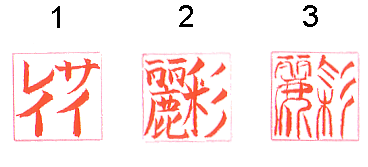
To illustrate, above are different seals for Sairei, Master Takase's professional name in Japan, in three seal styles.
For a seal design in seal script, consider a phonetic or literal translation to kanji, which allows the full range of seal scripts.
Translating Initials
As Japanese is a language of syllables, translating individual letters is awkward. The method is to translate how each letter is pronounced. The letter "A" is pronounced "ay" and becomes エー (ē). The single letter "W" takes five kana to write: ダブリュー (daburyū).
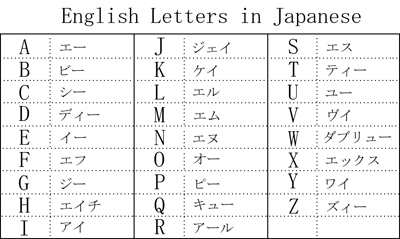
As an example, IBM's legal name in Japan is partly written as アイ・ビー・エム (ai bī emu). The middle dot (・) is used as a separator between initials.
Summary
Katakana is the standard way to write a foreign name in Japanese, and the closest to its sound. Its extended combinations write sounds that neither hiragana nor kanji can. The trade-off is one Master Takase meets daily in her work: the angular strokes that make katakana clear and efficient also limit what a calligrapher can do with it.
For designs where flowing brushwork matters, consider hiragana. For designs that carry meaning or call for seal script, consider kanji.
Ready to see your name? Search over 180,000 names, with designs composed from characters Master Takase brushed by hand.