

活人剣 · katsujinken · the sword that gives life, and 殺人剣 · satsujinken · the sword that kills
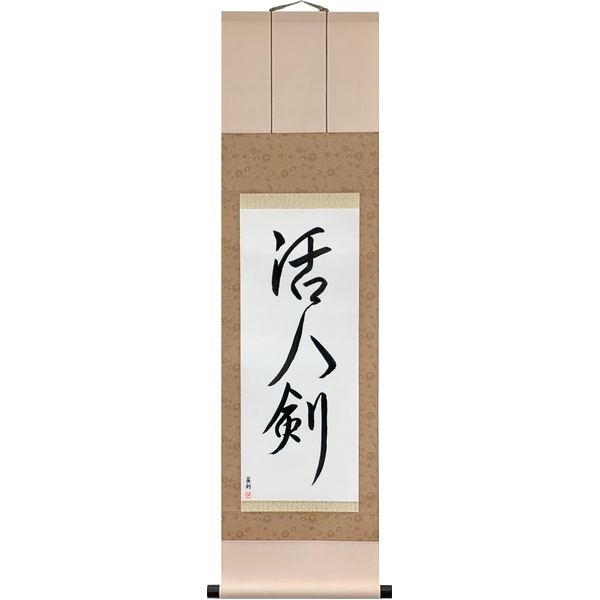
Sold as Life Giving Sword and Life Taking Sword, two scrolls · Read katsujinken; satsujinken; as a Zen pair, setsunintō katsuninken · Oldest witness the 景徳伝灯録 of 1004, where a Chinese master says of another that he has the sword that kills but not yet the sword that gives life; in Japan, a warrior's house rules of 1558 · Sense in Zen, the master's two hands, what he takes from a student and what he gives; in 柳生宗矩's book of 1632, the ruler's sword, which kills one evil man so that ten thousand may live; on a wall, the sword that is used to preserve life rather than take it
The words
Three characters each, and the two scrolls are halves of one saying of seven. 活 is to give life, to bring alive; 殺 is to kill; 人 a person. The last character is where the two halves differ, and it matters. The old pair is 殺人刀活人剣: the killing half takes 刀, the single-edged blade a warrior wore, and the life-giving half takes 剣, the double-edged straight sword of the Chinese books and the word Japanese uses for the sword as an art. The Clearys, translating the Blue Cliff Record in 1977, made the difference visible in English as the single-edged sword that kills people, the double-edged sword that brings people to life. The first scroll brushes the old form, 活人剣. The second brushes 殺人剣, with 剣, which is how the modern dictionaries head the word and how the catalogue's kanji-by-kanji explanation builds it, but not how the canon, the sixteenth-century warriors or 柳生宗矩 wrote it: their word is 殺人刀. A buyer who wants the Zen half or the Yagyū half wants 殺人刀; a buyer who wants the modern word has it.
The readings differ too. Read as Zen, in the Go-on the sutras keep, the pair is setsunintō katsuninken, and that is how the 日本国語大辞典 heads the seven characters, how the 1915 Zen dictionary spells them and how 柳生's book is read. Read as modern Japanese they are satsujinken and katsujinken, which is the catalogue's romaji and right for a word on its own. Both are in the dictionaries; neither is a mistake. And 殺人 by itself is killing a person, not a killer: the page's killer; murderer is the sense of 殺人者, and the page's own note that 殺人 is not murder is right.
A history, from the earliest witness
1004. The 景徳伝灯録, the first great record of the Chan lineages. The pair is already a proverb among the masters of the ninth century as the record remembers them. 夾山 says of 石霜, 石霜雖有殺人刀。且無活人劍, Shishuang has the sword that kills, but not yet the sword that gives life; a monk asks 清平 what is the sword that gives life? and is told do you understand?, asks what is the sword that kills? and is shouted at. The two swords are two things a teacher does. [CBETA T51n2076_p0326c05–06 and p0393b22–23; text]
Before 1052. 雪竇重顕, whose hundred cases became the Blue Cliff Record. 殺人刀,活人劍,具眼底辯取, the sword that kills, the sword that gives life: let those with eyes tell them apart. [CBETA T47n1996_p0689b15; text]
1125. 圜悟克勤, the 碧巌録. The book that fixed the phrase. Two cases open with it, in the sentence every Japanese dictionary quotes: 殺人刀活人劍。乃上古之風規。亦今時之樞要。若論殺也。不傷一毫。若論活也。喪身失命, the sword that kills, the sword that gives life: the rule of high antiquity and the pivot of the present day. Speaking of killing, not a hair is harmed; speaking of giving life, body and life are lost. In the thirty-first case a monk circles two masters' seats shaking his staff, and one says yes, yes, the other no, no, and both add 殺人刀活人劍。須是本分宗師, the sword that kills and the sword that gives life: for that you must be a master in your own right. 圜悟's marginal comments reach for it three times more. [CBETA T48n2003_p0152c14–16; p0155a18–19; p0170b09–10 and b16–17; p0172c23–24; p0188c09; p0192b07; text]
The twelfth century. 宏智 and 密庵. 宏智 puts it in verse with the order reversed, 活人劍殺人刀。倚天照雪利吹毛, and says it is 在臨際手裏, in Linji's hands; 密庵 has a master 秉殺人刀活人劍, wielding the two, to every place a blessing and an omen, an injury and a harm. [CBETA T48n2001_p0027a20 and p0029b22; T47n1999_p0973b28–29; text]
1228. 無門慧開, the 無門関. The eleventh case, 趙州 testing two hermits, closes with a verse of four three-character lines: 眼流星 機掣電 殺人刀 活人劍, eye a shooting star, working a lightning flash, the sword that kills, the sword that gives life. This is the other address the dictionaries give, and the one the Yagyū tradition names beside the 碧巌録. [CBETA T48n2005_p0294b17; text]
The fifteenth century. 東陽英朝's 禅林句集. The Japanese anthology of Zen phrases from which calligraphers have taken their one-line scrolls ever since lists 殺人刀活人劔 among the six-character sayings, with its two addresses, 碧岩垂示第十二 and 無門十一則. [13]
The late Muromachi. The ballad 満仲. The dictionary's first Japanese citation of the pair is a 幸若 ballad: 殺人刀活人剣、みな一念のうちなり, the sword that kills, the sword that gives life, all within one thought. [精選版 日本国語大辞典; the ballad not opened]
1558. 武田信繁's ninety-nine articles. The oldest dated warrior's use opened is a house rule. Among the ninety-nine articles Shingen's brother wrote for his son, dated by their colophon to the first year of Eiroku and transmitted in the 甲陽軍鑑, the one that a samurai must never be without his sword, even lying with his wife, is glossed with the Zen line: 縱ヒ雖在夫婦一所、聊タ不可忘刀ヲ事 云 殺人刀活人劔. The sword at the bedside is both. [15][15]
1580 to 1592. The 別所長治記. A captain shouts it as he charges: 小八郎聞モアヘス殺人刀活人劔ト云拾無是非掛イリ給フ, Kohachirō, hearing him out no further, cried "the sword that kills, the sword that gives life!" and charged in. This is the dictionary's first citation for 活人剣 as a word of its own. A seventeenth-century tale, the 室町殿物語, lists 活人劍殺人刀 among a swordsman's techniques beside the ten-character cut and the throwing blade. [17]
1632. 柳生宗矩, the 兵法家伝書. The shōgun's sword-master made the two halves the names of the two books of his family's text, and in the colophon dated the ninth month of 1632 said why: 此卷上下を殺人刀活人劔と名たる心は、人をころす刀、却て人をいかすつるぎ也、とは夫亂たる世には、故なき者多く死するなり、亂たる世を治める爲に殺人刀を用ひ、巳に治る時は殺人刀を卽て活人劔ならずや、是を以所名付也, the meaning of naming these two books "the sword that kills" and "the sword that gives life" is that the sword that kills people is, on the contrary, the sword that gives them life. In a world in disorder many die for no cause; to bring order to a disordered world the killing sword is used, and once order is made, is not the killing sword then the sword that gives life? That is why they are so named. The preface had already argued it from the Chinese maxim that weapons are instruments of ill omen: 一人の惡に依て萬人苦む事あり、しかるに一人の惡をころして、万人をいかす是等誠に人をころす刀は、人をいかすつるぎなるべきにや, because of one man's evil ten thousand suffer; to kill that one evil man and give life to ten thousand: is not the sword that kills people truly the sword that gives them life? And the body: 兵法は人をきるとばかりおもふはひが事也、人をきるにはあらず、惡をころす也, to think the art of the sword is only cutting people down is a mistake; it does not cut people, it kills evil. [22]
1830. 安西於菟, on a tea-room scroll. A connoisseur of calligraphy tells of visiting a house where a one-line scroll hung in the tea room reading 人刀活人劔, five characters, mounted in brocade with a certificate from an old-calligraphy appraiser, and the host said 武士は人を活す為に帯刀するとはよき悟りなり, that a samurai wears his sword to give people life is a fine insight. The author saw what had happened: a monk had brushed the seven characters, and a dealer had cut off the 殺, because tea people abhor the word for killing, 殺人刀活人剣の妙語を損壊したる大ひなる罪なるべし, a great crime, to have wrecked the marvelous phrase. It is the closest thing in the record to the scroll this house sells. [23]
1915. 山田孝道's 禅宗辞典. The Zen dictionary's entry: 師家の學人を接する自由の妙用を刀劍を假りて示す。殺は消極、掃蕩、把住の意。活は積極、扶起、放行の意, the master's free working in receiving a student, figured as a sword: killing is the negative, sweeping away, holding fast; giving life the positive, raising up, letting go, with the 碧巌録's twelfth case quoted; and elsewhere the pair as the first two of the seven things a Rinzai monk carries on him. [24]
Today. The 日本国語大辞典: 活人剣 is a sword that gives life: a sword is by nature for killing and wounding, but by the way it is used may become a thing that gives life; also, that way of the sword; 殺人剣 is a sword used with the aim of killing; 殺人刀; and the seven characters together are in Zen, the working of the Zen man who cuts off deluded feeling, figured as a sword. 大辞泉 says the same and adds, for the pair, the master holding back the student's wisdom and leading him freely toward completion, figured as the sword of free killing and giving life. [kotobank; text]
The sense across time
There is one image and it has been held four ways, all of them still alive. In the Chinese records and in every Japanese Zen dictionary the two swords are one teacher's two hands: what he takes from a student and what he gives, and a master must have both. In 柳生宗矩's book they become the ruler's sword, which kills one man so that ten thousand may live, a reading Thomas Cleary rightly says the Zen books never make. In the sword schools the pair is technical and older than Yagyū: 殺人刀 is swordsmanship that strikes first and kills the opponent's response, 活人剣 swordsmanship that draws him out and answers, and the 新陰流 has a form named for the first. And on walls and in tea rooms the two are the sword used to preserve life and the sword used to take it, which is what the house's pages say and what the 1830 host said, to the author's disgust. The 日本国語大辞典 keeps the tea-room sense as its second clause, so it is a dictionary sense and not only a sentiment.
What is not a source
沢庵's 不動智神妙録, which the encyclopedias set beside Yagyū's book as the source of its Zen, does not use either word; the two names are Yagyū's own borrowing from the 碧巌録 and the 無門関. The kendo and aikido books that carry the pair are reception, not sources. The manga Rurouni Kenshin, which supplies most of the Internet Archive's hits for satsujin-ken, is a witness to the modern word's currency and to nothing older.
The text in English
1977. Thomas Cleary and J. C. Cleary, The Blue Cliff Record, Shambhala, Boulder. The first English 碧巌録 and the first English of the phrase: The sword that kills people, the sword that brings people to life: this is the standard way of high antiquity, and at the fifteenth case the single-edged sword that kills people, the double-edged sword that brings people to life. [30]
1985. Hiroaki Sato, The Sword and the Mind, Overlook Press (Barnes & Noble printing, 2004). The first English 兵法家伝書. The two books are The Death-Dealing Blade and The Life-Giving Sword; the Zen readings setsuninto and katsuninken are kept and the note says both appear several times in the Hekiganroku; and from Yagyū's text a technical gloss, the sword that is positioned for attack is called the death-dealing blade, and the sword that is not, the life-giving sword. [31]
1994. Winston L. King, Zen and the Way of the Sword, Oxford University Press. The phrase as the name of an era: chapter 10 is The Life-giving "Sword" of the Martial Arts, the turn from killing art to self-cultivation. [32]
1997. Karl F. Friday, Legacies of the Sword, University of Hawai'i Press. The technical pair as the Kashima line keeps it: "setsunin-to" (i.e. "sword[smanship] that transfixes," or "swordsmanship that kills response") against "Katsujin-ken" ("Sword[smanship] that animates"); Kamiizumi's swordsmanship centered on katsujin-ken; and the note that the two terms derive from Buddhist allegory. [33]
2002. Minoru Kiyota, The Shambhala Guide to Kendo. "life-rendering sword" (katsujin-ken) and the "death-rendering sword" (satsujin-ken), and the sentence that names the house's reading as the common one: Popularly, katsujin-ken and satsujin-ken are interpreted as the employment of the sword for worthy … [34]
2003 and 2004. William Scott Wilson, The Life-Giving Sword, Kodansha International, and The Lone Samurai. The second English 兵法家伝書 took the phrase for its title; Wilson's biography of Musashi glosses the Yagyū pair as the "death-dealing sword" and the "life-giving sword." The 2003 book was not opened. [35]
2005. Thomas Cleary, Soul of the Samurai, Tuttle. The third English 兵法家伝書: Book 1 The Killing Sword, Book 2 The Life-Giving Sword, Book 3 No Sword; and the sentence this history leans on: "The sword that kills is the sword that gives life" is a Zen expression. In Zen literature it is never employed as Yagyu uses it here, to refer to actual killing. [36]
Today. JMdict: 活人剣, life-saving sword (a killing sword may be a sword of life depending on how it is used); 殺人剣, life-taking sword; sword used to kill; 殺人刀, (killing) sword. The house's Life Giving Sword is the English of Sato, King, Wilson and Cleary. Life Taking Sword is JMdict's gloss and no translator's; the translators say death-dealing, death-rendering and killing, and the page's own alternative, Killing Sword, is Cleary's. A rendering of either half must keep it a half: 活人剣 is an answer to 殺人刀, and the seven characters are the phrase.
A reading
The two scrolls sell one saying in halves, and the halves are true to it: the masters themselves split it, 柳生's book is two volumes, and a Japanese reader meets 活人剣 alone as a word with its own dictionary entry. The half worth a caution is the second. The tradition writes 殺人刀; 殺人剣 with 剣 is a modern headword, right in a dictionary and unknown to the canon, to 信繁, to the 別所長治記 and to Yagyū, so a buyer who wants the Zen or the Yagyū half wants 殺人刀, and this page should say which word it is selling. The first half is the one the tea rooms have always wanted, and I take the 1830 host's side against the author who mocked him: a sword that gives life is a fine thing to hang, and it was so then. But the force of the phrase is in the pair, which is why this history carries all seven characters, so a buyer knows that the sword that gives life is an answer to the sword that kills and not a sentiment on its own. On the English, Life Giving Sword is the tradition's and stands; Life Taking Sword is a dictionary's and nobody's, and if the page wants a translator's word it already offers one in Killing Sword. Signed, 典, 2026-09-07.
How this was read
By eye: the two template files. By text at the address: the canon at CBETA, every quotation to its Taishō column (the 景徳伝灯録 T2076 juans 16 and 23; 雪竇's 語録 T1996 juan 3; the 碧巌録 T2003 juans 2, 4 and 6; 宏智's 広録 T2001 juans 2 and 3; 密庵's 語録 T1999; the 無門関 T2005), any of which a reader's AI can open at cbdata.dila.edu.tw/stable/juans?work=
References
- Template M1004SSVC3A () — takase-images (by eye)
- Template M1088SSVC3A () — takase-images (by eye)
- 景德傳燈錄 卷16 (夾山 on 石霜) (1004) — CBETA T51n2076_p0326c05–06 (text)
- 景德傳燈錄 卷23 (吉州清平) (1004) — CBETA T51n2076_p0393b22–23 (text)
- 明覺禪師語錄 卷3 (雪竇) (d. 1052) — CBETA T47n1996_p0689b15 (text)
- 碧巖錄 第12則 垂示 (1125) — CBETA T48n2003_p0152c14–16 (text)
- 碧巖錄 第15則 垂示 (1125) — CBETA T48n2003_p0155a18–19 (text)
- 碧巖錄 第31則 評唱 (1125) — CBETA T48n2003_p0170b09–10, b16–17 (text)
- 碧巖錄 著語, cases 34 · 54 · 60 (1125) — CBETA T48n2003_p0172c23–24 · p0188c09 · p0192b07 (text)
- 宏智禪師廣錄 卷2 · 卷3 (12th c.) — CBETA T48n2001_p0027a20 · p0029b22 · p0030a14–15 (text)
- 密菴和尚語錄 (d. 1186) — CBETA T47n1999_p0965b20 · p0970b12–13 · p0973b28–29 (text)
- 無門關 第11則 頌 (1228) — CBETA T48n2005_p0294b17 (text)
- 東陽英朝『禅林句集』 (15th c. (1889 typeset)) — pid 899716 komas 4, 44, OCR ↩
- 幸若『満仲』 (室町末) — 日国 (kotobank) only; not opened
- 武田信繁, ninety-nine articles, in『甲陽軍鑑』 (永祿元年 (1558) by its colophon; compiled c. 1616) — 1893 温故堂 pid 899828 koma 14, OCR; Edo ms pid 1287447 koma 52, OCR ↩
- 『別所長治記』 (1580–92頃) — quoted in 武家名目抄, 1906 pid 772001 koma 56, OCR (heading ○殺人刀活人劔, koma 55); 日国 初出 for 活人剣
- 『室町殿物語』 (17th c.) — quoted in 武家名目抄, pid 772001 koma 30, OCR ↩
- 日葡辞書 (1603) — 日国 (kotobank) only; not opened
- 柳生宗矩『兵法家伝書』上巻序 (1632) — 1937 pid 1074542 koma 10, OCR
- 『兵法家伝書』殺人刀 body (1632) — pid 1074542 koma 11, OCR
- 『兵法家伝書』奥書 (寛永九年 (1632)) — pid 1074542 koma 39, OCR
- 福井久蔵, 解題 (1937) — pid 1074542 koma 4, OCR ↩
- 安西於菟『近世名家書画談』二編 (1830) — pid 2564850 koma 22 (classical), OCR ↩
- 山田孝道『禅宗辞典』 (1915) — pid 936741 komas 431, 306, 253, OCR ↩
- 精選版 日本国語大辞典 () — kotobank (text)
- デジタル大辞泉 () — kotobank (text)
- 日本大百科全書 (渡邉一郎) () — kotobank.jp/word/兵法家伝書 (text)
- JMdict () — JMdict_e.gz (text)
- ja.wikipedia 兵法家伝書 () — api extract (text; reported)
- Cleary & Cleary, *The Blue Cliff Record*, Shambhala (1977) — IA bluecliffrecord10000yuan, fts snippets; ISBN 0394732707; amazon.com/dp/0394732707 (200) ↩
- Hiroaki Sato, *The Sword and the Mind* (1985 (2004 printing)) — IA swordmindclassic0000yagy; ISBN 0760765316; amazon.com/dp/0760765316 (200) ↩
- Winston L. King, *Zen and the Way of the Sword*, OUP (1994) — IA zenwayofswordarm0000king; ISBN 0195092619; amazon.com/dp/0195092619 (200) ↩
- Karl F. Friday, *Legacies of the Sword*, Hawai'i (1997) — IA legaciesofswordk0000frid; ISBN 0824818474; amazon.com/dp/0824818474 (200) ↩
- Minoru Kiyota, *The Shambhala Guide to Kendo* (2002) — IA shambhalaguideto00mino; ISBN 1570629277; amazon.com/dp/1570629277 (200) ↩
- William Scott Wilson, *The Life-Giving Sword* (Kodansha International 2003), via *The Lone Samurai* (2004) (2003 · 2004) — IA lonesamurailifeo0000wils; ISBN 477002942X (the biography); amazon.com/dp/477002942X (200); the 2003 book not opened ↩
- Thomas Cleary, *Soul of the Samurai*, Tuttle (2005) — IA soulofsamurai0000unse; ISBN 0804836906; amazon.com/dp/0804836906 (200) ↩
- 鎌田茂雄 · 清水健二, *Zen and Aikido*, Aiki News (1992) — IA zenaikido0000unse; ISBN 9784900586130
- The house: catalogue and pages (2026) — etl/data; takase.com (text)
Books Cited
The books this article cites. Buying one supports its author.