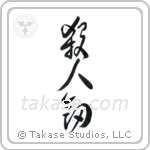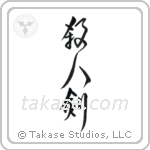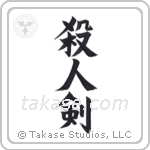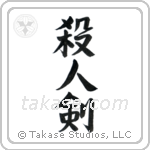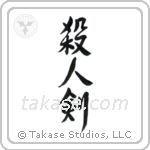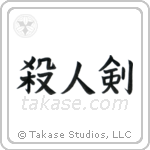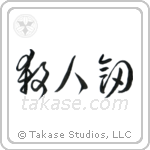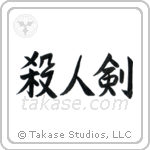

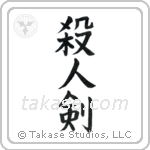
殺人剣 (satsujinken)
殺人剣, read satsujinken: the sword that kills, a sword used to take life. It is the other half of a seven-character Zen saying, 殺人刀活人剣, the sword that kills, the sword that gives life, and in that saying the killing sword is not a villain's. In Zen the two swords are one teacher's two hands, what he takes from a student and what he gives, and a master must have both; and in the book that Yagyū Munenori, the shōgun's sword-master, named for the pair, the sword that kills one evil man so that ten thousand may live is the sword that gives them life. The scroll brushes 殺人剣 with 剣, the form the modern dictionaries give the word; the Zen books and Yagyū write the killing half 殺人刀 with 刀, the single-edged blade, and this scroll is the modern word. Read as modern Japanese it is satsujinken; read as Zen, the pair is setsunintō katsuninken, and both readings are in the dictionaries. 殺人 is killing a person, which is not the same as murder. Life Taking Sword is the dictionary's gloss; Killing Sword is Thomas Cleary's, from his translation of Yagyū's book. Its other half, Life Giving Sword (katsujinken), is offered on its own. 殺人剣 is composed of the kanji 殺人 (read satsujin) meaning "killing a person" and 剣 Sword (ken).
Note that the Japanese word satsujin is often translated as murder but this is not strictly correct as satsujin only means "kill a person" which includes murder but it also may mean killing someone evil or killing someone in defense of oneself, one's family or one's country - so it does not have the strictly negative meaning that the word "murder" has.
Verify: 殺人剣 in the Japanese-English Dictionary
Couldn't add to cart. Please try again.