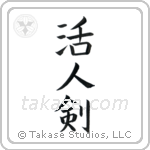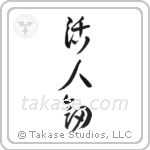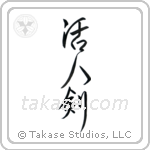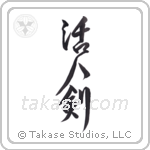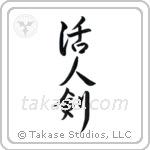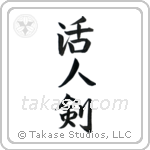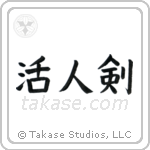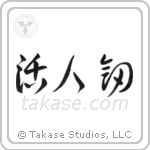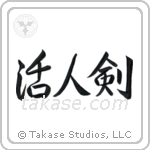

It is one half of a seven-character Zen saying, 殺人刀活人剣, the sword that kills, the sword that gives life, and it has always been the half people wanted on a wall. The pair is already a proverb in the earliest Chan records, where one master says of another that he has the sword that kills but not yet the sword that gives life; the Blue Cliff Record fixed it as the rule of high antiquity and the pivot of the present day, and the Gateless Gate put it in verse.
In Zen the two swords are one teacher's two hands, what he takes from a student and what he gives, and a master must have both. In Japan the line went to war: a Takeda house rule glossed the samurai's sword with it, a captain shouted it as he charged, and Yagyū Munenori, the shōgun's sword-master, made the two halves the titles of his two books of the sword and explained the pair as the sword that kills one evil man so that ten thousand may live.
Tea rooms took the giving half alone, and one connoisseur wrote in disgust of a scroll from which a dealer had cut the killing word. Life Giving Sword is the translators' English, Hiroaki Sato's first and then William Scott Wilson's and Thomas Cleary's. Its other half, Life Taking Sword (satsujinken), is offered on its own.
We want you to be as happy with the meaning as you are with Master Takase's art. To learn more, visit Philology of 活人剣.