

有段者 · yūdansha · Black Belt
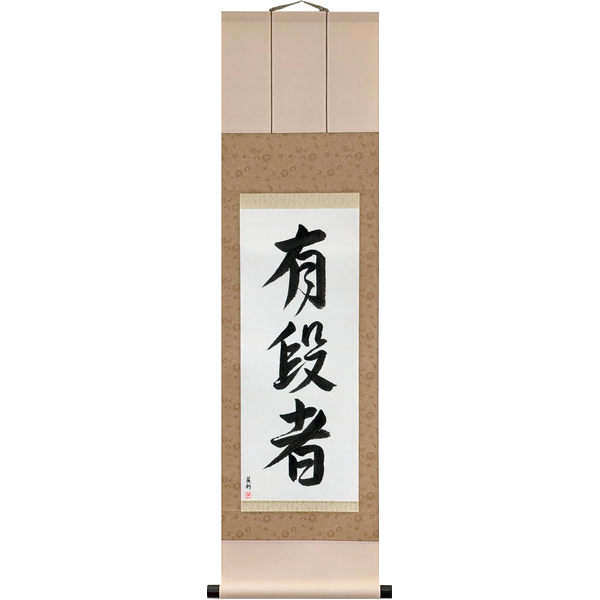
Sold as Black Belt · Read yūdansha, three characters · Register standard; a technical word of budō, go and shōgi, in print by 1907 and in the dictionaries by 1915 · Sense a person who holds a dan grade, shodan or above; the belt is the sign, the word is the rank.
The word
有 is to have, 段 is a dan, a grade of skill, and 者 is a person: one who has a dan. The whole word hangs on 段, and 段 belonged to the board games before it belonged to the dōjō. The 日国's oldest citation for 初段, first dan, as a grade is a comic book of 1814 about go and shōgi players, and its entry for 有段者 says so in its first clause: in budō, go, shōgi and the like, a person who holds a dan grade; shodan and above. The 大辞泉 gives 段位 as the rank expressing skill in jūdō, kendō, go, shōgi and the like, above 級. So the word does not say black belt. It says ranked, in the sense a go player is ranked, and it is used of go players without explanation in 1914, a professional's dan being another matter from an amateur's, which has a handicap in it. The English word the house sells it under is the sign a visitor saw on the mat, and the history explains how the two met.
The dictionaries' first citation is 1935 (北条清一『武州このごろ記』, he does not look like a jūdō 有段者). The word is older than that in print by twenty-eight years: the fiftieth-anniversary history of Keiō (1907) counts the jūdō club's members as twenty-odd 有段者, eighty-odd 有級者, and by 1915 the 『大日本国語辞典』 has it as a headword, in jūdō and the like, shodan and above, which the 『言泉』 of 1922 widens to jūdō, go, shōgi. Advertisements for jūdō manuals in 1914 and 1922 put 嘉納 and the 有段者 masters on one line, and that is where the word's dōjō weight comes from. In the archive it rises through the 1920s and peaks in the 1930s, when every school had a kendō and a jūdō hall. [The 1907, 1914, 1915 and 1922 witnesses are OCR snippets of the harvest archive, with their koma addresses in the account; not yet read at the scan.]
Where it is used
Of anyone with a dan: a jūdōka, a kendōka, a karateka, a go or shōgi player. In 1923 a Shintō lecturer uses it as a plain figure, whether a duffer or a 有段者, both are go players. It has no register but the technical; nothing religious or moral attaches to it. In English, every use found is jūdō's, and the earliest is E. J. Harrison's, a journalist who trained at the Kōdōkan before 1913 and wrote of the proportion of yudansha, who are allowed to wear black belts as a sign, and of yūdansha scarcely five feet high who threw him. The Budokwai's bulletin in London glosses it in 1946 as holder of "Dan" grade, and Harrison's manual of 1952 as holder of a Dan (grade, rank, degree); his 1955 edition gives the pair: mudansha or non-dan, and dan-holders are called yudansha. [All four from the archive's search highlights; the scans are lending-only.]
The word in English
Black belt is what a yūdansha wears, and Harrison's 1913 sentence is the place the two are joined in English: the black belt is a sign, the yūdansha is the person. JMdict and the house both gloss the word as black belt, which is right for what a buyer means and loose for what the word says; the house's page glosses 段 itself as dan (black belt) rank, which is true in the dōjō and not on the go board. What a rendering must keep is the rank: dan holder, ranked; the belt may follow in brackets.
A reading
Sell it as Black Belt, because that is the English, and say on the page what the word is: one who holds a dan, a term the board games made and the dōjō borrowed, in print by 1907, and the sign of it on the mat is the belt a foreigner noticed in 1913 and English has said ever since. A buyer with a dan in go has as much right to the scroll as one in jūdō, and the word knows it. Signed, 典, 2026-09-08.
How this was read
By eye: the template. By text: the three dictionary entries at kotobank. By OCR: the harvest archive on disk, 127 books of 9,870 (the NDL Lab's own index was not yet searched when this was written), sixteen of them at the snippet, with koma and image address in the account; the archive's English full text on yudansha, 692 hits, four at the highlight. Not opened: any Japanese witness at the scan; Harrison at the page; the Kōdōkan's own record of its first dan awards, so the year the grade entered jūdō is not given here; the Meiji bilingual dictionaries on the shelf, searched by OCR and found without the word, as a word of the 1900s would be.
References
- The scroll (ours), template M1006SSVB4A, by eye (—) — takase-images/templates/scrolls/martial-art/M1006SSVB4A-…-template.jpg
- The catalogue (ours) (current) — cultural_works 429; the live page (curl)
- 精選版日国, 有段者 (current) — kotobank (TEXT)
- 精選版日国, 初段 ③ (current) — kotobank (TEXT)
- 慶応義塾五十年史 (1907) — pid 812742 koma 228 (OCR); also 992524 k229
- 大町桂月『日本男児論』 (1914) — pid 933627 koma 155 (OCR)
- 山崎延吉『農民教育』, an advertisement for a jūdō book (1914) — pid 980194 koma 201 (OCR)
- 上田万年・松井簡治『大日本国語辞典』 (1915) — pid 954645 koma 104 (OCR); 1871514 k105
- 横山健堂『大将東郷』 (1915) — pid 950830 koma 259 (OCR)
- 落合直文『言泉』 (1922) — pid 969159 koma 103 (OCR)
- 『図解剣道教範』, an advertisement (1922) — pid 965095 koma 191 (OCR)
- 田中義能『神道講演』 (1923) — pid 971061 koma 19 (OCR)
- E. J. Harrison, The Fighting Spirit of Japan (1913) — archive.org india.history.resource.91404 (highlight)
- The Budokwai, Judo Quarterly Bulletin 2.2 (July 1946) — archive.org (highlight)
- Harrison, The Manual of Judo (1952) — archive.org the-manual-of-judo (highlight)
- Harrison, The Fighting Spirit of Japan, later ed. (1955) — archive.org fightingspiritof0000harr (highlight)
- The local archive (9,870 books to about 1949) — search_ndl_archive.py