

我が運命を決めるのは我也我が魂を制するのは我也 · 戦争と平和 · 運命の悪戯 · 今を生きる · 来た見た勝った · 私を殺さないものは私を強くする · I am the master of my fate · War and peace · A trick of fate · Live the moment · I came, I saw, I conquered · What does not kill me makes me stronger
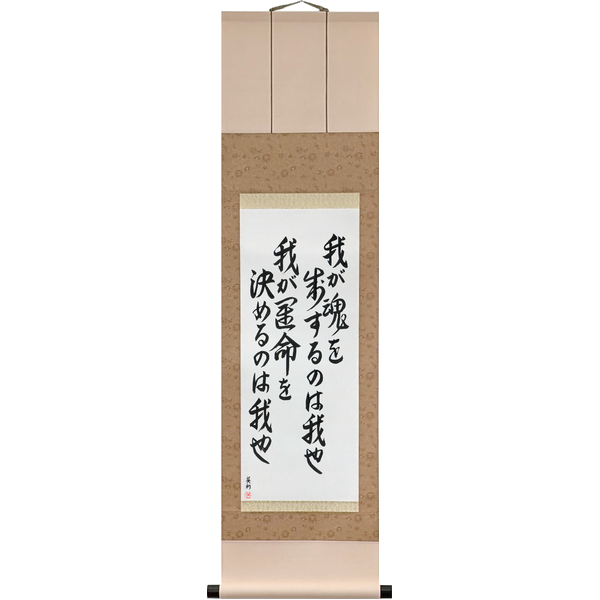
Sold as I Am the Master of My Fate, I Am the Captain of My Soul · War and Peace · Whim of Fate · Live the Moment; Carpe Diem · I Came, I Saw, I Conquered · What Does Not Kill Me Makes Me Stronger · Read waga unmei wo kimeru no wa ware nari, waga tamashii wo seisuru no wa ware nari · sensō to heiwa · unmei no itazura · ima wo ikiru · kita mita katta · watashi wo korosanai mono wa watashi wo tsuyoku suru · Register one classical Japanese sentence with the kanbun copula 也; a novel's title; a dictionary phrase; and three plain modern sentences · Oldest witness Caesar's three words as Suetonius and Plutarch report them, 47 BC; Horace's ode, 23 BC; Henley's poem, dated 1875, printed 1888; Tolstoy's novel, 1869; Nietzsche's aphorism, 1889; in Japanese, 運命の惡戯 in Ueda Bin's translations of 1901, 戦争と平和 as a title in 1914, 来たり見たり勝ちたり in 1931, 今を生きる in 1936, the Henley couplet uncredited on the Japanese web, and the Nietzsche in no prewar book · Sense six lines the West has said for a long time, and how each came to be said in Japanese.
The sense: originals and renderings
Six scrolls, five of them renderings of a famous Western line and one a Japanese phrase that entered the language through a translation. The reading's work was to find the originals at their texts and the Japanese at its earliest print, and to say for each which is which. Caesar's veni, vidi, vici is three verbs in Latin and three in Japanese, 来た見た勝った, as terse as the original and in every Japanese reference work; a 1931 seducer's manual has it in the classical perfect. Horace's carpe diem became the English live the moment and the 1989 film Dead Poets Society, whose Japanese title, いまを生きる, is the scroll's phrase; a religious writer had used the same four characters in 1936 for a different reason. Henley's couplet, I am the master of my fate: I am the captain of my soul, is on the scroll in the one Japanese rendering a Japanese reader of the 2009 film Invictus will know, with the copula written 也 as the scroll's own touch. 戦争と平和 is Tolstoy's title as every Japanese edition since 1914 has written it. Nietzsche's was mich nicht umbringt, macht mich stärker is on the scroll in the house's plain Japanese, with no prewar Japanese page behind it. And 運命の悪戯, a trick of fate, has its own dictionary entry and a Japanese life that begins, tellingly, in a translation of 1901.
The words
The words of the six are ordinary and the pages gloss them rightly; three deserve a line. 也 nari is the kanbun writing of the classical copula, and it is what makes the Henley scroll read as a vow rather than a sentence; the Japanese encyclopedia writes the same line with なり in kana. 悪戯 itazura, mischief, is derived by the dictionary from 徒, idle, vain, and runs from a prank through a child's meddling to a euphemism for indecent assault; in 運命の悪戯 it is the first sense and a little of the third, fate toying with what it should leave alone, and the dictionary defines the phrase whole as 人知の及ばないものにもてあそばれているかのような、奇妙な巡り合わせ, a strange turn of circumstance, as though one were being toyed with by something beyond human knowing. 勝つ katsu, to win, is what every Japanese rendering of vici uses, since Japanese has no conquered in one syllable. [kotobank.jp/word/運命の悪戯-1824659 · /word/悪戯 · /word/来た見た勝った-3210292, text; read by the investigator]
A history, from the earliest witness
47 BC, and 1931. Veni, vidi, vici. Caesar's three words on the victory at Zela over Pharnaces of Pontus: the encyclopedia reports two ancient sources and quotes neither: Plutarch's Life of Caesar, which has Caesar write them to Amantius, a friend in Rome, and Suetonius's Julius, which has them carried as a placard in his Pontic triumph; the chapter numbers usually given, Plutarch 50 and Suetonius 37, are the seat's from recall and not the page's. The three Japanese reference works on one platform inherit the disagreement, one giving a letter to a friend, one a report to Rome, one a report to the Senate. The modern Japanese, 来た見た勝った, is the dictionaries' headword and the scroll's; the one prewar page writes the classical perfect and misspells the Latin, in a guide to seduction praising the directness of ancient courtship: 希臘時代はなんといつても、例のVini,vidi,vici(來たり見たり勝ちたり)といふ思想で、非常に心持が簡潔だつたから, in the Greek age it was, after all, that "veni, vidi, vici" way of thinking, and feeling was very simple. [en.wikipedia.org/wiki/Veni,_vidi,_vici, text; kotobank.jp/word/来た見た勝った-3210292, text; 畑耕一『女たらしの昇天』新思想社 1931, NDL pid 1170982, koma 42, OCR]
23 BC, 1936, 1989. Carpe diem and いまを生きる. Horace's eleventh ode tells Leuconoe not to ask what end the gods have given, to strain the wine and cut long hope to the short space, and ends dum loquimur, fugerit invida aetas: carpe diem, quam minimum credula postero, while we speak, envious time has fled: pluck the day, trusting the next as little as you may, where carpe is the verb for picking fruit. The English live the moment is the ode's advice in the idiom of the 1980s, and Dead Poets Society (1989) built a plot on it; its Japanese title is いまを生きる, the scroll's phrase in kana. The four characters were Japanese before the film, and for another reason: a 1936 religious book expounding the teaching of 実相 says 實相の世界は今を生きる世界だ。今といふても今といふうちに過去になつて居るその今を生きる世界だ, the world of true aspect is a world that lives the now, the now that is already past even as one says "now". Not Horace and not the film; the same words from a Buddhist direction. [thelatinlibrary.com/horace/carm1.shtml, text; ja.wikipedia.org/wiki/いまを生きる, text; 辻村楠造『皇国大日本』1936, NDL pid 1092528, koma 14, OCR]
1869, 1914. War and Peace. Tolstoy's novel is 戦争と平和 in every Japanese edition, in the old form 戰爭 before the war. The library's earliest imprints are three: Shimamura Hōgetsu's 1914 abridgement in a series of great Western works as stories, whose title leaf reads 戰爭と平和 トルストイ原作; Baba Kochō's 1915 translation; and Shimamura and Suzuki Etsu's complete translation of 1916. The Japanese encyclopedia says the first translation was a Taishō co-translation by Nobori Shomu in six volumes, which the library's first page of imprints does not show; the two disagree on who was first and the history records that without settling it. The scroll's two nouns do not depend on it. [lab.ndl.go.jp/dl/api/book/948935 (1914, koma 3 OCR) · /book/950223 (1915) · /book/954325 (1916), metadata; ja.wikipedia.org/wiki/戦争と平和, text]
1875, 1888, 1923, 2009. Henley's couplet. The poem is untitled by Henley, numbered IV in his Poems of 1904 under the dedication I. M. R. T. Hamilton Bruce, dated 1875 at its foot, first printed in Littell's Living Age on 28 July 1888, and titled Invictus by Quiller-Couch in the Oxford Book of English Verse; the scroll takes its last two lines, I am the master of my fate: / I am the captain of my soul. The NDL's reference service, asked for Japanese translations, found one before the war, Urase Hakuu's in 『現代英米詩選』 of 1923 under the title 「打ち勝たれぬ心」, the heart that cannot be beaten, and called it the only one it could locate; that book is on the library's restricted service and could not be read from here, so its wording is unknown to this history. The line the scroll carries has no book behind it that was found: its one located address is the Japanese encyclopedia's article on the 2009 film Invictus, where Mandela repeats the two lines and the article gives them, uncredited, as 我が運命を決めるのは我なり、我が魂を制するのは我なり, what decides my fate is I; what governs my soul is I, with 制する, a verb of control, for captain. The scroll writes the same sentence with 也 for なり. [en.wikisource.org/wiki/Page:Poems_Henley.djvu/141 · /wiki/Out_of_the_night_that_covers_me (the versions page; the s32 account's title lacked of and 404s), text; crd.ndl.go.jp, reference 1000235686, text; ja.wikipedia.org/wiki/インビクタス, text; lab.ndl.go.jp/dl/api/book/977428, HTTP 500, not readable]
1889. Nietzsche. The eighth of the Sprüche und Pfeile that open Götzen-Dämmerung, read at the Kröner text of 1922: Aus der Kriegsschule des Lebens. – Was mich nicht umbringt, macht mich stärker, from the war-school of life: what does not kill me makes me stronger. The heading is part of the aphorism and the scroll drops it, as English does. The Japanese, 私を殺さないものは私を強くする, is in no prewar book under two spellings; the standard Japanese translations of the book were not opened, and the scroll's plain sentence is the house's. [projekt-gutenberg.org, Götzen-Dämmerung, Sprüche und Pfeile 8, the Kröner 1922 text; labsearch 私を殺さないものは 0 · 殺さぬものは我を強くする 0]
1901. 運命の悪戯, born in translation. The dictionary gives the phrase a headword and no date. Its oldest page in the library is Ueda Bin's 『みをつくし』 of 1901, a book of translations from Western literature, in a castaway's monologue signed Alarcón: 消えにけり、噫、消えにけり。甚しき運命の惡戯よ, gone, ah, gone; what a cruel trick of fate, as the rescue ship rounds the cape without seeing him. The phrase enters the Japanese record inside a translation, which is consistent with its being a rendering of a Western phrase, irony of fate, ironie du sort, a trick of fate, and does not prove it; the Spanish was not opened. From 1901 it is in 316 prewar books, and the page is right that it is everyday Japanese. [上田敏『みをつくし』文友館 1901, NDL pid 876471, koma 90, OCR, the piece signed アラルコン with a note on Alarcón on koma 91; kotobank.jp/word/運命の悪戯-1824659, text; labsearch 運命の悪戯 316]
What is not a source
Suetonius and Plutarch were not opened at the text; the encyclopedia reports them. Horace was, and Henley was, at a page-image transcription. The 1923 Japanese translation of Henley exists and is unread, so the history does not claim that the scroll's line descends from it or does not. The Nietzsche is read at a 1922 edition, not the 1889 first. The Alarcón behind 運命の惡戯 was not opened, so the phrase's status as a calque is a likelihood, not a finding.
The phrases in English
Five of the six English titles are the received English of their originals, and the sixth, Whim of Fate, is fair for 運命の悪戯 where trick of fate is nearer, since 悪戯 is a prank and not a mood. What a rendering must keep: the three bare verbs of Caesar and their tense; the imperative of Horace without the wine; the parallel clauses and the copula in Henley, which are what make the Japanese a vow; the noun order in Tolstoy's title; the negative relative clause in Nietzsche, that which does not kill me; and in 運命の悪戯 the mischief, benign as often as cruel. The house's romaji on the pages carries the seat's standard; the catalogue's sensou is the wapuro form. The page for the Henley scroll spells the poet's middle name Earnest; it is Ernest.
A reading
Six classics, and what the reading adds is dates and one surprise. The dates: a 1931 seducer quoting Caesar in the classical perfect; a 1936 religious writer using Horace's four characters for the Buddhist now; Tolstoy on Japanese title pages in 1914, 1915 and 1916; Henley's couplet with no Japanese book behind it and a 1923 translation locked behind a library service. The surprise is 運命の悪戯, the one phrase here that a Japanese reader would swear was native, whose oldest page is a Spanish castaway in Ueda Bin's Japanese; if it is a calque, and it looks like one, it is the best-naturalized of the six. Signed, the philologist, 2026-09-06.
Notes
- 也 and なり. The scroll writes the copula in kanji; the encyclopedia's line writes it in kana; one sentence.
- The 1923 Henley. 浦瀬白雨『現代英米詩選』紅玉堂 1923, NDL pid 977428, pp. 88–89, is on the NDL's restricted service (HTTP 500 at the Lab API); a print or a reading-room visit would settle whether the scroll's rendering descends from it.
- The first War and Peace. The library's 1914 imprint and the encyclopedia's Nobori Shomu edition disagree; not settled.
- Nietzsche's heading, Aus der Kriegsschule des Lebens, is dropped by the scroll as it is by the English; a page could restore it.
- Romaji. sensō to heiwa; the rest as the pages give them; を as wo pending the stand.
How this was read
A bracket that names a National Diet Library leaf as pid and koma resolves at lab.ndl.go.jp/dl/api/page/<pid>_<koma> for the OCR text and at dl.ndl.go.jp/api/iiif/<pid>/R<koma, seven digits>/full/2400,/0/default.jpg for the image. By OCR, own-hand at the koma: the 1901, 1931 and 1936 books (re-opened through the page API s32, the zips pulled s49); the 1914 War and Peace title leaf. By metadata: the 1915 and 1916 imprints. By the Lab's full-text search, own-hand: the counts in the brackets. By text: Horace at the Latin Library; Henley at the Wikisource page-image and its versions page; the NDL reference service's entry; the Japanese Wikipedia on Invictus, War and Peace and いまを生きる; the English Wikipedia on veni, vidi, vici; Nietzsche at Projekt Gutenberg-DE, the Kröner 1922 text; kotobank for 来た見た勝った, 運命の悪戯 and 悪戯, read by the investigator s32. Not opened: Suetonius and Plutarch at a text; a Japanese Plutarch; the 1923 Urase translation; the Nobori edition of Tolstoy; a Japanese Götzen-Dämmerung; Alarcón's original; the 1888 Living Age; any leaf by eye.
References
Each witness is cited in the account above, at the frame or entry where it was read. A linked list follows when the record for this text is completed.