

運命無し · unmei nashi · No Fate
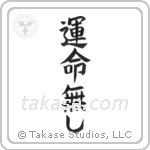
Sold as No Fate · Read unmei nashi, four graphs, a classical sentence · Register classical grammar; no Japanese tradition of the sentence that the sources can see; plain prose says 運命はない · Sense one: there is no fate.
The words
運命 is the power beyond a person's will that hands out good and ill fortune, and the fortune so handed out. It is a Chinese word, in Japanese since 1093, but the sense a buyer means is young: the national dictionary's own note says that in its first Japanese use the word meant lifespan, that in the Tale of the Heike it meant luck, which opens and declines, and that the modern sense, destiny, came when the word was joined to the Western doctrine of fate. The Meiji dictionaries date the change. Hepburn's dictionary of 1886 has no entry for the word at all, read by eye down the column where it would stand, and renders English fate with four other words, ten-un, tem-mei, un and yakusoku; Brinkley in 1896 admits it only as a synonym. Its kin each carry a history of their own: 天命, the decree of Heaven, which Confucius said he knew at fifty; 宿命, which was a Buddhist word about past lives until Meiji scholars re-read its characters as predestined fate in 1881; and the native 定め, whose one sense is fate and whose other is being fixed. 無し is the classical there is none. English fate is the inescapable and usually unhappy allotment, destiny the appointed and grander one; 運命 covers both, and No Fate is the plain rendering of the four graphs.
Where it comes from
At the source of the word the negation exists, and it is a question that expects the answer no. In a circular letter of the 560s the Chen minister Xu Ling quotes a Song emperor of the previous century: how could the world of men be without fate? Whenever a good post falls vacant, I think of Yang Xuanbao. That anecdote is the one the Japanese dictionaries cite for the word, and its point is that there is fate. The Analects say it without a question: death and life have their determined appointment; riches and honors depend upon Heaven. The oldest fate-sense of the word in Chinese is the title of a third-century essay, On Fate, named beside the Balanced Discourses in a treatise on literature around 500.
Japanese has a classical sentence with exactly this grammar and it means something else. Kenkō, around 1330, wrote if the dew of Adashino never vanished and the smoke of Toribeyama never cleared, and people lived on forever, where would the pathos of things be? It is precisely because nothing in this world is fixed that it moves us. The sentence a modern reader might take for there is no fate, 定めなし, is the medieval word for impermanence, and it is the one such sentence that the prewar archive returns in numbers, one hundred and eighty-five books, from Chikamatsu's lovers whose meetings in this world are not fixed to a Meiji dictionary that glosses fleeting with it. The sentence on this design, in kana, appears in five prewar books, and every one is either a translation or an argument: an 1895 translation of an American manual for young men says that beasts are not moral, so they lack character, so they also have no fate; they only eat, only sleep, only breed, only die; the critic Takayama Chogyū, in an essay on fate and tragedy, that fate is the marrow of tragedy, its life; no fate is no tragedy; a 1936 careers book, that no fate can match effort and patience. Plain prose of the same decades says 運命はない, with the topic particle, as in a 1922 translation of Maeterlinck: there is no fate of joy, there is no lucky star. In the exact form brushed here, with the kanji and the kana し, the archive returns nothing, and no dictionary carries the sentence as a headword.
The text in English
Legge gave the Analects' line as determined appointment in 1861, and Hepburn's fate, destiny determined by Heaven in 1886 is for 天運, not for this word. The sentence on the design has one famous English carrier: the 1991 film Terminator 2: Judgment Day, which its encyclopedia article says emphasizes the concept of free will and the value of human life, quoting the film's line "no fate but what we make". The Japanese article on the film has no sentence with 運命 in it, and a subtitle corpus renders a filmed There is no fate as 運命じゃなく. The house's No Fate is Timothy L. Jackowski's rendering for Takase Studios, and the Japanese under it is exact for the English. A rendering of this design must keep the statement form, there is no fate, and should tell the buyer that the Japanese is a rendering of the English, not a saying the Japanese have.
A reading
Signed 典, 2026-09-08. This sentence is the house's, not Japan's, and that is a fact to state rather than a fault to hide. Its grammar is classical and correct; its idea is the film's; and between them no source here shows a Japanese writer saying there is no fate except to argue with fate, as the critic and the careers book do. The two classical neighbors say the opposite: Kenkō's nothing is fixed is about impermanence, and the Chinese emperor asks whether there could be no fate in order to say there is. When Japanese did argue with fate it said that effort beats it, or that a person carves their own, which is the sentence this catalogue sells as 運命を制す. The design is legible and exact for the English, and a buyer who wants the film's line will get it. The page should say in one sentence whose sentence it is and should not present the four graphs as a proverb; it should also fix its word line, which at the moment prints the title of another design where 運命 should be. Two small questions, neither blocking: for Eri, whether 運命無し reads as a natural short sentence or as a foreigner's construction, and which spoken form she would give; for Tim, whether No Fate was made for the film's line, which this history assumes from the English.
How this was read
By eye: the template; three pages at the National Diet Library's image host, the critic's essay in the 1912 collected works, the 1936 careers book, the 1895 translation; Hepburn's 1886 column from the shelf PDF. By text: four dictionary pages at kotobank; the Analects and the two 運命 searches at the Chinese Text Project; the Book of Chen chapter at Chinese Wikisource; Kenkō's seventh section at Japanese Wikisource and at a modern edition, which differ on whether the word is in kana; the two Wikipedia articles on the film; Weblio and jisho. By OCR: the local harvest archive of 9,873 prewar books on ten forms; the Maeterlinck and the 1907 novel; Brinkley; the rhyme dictionary's quotation of the Book of Chen. Not opened: the Library's own index, which waits on Tim's run; the film's screenplay or any Japanese subtitle; the rhyme dictionary's entry by eye; the Book of Song biography the dictionaries cite; the third-century essay itself; Hepburn's earlier editions for this word. Every address is in the account, marked by eye, OCR or text.
References
- 論語 顏淵 5 (ctext) (Warring States) — ctext.org/analects/yan-yuan
- 論語 為政 4 · 季氏 8 (ctext) (Warring States) — ctext.org/analects/wei-zheng · ji-shi
- 墨子 大取 · 京氏易傳 歸妹 (ctext search) (pre-Qin · Han) — ctext.org/pre-qin-and-han?searchu=運命 (3 / 2)
- 文心雕龍 論說 · 三國志 孫皓傳 引 江表傳 (ctext search) (c. 500 · 3rd c.) — ctext.org/post-han?searchu=運命 (22 / 21, first two)
- 陳書 卷26 徐陵傳 (zh.wikisource) (560s, quoting 宋文帝) — zh.wikisource.org/wiki/陳書/卷26
- 中右記 (日国) (1093) — kotobank 運命-35734
- 平家物語 (日国) (13th c.) — kotobank 運命-35734
- 徒然草 第七段 (國文大觀; tsurezuregusa.com) (c. 1330) — ja.wikisource.org/wiki/徒然草_(國文大觀) · tsurezuregusa.com/007dan/
- 佩文韻府 卷93–102 (1885 print of 1711) — pid 895785 k606, opened, not readable by eye
- Hepburn, 3rd ed. (1886) — shelf PDF page 752 = p. 710 by eye; OCR 144341
- モキソム著・鹿州生訳 青年規箴 (1895) — pid 757513 k6, by eye
- Brinkley (1896) — OCR 237224
- 高山樗牛 運命と悲劇, 樗牛全集 (before 1902 (印 1912)) — pid 930959 k86 (p. 137), by eye
- 伊原敏郎 新朝顔日記 (1907) — pid 1086963 k82, OCR
- 鷲尾浩 訳 マーテルリンク全集 (1922) — pid 962811 k165, OCR
- 加藤直士 就職より立身へ (1936) — pid 1255440 k15 (pp. 12–13), by eye
- Terminator 2: Judgment Day (en.wikipedia) (1991) — en.wikipedia.org/wiki/Terminator_2:_Judgment_Day
- Weblio 英和 no fate · 和英 運命 · 英和 fate (current) — ejje.weblio.jp
- jisho / JMdict (current) — jisho.org/search/運命無し
- The local archive, ten forms (to 1949) — search_ndl_archive.py, local_archive_hits.jsonl