

友よ水になれ · 誰も信じるな · 長寿と繁栄を · 命は道を拓く · 吐く息一つにも生命が宿り · tomo yo mizu ni nare · dare mo shinjiru na · chōju to han'ei wo · inochi wa michi wo hiraku · hakuiki hitotsu ni mo seimei ga yadori · Be water, my friend · Trust no one · Live long and prosper · Life finds a way · Life in every breath
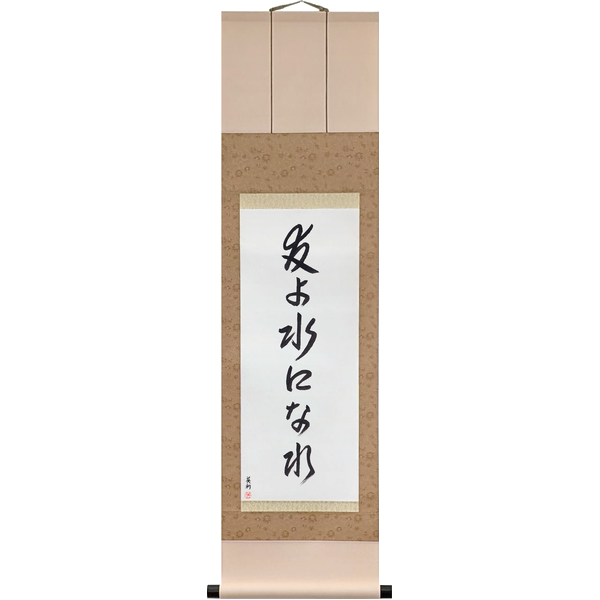
Sold as Be Water My Friend · Trust No One · Live Long and Prosper · Life Will Find a Way · Life in Every Breath · Read as above · Register spoken Japanese: two imperatives, a prohibition, a wish with its verb withheld, a statement, and a line of speech left open on its continuative · Oldest witness each in its film or series: Bruce Lee's lines written for Longstreet (1971) and shown in a 2000 documentary; The X-Files' end caption (1994); Star Trek, Amok Time (1967); Jurassic Park (1993); The Last Samurai (2003); in Japanese, 長寿と繁栄 as a plain wish in a 1915 health manual, and nothing for the other four before 1946 · Sense five things a character said that people now want on a wall.
The sense: whose Japanese
Five scrolls carry English lines from the screen, and the reading sorted them by whose Japanese they wear. 長寿と繁栄を, live long and prosper, is the Japanese encyclopedia's own rendering of the Vulcan blessing and, the account supposes, the dub's; it is also a wish a Japanese well-wisher could have made in 1915, and one did. 命は道を拓く, life finds a way, is the house's, and a better verb than the fan rendering a Japanese viewer may know; 誰も信じるな, 友よ水になれ and 吐く息一つにも生命が宿り are the house's Japanese for lines with no Japanese page behind them. The pages already explain the grammar of each well, and the history's work is to say where each line was spoken and which Japanese a buyer is getting.
The words
The words are ordinary and the pages gloss them rightly. 水になれ is the imperative of なる, become; 友よ is the vocative, put first where English puts my friend last. 誰も with a negative is no one, and な is the prohibitive, so that without it the sentence would say trust everyone, as the page notes. 長寿 chōju, long life, and 繁栄 han'ei, prosperity, end on を with the verb of wishing unsaid, which is how Japanese blesses. 命 inochi is life in a body; 生命 seimei is life as a phenomenon, the word the fan rendering used; 拓く hiraku is the land-clearing spelling of 開く, which the dictionary gives under the sense 未開拓の場所・土地などに手を入れて利用できるようにする, to break ground, beside 後進に道を開く, to open a way for those who follow. 吐く息 is breath breathed out; 宿り is the continuative of 宿る, to dwell, which leaves the sentence open, as a line of speech is. [kotobank.jp/word/開く-601707, text; read by the investigator]
The English and the Japanese overlap fully in sense; the differences are of address and mood. Japanese puts the vocative first and the verb last; it withholds the verb of a wish; it makes finds a way into opens a way, which is stronger and, for what Malcolm meant, truer.
A history, from the earliest witness
1915, then 1967. 長寿と繁栄を. The Vulcan salute and its spoken blessing first appeared in the Star Trek episode Amok Time in 1967, the gesture Leonard Nimoy's and the words scripted by Theodore Sturgeon. The Japanese encyclopedia's article on Vulcans gives the greeting as 「長寿と繁栄を」 beside the English, and does not say whether that is the dub's, a subtitler's or its own. The pairing was a Japanese wish before it was a Vulcan one: a 1915 guide to natural cures promises the reader who lives by nature 健康と長壽と繁榮とを保ち得るのである, can keep health, long life and prosperity, the only prewar page with the two nouns together, and it shows the rendering is good because it was already Japanese. [en.wikipedia.org/wiki/Vulcan_salute · ja.wikipedia.org/wiki/バルカン人, text; 井上正賀『万病自然療法』大学館 1915, NDL pid 935045, koma 161, OCR with run-in furigana]
1971 and 2000. Be water, my friend. Wikiquote gives the passage whole, from empty your mind to be water, my friend, and sources it to the 2000 documentary Bruce Lee: A Warrior's Journey, with the note that Lee was reciting lines he had written for his role in the television series Longstreet in 1971. So the sentence is scripted, Lee's own, and first spoken on television; the tradition's 1971 interview is that. The Japanese is in no book and not in the Japanese encyclopedia's long article on Lee; it is the house's, and a good short one: the vocative first, the imperative last. [en.wikiquote.org/wiki/Bruce_Lee, text; ja.wikipedia.org/wiki/ブルース・リー, text; labsearch 友よ水になれ, 0 hits]
1993 and 1994. Life finds a way and Trust no one. Ian Malcolm's line in Jurassic Park is, in David Koepp's final-draft screenplay, I'm simply saying that life - - finds a way, his answer to whether an all-female population could breed; the page's will is the tattoo's smoothing. A fan quotations site gives the scene in Japanese with the line as 生命は道を探す, life searches for a way, which is one rendering a Japanese viewer may carry; the house's 命は道を拓く, life breaks a way open, is its own and the better Japanese for a wall, and 道を拓く is an ordinary idiom in seven hundred prewar books. Trust no one is one of the captions The X-Files substituted for its usual The truth is out there at the end of certain episodes, first in The Erlenmeyer Flask (1994); the series' pilot aired 10 September 1993 and Japanese broadcast began 22 November 1995. The Japanese encyclopedia gives the regular caption's Japanese, 真実はそこにある, and none for this one; 誰も信じるな is the house's. [controlroom.jurassicoutpost.com/app/uploads/2016/05/JurassicPark-Final.pdf, the Koepp screenplay, text; eiga-square.jp/title/jurassicpark/quotes/6, text; en.wikipedia.org/wiki/The_X-Files · /wiki/Pilot_(The_X-Files) · ja.wikipedia.org/wiki/Xファイル, text; labsearch 道を拓く 700 · 誰も信じるな 0]
2003. Life in every breath. The line is Katsumoto's, in the cherry garden the morning after the night attack, and the transcript gives the speech whole: Like these blossoms, we are all dying. To know life in every breath, every cup of tea, every life we take. The way of the warrior. Life in every breath. That is Bushido. The page calls the scroll a direct quote; the English is, and the Japanese, 吐く息一つにも生命が宿り, in even one breath breathed out, life dwells, is the house's or a subtitler's, since neither the Japanese subtitle nor the dub was opened, and no book has it. Its two halves are ordinary Japanese, and the continuative 宿り leaves it open as Katsumoto's sentence is. [springfieldspringfield.co.uk/movie_script.php?movie=last-samurai-the, the film's dialogue as transcribed, text; labsearch 息一つにも 1, unrelated · 生命が宿り 31]
What is not a source
None of the five has a Japanese source. 長寿と繁栄を has a Japanese life of its own, older than the show, which is why it fits; the other four are English lines put into Japanese by the house, and the pages should say so. The 1915 health manual is not a witness for Star Trek; it is a witness that Japanese wished the same wish.
The phrases in English
The English titles are the lines themselves, with two smoothings the pages already show: Life Will Find a Way for life finds a way, and Be Water My Friend without its comma. What a rendering must keep: the vocative and the imperative in Lee's line; the prohibitive な, without which the X-Files caption inverts; the withheld verb of the Vulcan wish; 拓く rather than 探す if the buyer means what Malcolm meant; and, for Katsumoto's line, the open ending, since it is the middle of a speech. The house's romaji on the pages carries the macrons of the seat's standard; the catalogue's chouju is the wapuro form and shinjiruna runs two words together.
A reading
Five scrolls from the screen, and only one of them wears Japanese that was Japanese before the screen: 長寿と繁栄を, which a health writer wished his readers in 1915 and which the encyclopedia now gives as the Vulcan blessing. That is the best kind of translation and the page can say so. The other four are the house's Japanese for English lines, and honest about it; the reading's one preference is for the house's 拓く over the fan site's 探す, because life in Malcolm's sentence does not look for a way, it makes one. Katsumoto's speech is worth quoting whole on its page, since the scroll's five words are the middle of it. Signed, the philologist, 2026-09-06.
Notes
- The Last Samurai line was unverified in the s32 account; it is settled at a transcript s49 as Katsumoto's, in English, in the cherry-garden scene. The Japanese subtitle remains unread.
- Who first wrote 長寿と繁栄を for the Vulcans is not settled; the encyclopedia gives it uncredited.
- Romaji. chōju to han'ei wo, dare mo shinjiru na (three words) under the seat's standard.
How this was read
A bracket that names a National Diet Library leaf as pid and koma resolves at lab.ndl.go.jp/dl/api/page/<pid>_<koma> for the OCR text and at dl.ndl.go.jp/api/iiif/<pid>/R<koma, seven digits>/full/2400,/0/default.jpg for the image. By OCR, own-hand at the page API: the 1915 health manual. By the Lab's full-text search, own-hand: the six counts in the brackets. By text: Wikiquote's Bruce Lee page; the English and Japanese Wikipedia articles on The X-Files, its pilot, the Vulcan salute and Vulcans; the Koepp screenplay at a mirror; the fan quotations page; the Last Samurai transcript; the kotobank entry for 開く, read by the investigator s32. Not opened: the Longstreet episode or the 2000 documentary at a dated source; a Japanese dub or subtitle of any of the five; the Amok Time script; the 1915 leaf by eye; the 700 pages with 道を拓く beyond the oldest snippet.
References
Each witness is cited in the account above, at the frame or entry where it was read. A linked list follows when the record for this text is completed.