

適者生存 · tekisha seizon · Survival of the Fittest
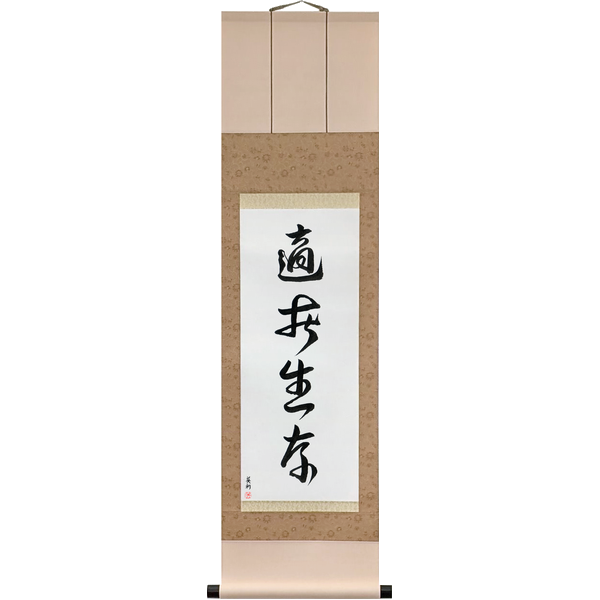
Sold as Survival of the Fittest · Read tekisha seizon · Coined by Herbert Spencer in 1864; adopted by Darwin in 1869 as more accurate than natural selection · In Japanese first as 適種生存, the fit species, in 1881; as 適者生存, the fit one, in 1883 · Went on into Chinese by 1902.
The words
適者 is the one that fits: 適 means suited to, and nothing in it means strong. 生存 is to stay alive. Together, in the dictionary's words, in the struggle for existence, only what is best suited to its surroundings survives and leaves descendants. Every word in the phrase's family is Meiji: 生存競争 (the struggle for existence), 自然淘汰 (natural selection) and 優勝劣敗 (the superior win, the inferior lose) were all made between about 1879 and 1882, in the same rooms.
A history, from the earliest witness
1864 and 1869. Spencer's phrase, Darwin's adoption. Spencer wrote it in The Principles of Biology, in a chapter that tried to restate Darwin in mechanical terms: those will survive whose functions happen to be most nearly in equilibrium with the modified aggregate of external forces. But this survival of the fittest implies multiplication of the fittest. His own footnote, added later, says the expression was here used for the first time, and that Wallace wrote to Darwin in 1866 urging him to adopt it. Darwin did, from the fifth edition of the Origin in 1869: the expression often used by Mr. Herbert Spencer, of the Survival of the Fittest, is more accurate, and is sometimes equally convenient, and he retitled his chapter Natural Selection; or the Survival of the Fittest. The catalogue calls the phrase Darwin's famous quote. It is Spencer's, which Darwin borrowed and said so.
1881. The fit species. The first Japanese rendering is in the philosophical vocabulary compiled at Tokyo University in 1881: Survival of the fittest, 適種生存, tagged as biology. The second character is species: the fit species survive. The 1884 second edition keeps it. [哲学字彙 1881, pid 752942 koma 47, read by eye]
1883. The fit one. The zoologist Ishikawa Chiyomatsu had heard Edward S. Morse lecture on Darwin at Tokyo University in 1877–79. In 1883 he published the lectures, and opened them: since Darwin's book on the origin of species came out it has swept the world, and those who study the principles of the struggle for existence and the survival of the fittest come one on the heels of another, in Europe and America and among our own scholars too. This is the word as the scroll has it, and the oldest book that carries it. One character changed: the fit one, not the fit species. [動物進化論 1883, pid 832826 koma 2, by eye]
1884. Spencer himself, in Japanese. A translation of Spencer's Political Institutions, with a preface by Fukuzawa, has the sentence and the word on one page: organisms of one kind compete with each other, the fit survive and the unfit perish … if the great way of the survival of the fittest and the struggle for existence were not in this universe, no living power would develop at all. Later in the book the word does Spencer's social work: by the principle of survival of the fittest, only the races suited to despotism will survive under it. The book that made the phrase's three sisters household words, Katō Hiroyuki's 人権新説 of 1882, does not use this one at all. [政法哲学, dated 明治17年10月 on its title page, pid 783387 koma 19, by eye]
1886–1906. The spread, and the rival. By 1886 a professor was explaining why old plays survive by the principle of survival of the fittest; by 1888 a satirist applied it to temperance societies. From 1891 a rival form appears, 最適者生存, with the superlative, the fittest, and both Meiji translations of the Origin, in 1896 and 1905, use it for Darwin's own sentence. The Library's count settles which form the language kept: 2,739 books for the scroll's form, 35 for the superlative. The word's curve runs from fourteen books in the 1880s to a peak of 734 in the 1920s, and three times as many of them are in the social sciences as in the natural.
1898–1924. China, from Japan. Yan Fu's Chinese version of Huxley in 1898, the book that carried evolution to a generation of Chinese readers, does not use the four characters: its phrase is things compete, heaven selects, and its fit are the most suitable. The four-character word appears in Chinese in 1902, in an essay Liang Qichao wrote in exile in Japan; a Tokyo Japanese-Chinese dictionary defines it for Chinese students in 1908; by 1924 it is Sun Yat-sen's, asking whether the Chinese are the fit or the unfit. The word was made in Japan and went west.
The sense across time
The word has meant one thing in every use: the surroundings decide who lives. What moved was the size of the thing that fits. A species in 1881; an individual in 1883; a race in 1884, in Spencer's own Japanese; a nation by 1924, in Chinese. Darwin's reason for adopting it, that it says less than selection, with its hint of a selector, is the reason it has been so easy to carry from biology into everything else. The dictionaries also record the standing objection, that the fit survive and the survivors are the fit is a circle, and the standard answer, that this is a matter of wording.
What is not a source
Not Darwin's coinage: Spencer's, in 1864, which Darwin adopted five years later. Not the strong survive: 適 is suited, and the phrase is not 弱肉強食, the strong eat the weak. Not Chinese: the four-character form went from Japan into Chinese, not the other way. Not 加藤弘之's: the father of Japanese social Darwinism used the phrase's sisters and not this one.
The text in English
The Japanese word glossed back into English in the Meiji dictionaries: Tekisha-seizon 適者生存 n. Survival of the fittest in a Japanese-English dictionary of 1909, the earliest such entry on the shelf; a 1909 idiom dictionary still gives both Japanese forms, the fit one and the fit species; a 1918 English-Japanese dictionary pairs it with Katō's word, 適者生存、優勝劣敗; a 1925 dictionary of words born from English spells it out in katakana. The catalogue's English is right. Its attribution is the one thing on the page to fix.
A reading
Sell it as Spencer's phrase in Ishikawa's Japanese. The page should say in one sentence that Spencer coined it and Darwin borrowed it, and then tell the Japanese story, which is the better one: a vocabulary that made the fit a species, a zoologist who made it a person from lectures he had sat through, a superlative rival that the Darwin translators preferred and lost, and a word that went on to China. A buyer should also hear that 適 is suited, not strongest. The scroll brushes the form that won, and is right to. 典, 2026-09-07.
How this was read
By eye: the template file; the 1881 vocabulary, the 1883 lectures and the 1884 Spencer at the scan. By text at the address: the National Diet Library's full-text index on the word pulled whole and classed by decade and subject, and on its four sisters and its rival; page-level hits in seven early books; the local harvest of that library for the dictionaries; eleven kotobank entries; Spencer's chapter and Darwin's chapter at the text; the Chinese side by search. Not read: the 1886–1906 books at the scan; Spencer's 1864 first edition and Darwin's 1869 fifth at their pages; Yan Fu whole; the dictionaries at the scan. Every address is in the account.
References
Each witness is cited in the account above, at the frame or entry where it was read. A linked list follows when the record for this text is completed.