

松涛館空手道 · 剛柔流空手道 · 一心流空手道 · 国際和道流 · 日本空手協会 · 沖縄剛柔流 · 糸東流空手道 · 少林流空手道 · 和道流空手道 · 木村修交会空手道 · 井上派糸東流慶心会 · eleven karate school names
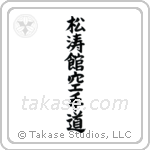
Sold as Shotokan Karate-Do · Goju-ryu Karate-do · Isshinryu Karate-Do · International Wadoryu · Japan Karate Association · Okinawa Goju-Ryu · Shito-Ryu Karate-Do · Shorin-Ryu Karate-Do · Wadoryu Karate-Do · Kimura Shukokai Karate-Do · Inoue-Ha Shitoryu Keishin-Kai · Read shōtōkan karatedō · gōjūryū karatedō · isshinryū karatedō · kokusai wadōryū · nihon karate kyōkai · okinawa gōjūryū · shitōryū karatedō · shōrinryū karatedō · wadōryū karatedō · kimura shūkōkai karatedō · inoueha shitōryū keishinkai · Oldest witness the two-school division every style descends from, 昭靈流 and 昭林流, in Funakoshi's own first book, 1922; the first style name to reach a public-domain Japanese book, 剛柔流, in an Okinawan history of 1941 · Sense proper names, each chosen by a founder between 1931 and 2004, and two of them the house's own Japanese for an English name.
The sense: eleven names, three kinds
These are not sayings. They are the names karate students wear on their backs and hang in their dōjō, and a buyer who wants one wants it spelled the way the school spells it. Karate had no named styles before the 1930s. When Funakoshi Gichin brought the art from Okinawa to Tokyo in 1922 he wrote that the many lineages are in fact no more than two schools, 昭靈流 and 昭林流, told apart by the build of the body each suited; two years later he spelled the second 少林流, the Shaolin school, and that spelling is on the eighth design here. The named styles came one after another as the art settled on the mainland and sought a place beside judo and kendo: 剛柔流 in 1931, 小林流 in 1933, 糸東流 in 1934, 和道流 registered in 1938; 松濤館流 was never a name its founder used, and the school took it from his dōjō after his death. 一心流 is Okinawan and postwar, named in 1956. The other four are not styles but bodies: the Japan Karate Association of 1948, and three organizations of the last half-century whose names the Japanese library does not carry at all. Two of those, 国際和道流 and 木村修交会, appear in no Japanese source in the exact form the designs write them; they are the house's rendering, character by character, of an English organization's name, made for its members. The one unattested string that a Japanese newspaper does write is 井上派糸東流慶心会, a Tottori school founded in 2004. Each name below has its own short history; together they are a history of how a bare-handed Okinawan art acquired the Japanese habit of naming schools.
The words
流 ryū, a current, and since the medieval arts a school or lineage of an art; 派 ha, a branch of one; 会 kai, an association; 館 kan, a hall. The four kinds of name in this family are these four words. The Japanese encyclopedia notes that the -ryū habit is Japanese, not Chinese, where a boxing style is a -quan (拳); the Okinawan art acquired its styles when it acquired a Japanese audience. [ja.wikipedia.org/wiki/空手道 § 流派, text]
空手道 karatedō, the word on eight of the eleven designs, is itself a mainland spelling. Okinawa wrote 唐手, Chinese hand, and read it tōde or karate; the naval officer who prefaced Funakoshi's 1922 book already wrote 空手術, the art of the empty hand, and Funakoshi's Keiō students adopted 空手 in 1929 from the Heart Sutra's 空, with 道 added on the model of 柔道 and 剣道; an Okinawan masters' conference at Naha voted to follow in 1936 [pid 971654 koma 13, by eye; ja.wikipedia.org/wiki/空手道 § 空手の表記, text; kotobank 日本大百科全書, text]. Before any of this, 空手 was an ordinary Japanese word for empty-handed, cited from 1586. [精選版日本国語大辞典 at kotobank, text]
松濤 shōtō, pine waves, the sound of wind in pines, was Funakoshi's pen name; 松濤館 was his dōjō. 濤 is the old form and 涛 the new; the design writes 涛, and the encyclopedia gives 松涛館流 as the style's new-form spelling [the template image, by eye; ja.wikipedia.org/wiki/松濤館流, text]. 剛柔 gōjū, hard and soft, is the pair Miyagi Chōjun took, the tradition says, from a line of the 拳之大要八句, the eight maxims of boxing, in the 武備志 that Okinawan karate hands down, a Fujian manual and not the Ming military encyclopedia of the same name: 法剛柔呑吐, the method is hard and soft, swallowing and spitting; the encyclopedia marks the story citation needed [ja.wikipedia.org/wiki/剛柔流, text; the 武備志 not opened]. 糸東 shitō is the first character of each of Mabuni Kenwa's two teachers, 糸洲安恒 and 東恩納寛量 [ja.wikipedia.org/wiki/糸東流, text]. 和道 wadō, the way of harmony, is Ōtsuka Hironori's, first as 神州和道流 [ja.wikipedia.org/wiki/大塚博紀, text]. 少林 · 小林 · 松林 are three spellings of one reading, shōrin, the Japanese name of the Shaolin temple; 小林流 is also read kobayashi-ryū to tell it from the others [ja.wikipedia.org/wiki/小林流_(空手道), text]. 一心 isshin, one heart, wholehearted [en.wikipedia.org/wiki/Isshin-ryū, text]. 修交会 shūkōkai: 修 to train, 交 to meet or cross, 会 an association; the school's own English is the way for all [en.wikipedia.org/wiki/Shūkōkai, text]. 慶心会 keishinkai takes its 慶 from its founder's given name, 慶身 Yoshimi [inoue-ha-kenshinsya.wixsite.com/home/about, text]. 国際 kokusai, international; 協会 kyōkai, association; 沖縄 Okinawa.
A history, from the earliest witness
1922. Funakoshi's first book. Funakoshi, then writing his name 富名腰義珍, published 『唐手 琉球拳法』 in Tokyo in November 1922, the first book on the art. Its chapter What is karate ends with a section headed 二 流儀, the schools:
後世師範者の名に依つて種々の流儀に別れてはゐるが、其實昭靈流と昭林流の二派に過ぎないのである。昭靈流は體質肥滿骨格偉大なる者に適し、昭林流は之に反し、骨格倭小體力貧弱にして楊柳の如く瘠… Later generations divided it into various schools under the names of their masters, but in fact it is no more than two: the Shōrei school and the Shōrin school. Shōrei suits the heavy-set and large-boned; Shōrin the opposite, the small-boned and slight, willow-thin… — 富名腰義珍『唐手 琉球拳法』武侠社 1922, 唐手とは何ぞや, printed pp. 4–5 [NDL pid 971654, koma 30, by eye; the same koma names the Chinese teachers of each school and their Okinawan pupils]
The preface to the same book, by the naval captain 漢那憲和, opens 琉球に空手術なるものあるを聞くや久し, I had long heard that Ryūkyū has an art called karate-jutsu, with 空手 spelled with the empty character seven years before Funakoshi's students made that spelling the standard. [pid 971654, koma 13, by eye]
1924. Funakoshi writes 少林流. Tokyo City's Materials for citizens' physical education carries a piece by 富名腰義珍, 琉球拳法唐手, with an appendix What is karate. Under 流儀, schools:
大別して少林流、昭靈流の二派とす。顧ふに少林流のは少林寺流の略にて昭靈流は昭靈寺流の略ならんかと疑はる、サモなくは、後人技巧の上より靈肉一致と云ふ意味から名命した名前ではなからうか。後世師匠の名を採りて、色々の流儀があるやうだが、元々この二流に過ぎない Broadly there are two schools, Shōrin and Shōrei. I suspect Shōrin is short for the Shaolin-temple school and Shōrei for a Shōrei-temple school; if not, later men may have named them for the union of spirit and flesh their technique aims at. There seem to be various schools that took their masters' names, but originally there are only these two. — 東京市編『市民体育資料』1924, 附録 唐手とは何ぞや, printed pp. 126–127 [NDL pid 1915291, koma 63, by eye]
The spelling has moved in two years from 昭林 to 少林, the Shaolin temple's own characters, and the eighth design here, 少林流空手道, writes it Funakoshi's 1924 way. The same appendix traces the art's distant source to the Shaolin temple and to Zen; that is the tradition, and this history names it as one in the section below.
1926. 唐手 and 空手 are one word. Motobu Chōki's manual on sparring opens 琉球の拳法、唐手卽ち空手とは如何なるものか, what is the Ryūkyūan boxing called tōde, that is, karate? [本部朝基『沖縄拳法唐手術 組手編』唐手術普及会 1926, NDL pid 922034, koma 6, OCR]. A popular sporting novel of the same year puts Motobu himself into a boxing ring as a walk-in, has a judoka in the wings cry 唐手!, and names his stance as 唐手に於ける少林流、ピンアン四段, the Shōrin school of karate, Pinan fourth level; the same page calls Funakoshi 沖繩縣尙武會長 and a master of the art. The two-school vocabulary had reached fiction. [鳴弦楼主人『名人達人決死の大試合』大日本雄弁会 1926, chapter 琉球特有の武技唐手, printed p. 156, NDL pid 1018991, koma 87, OCR; koma derived from the OCR zip s49, the Lab's scan 152 being its own page count]
1930–1934. The styles are named. The Japanese encyclopedia's account, which this history reports and did not confirm at a primary, runs: in November 1930 Miyagi Chōjun's senior pupil, asked at a Tokyo demonstration what his school was called, could not answer, and Miyagi named it 剛柔流拳法; the name is first in print in Miyagi's own 『剛柔流拳法』 of 1931. At the same demonstration Funakoshi, who professed 無流派主義, no school, entered his students under the improvised name 昭霊流少林派. Chibana Chōshin named his 小林流 in 1933; Mabuni Kenwa opened the 養秀館 in Osaka in 1934 and named his school 糸東流, having called it 摩文仁流 in 1931, and the advertisements in his 1934 books still style him 剛柔流拳法師範 [ja.wikipedia.org/wiki/宮城長順 · /wiki/松濤館流 · /wiki/小林流_(空手道) · /wiki/摩文仁賢和, text]. What the public-domain library holds from these years is the Imperial Library's accession list of 1935, which enters Mabuni's 空手拳法十八の研究, the second of the 空手研究叢書, with the secret book 武備誌 appended, under 兵事 [『帝国図書館報』第27冊第10号 1935, NDL pid 1939585, koma 13, printed p. 23, by eye and OCR; Funakoshi's 『空手道教範』 of the same year is not on that leaf, and the Library's full-text hits for its title are the 1958 reprint's catalogue entries]; the books themselves are not open online.
1932. An Okinawan guide. Shimabukuro Gen'ichirō's 『沖縄案内』, in its chapter on customs, under 流儀:
唐手は大別して明靈流と少林流の二派に分れるが前者は體質肥滿、骨格偉大な人に適し、基本姿勢は可なるも、敏活を缺くの嫌あり後者は體軀倭少、瘠せ形の人に適し機敏なるに反し、基本姿勢に缺陷がある。 Karate divides broadly into two schools, Meirei and Shōrin; the former suits the heavy and large-boned, sound in stance but wanting quickness, the latter the small and slight, quick but defective in stance. — 島袋源一郎『沖縄案内』1932, 第十五章 風俗, printed p. 328 [NDL pid 1170658, koma 225, by eye; the running head reads 新版沖縄案内, the catalogue 沖縄案内 1932; the 1937 edition, pid 1908935, repeats it, OCR]
明靈流 is Funakoshi's 昭靈流 under another first character; the sentence is his 1922 sentence rewritten, and it shows how far the two-school picture still governed Okinawan writing as the mainland styles were being named.
1938–1939. 和道流 and 松濤館. Ōtsuka Hironori, a jūjutsu man who had been Funakoshi's earliest Tokyo pupil, registered his school with the 大日本武徳会 in 1938 as 神州和道流空手術 and shortened the name to 和道流 the next year, the encyclopedia says; the federation that carries his name says the style was founded in 1934 and that the name was first used on joining the 日本古武道振興会, which it dates to 昭和4年, 1929, though that society was founded in 1935. The sources disagree by a decade and this history holds them side by side [ja.wikipedia.org/wiki/大塚博紀 · /wiki/和道流, text; wado-ryu.jp/histor/, text; ja.wikipedia.org/wiki/日本古武道振興会, text]. In 1939 Funakoshi's students built him a dōjō in Zōshigaya, Tokyo, and named it 松濤館 after his pen name; he never called his karate 松濤館流, and the name is what other bodies came to call his lineage after the war. [ja.wikipedia.org/wiki/松濤館流, text]
1941. The first style name in a public-domain book, and the pen name in print. Shimabukuro's 『琉球百話』, in a chapter he wrote to correct his 1932 account, is the earliest book the National Diet Library serves in which 剛柔流 names a karate school:
空手も首里流と那覇流とは、多少趣きが違つてゐたといはれてゐるが、此の東恩納先生の高弟が今本縣に於ける權威者たる剛柔流の宮城長順氏であり糸洲先生の流を承けた人々も首里に多い。 Karate too, it is said, differed somewhat between the Shuri and Naha schools; the senior pupil of this Master Higaonna is Mr. Miyagi Chōjun of the Gōjū-ryū, the authority in this prefecture today, and those who received Master Itosu's school are many in Shuri. — 島袋源一郎『琉球百話』沖縄書籍 1941, 五三 空手道の起原と其の沿革, printed pp. 147–148 [NDL pid 1052000, komas 91–92, by eye; the OCR reads 權成者 for the leaf's 權威者]
The same page credits the art's spread to the universities to 松濤富名腰義珍先生を始とし、本部朝基、摩文仁賢和等諸先生, Master Shōtō Funakoshi Gichin first, and Masters Motobu Chōki, Mabuni Kenwa and the rest: the pen name 松濤, in print, in its bearer's lifetime, as his title [koma 92, by eye]. Of the nineteen spellings searched across the Library's public-domain books, this is the only one of 16 books with 剛柔流 that means karate; the others are Confucian and Ōmoto cosmology. 糸東流, 松濤館流 and 松涛館流 return nothing to 1945, and 和道流 two unrelated hits. [labsearch_karate.txt, the Lab full-text API]
1948–1956. The bodies and the last style. The 日本空手協会 was founded in Tokyo in November 1948 with Funakoshi as 最高師範, the association's own history says; the encyclopedia's life of Funakoshi dates the founding meeting to May 1949, with 西郷吉之助 as president. It became a 社団法人 in 1957, the first karate body to do so, and a 公益社団法人 in 2012; its style is 松濤館流, and a note in its 1956 monthly asked members not to use that name, since 松濤 was Funakoshi's pen name and he had named no school [jka.or.jp/about-jka/history/, text; ja.wikipedia.org/wiki/日本空手協会 · /wiki/船越義珍 · /wiki/松濤館流, text]. On Okinawa, Shimabukuro Tatsuo, a pupil of Kyan Chōtoku and Miyagi, announced on 15 January 1956 that his synthesis of Shōrin, Gōjū and weapons would be called 一心流; the U.S. Marines stationed on the island carried it home, which is why the third design here sells [en.wikipedia.org/wiki/Isshin-ryū · /wiki/Tatsuo_Shimabuku; ja.wikipedia.org/wiki/島袋龍夫, text]. In 1964 the 全日本空手道連盟 was formed around the bodies of the four mainland styles, and 四大流派, the four great styles, has been the phrase since. [ja.wikipedia.org/wiki/空手道, text]
1946–1995. 修交会 and Kimura. Tani Chōjirō (1921–1998), a Kobe pupil of Mabuni, received his teacher's certificate in 1946 and hung a carved sign reading 修交会 over the dōjō at his house; the style is 谷派糸東流. His senior pupil Kimura Shigeru (1941–1995) left for Africa in 1965, taught in England, and settled in the United States in 1970; the power-centered Shūkōkai he taught came to be called Kimura Shukokai, and after his death his four senior students formed Kimura Shukokai International to carry it [en.wikipedia.org/wiki/Shūkōkai, text; shuriway.com/kimura.html, text]. The Japanese encyclopedia's list of karate bodies has one 修交会, the 糸東流修交会空手道連合; no Japanese source found writes 木村修交会. [ja.wikipedia.org/wiki/空手道会派・団体一覧, text; a web search for the exact string, 2026-09-06]
1990–1991. The Wadō International Karate-Do Federation. Suzuki Tatsuo (1928–2011), a direct pupil of Ōtsuka who had taught in London since 1965, founded the Wado International Karate-Do Federation to preserve the style as his teacher had taught it: in 1990 by the federation's own account, in 1991 by the encyclopedia's. Its Japanese name, in the federation's own romanization, is Wado Kokusai Karate-Do Renmei, 和道国際空手道連盟, with Wadō first; the design's 国際和道流, international Wadō-ryū, keeps the English order and is not the federation's name. [wikf.com/about_wikf.php, text; en.wikipedia.org/wiki/Tatsuo_Suzuki_(martial_artist), text; a web search for the exact string 国際和道流, 2026-09-06, finds no organization of that name]
2004. 井上派糸東流慶心会. Inoue Yoshimi 井上慶身 (1946–2015), a Tottori man who trained under Hayashi Teruo of the 林派糸東流 and coached Japan's national kata team, founded the Inoue-ha Shitō-ryū Keishin-kai with its headquarters dōjō in Tottori in 2004; one biography says 2005, a year after Hayashi's death. The name is in the Japanese press today. [inoue-ha-kenshinsya.wixsite.com/home/about, text; karatephilosophy.com, text; nnn.co.jp/articles/-/51875 (日本海新聞, 2023-05-28), text]
The designs. All eleven are brushed as the catalogue writes them, with one exception: the sixth design reads 沖縄剛柔流, and the catalogue's 龍 is a typo in the data, not on the paper; the first reads 松涛館 with the new-form 涛. [the design images, M1012SSVB5A · M1110OB6A · M1114OB7A · M1129OB8A · M1100VB4A · M1127OB8A, by eye]
What is not a source
The Shaolin temple is the tradition's origin, not a documented one. Funakoshi in 1924 traces the distant source of boxing to Shaolin and to Zen and reads 少林流 as short for the Shaolin-temple school; the Japanese encyclopedia notes that neither 昭林 nor 昭霊 is a school known in China, and that Itosu's two-school account has no Chinese confirmation [pid 1915291, koma 63, by eye; ja.wikipedia.org/wiki/空手道, text]. The 武備志 line behind 剛柔 is the tradition's, told of Miyagi and marked unsourced by the encyclopedia, and was not opened here; the 武備志 Mabuni appended to his 1934 book is that Okinawan manual, not the Ming encyclopedia. And the 松濤舘 that an eighteenth-century Edo poet built beside Engakuji in Kamakura, recorded in the Sagami gazetteer, is a homonym: Funakoshi took his pen name from the pines, not from the poet, though his memorial stone now stands in the same temple's grounds. [pid 763967, koma 139, by eye; ja.wikipedia.org/wiki/船越義珍, text; see Notes]
The names in English
The Meiji bilingual dictionaries have none of these words; they are proper names, and the English world learned them as romaji. The Occupation-era Marines who trained on Okinawa brought Isshinryu and Goju-Ryu home as sounds, and the mainland federations wrote Shotokan, Shito-Ryu and Wado-Ryu without macrons on their own English sites, which is why the house's English titles keep those forms [wikf.com; jka.or.jp; en.wikipedia.org/wiki/Isshin-ryū, text]. The house's titles are transliterations, Timothy L. Jackowski's, made for Takase Studios, and the one English word among them, International, is the design's own. Today's page romaji already carries the macrons of the seat's standard (shōtōkan, gōjūryū, kyōkai). A rendering of any of these must keep 流 as -ryū, the school's own spelling of its name, and for the two English-born names must not be mistaken for the organization's own Japanese.
A reading
Eleven names, and the reading is short: a school's name is right when it is the school's, and ten of these are. The two-school tradition Funakoshi wrote down in 1922 is the ground the whole family stands on, and it is a pleasure to find that the design that writes 少林流 writes it exactly as he did two years later, before any of the named styles existed. 剛柔流, 糸東流, 和道流 and 松濤館流 are the four the mainland calls great, and their dates, 1931, 1934, 1938, and the postwar naming of the fourth, are the encyclopedia's; the library the seat can open holds the words only from 1941, in an Okinawan schoolmaster's history, which is also the first place I found 松濤 printed as Funakoshi's title. The two names the library does not hold at all, 国際和道流 and 木村修交会, are what a bilingual calligrapher does for a student whose federation has an English name: she writes what it means, and the design says so on its face by carrying 国際 and 木村 where a Japanese body would put them differently or not at all. That is not a defect; it is the house's Japanese, and a buyer should know it is. Signed, the philologist, 2026-09-06.
Notes
- The 529 catalogue string. The catalogue and the live page write 沖縄剛柔龍, dragon, for the brushed 沖縄剛柔流, school; the two characters share the reading ryū. The typo is in the data row, not in the art. Filed to 礎 2026-09-06 (s47).
- 松涛 and 松濤. The design writes the new form; the encyclopedia heads its article 松濤館流 and gives 松涛館流 as the 新字体. Both are the one word.
- The Kamakura 松濤舘. The Sagami gazetteer, compiled 1841 and printed 1888, gives the life of the blind Edo poet 高野蘭亭 (1704–1757): the monks of Kenchōji and Engakuji built him a hut beside Engakuji's hill, 名以五勝曰松濤舘, named for its five beauties, called Shōtōkan, with a 蕉鹿園, a 漱玉橋 and a 灌花井 [『新編相模国風土記稿』第1輯, 鳥跡蟹行社 1888, NDL pid 763967, komas 138–139, printed pp. 56–57, by eye; the poet's name and 號 on koma 138, the hut on 139]. The 250 Lab hits for 松濤館 to 1945 are this hut and its poet; not one is the dōjō. Funakoshi's memorial stone, 空手に先手なし, stands in Engakuji's grounds today. [ja.wikipedia.org/wiki/船越義珍, text]
- Funakoshi's spellings. 1922 昭靈流 · 昭林流; 1924 昭靈流 · 少林流; 1930 昭霊流少林派 (reported). Shimabukuro 1932 writes 明靈流. The OCR of the 1922 book reads 昭霊 once, in the 「アソン」 parenthesis on printed p. 4, for the leaf's 昭靈; in the 二 流儀 section on p. 5 it reads 昭靈, as the leaf does, and 瘠 with the leaf at the line's end.
- The OCR of 1052000 koma 92 reads 權成者 where the print reads 權威者; the history quotes the leaf.
- Dates the sources give twice. JKA 1948 (its own site, the encyclopedia's article on the body) and May 1949 (the encyclopedia's life of Funakoshi). WIKF 1990 (its site) and 1991 (the encyclopedia). Keishin-kai 2004 (the Hong Kong branch's page; the WKF) and 2005 (a biography). 和道流 1929, 1934, 1938, 1939 (the federation and the encyclopedia, as above). The history reports each pair; none is settled here.
- Two strings the Japanese web does not carry. A web search on 2026-09-06 for 「木村修交会」 and for 「国際和道流」 as exact strings returns no organization of either name; the 519 design folder's own note holds only the kanji string.
- Live pages. All eleven have a word page under
/JapaneseCalligraphy/; the scroll rows aredraft. The 529 page carries the typo; the 472 and 533 pages carry short glosses that the account found right. - Romaji. The catalogue's macron forms match the seat's standard; the design folders' shoutoukan and goujuuryuu are the wapuro forms of the same words.
How this was read
A bracket that names a National Diet Library leaf as pid and koma resolves at lab.ndl.go.jp/dl/api/page/<pid>_<koma> for the OCR text and at dl.ndl.go.jp/api/iiif/<pid>/R<koma, seven digits>/full/2400,/0/default.jpg for the image. By eye at the page: Funakoshi's 1922 book at its preface and its 二 流儀 (NDL pid 971654, komas 13 and 30); Tokyo City's 1924 collection at Funakoshi's appendix (pid 1915291, koma 63); the 1932 Okinawa guide (pid 1170658, koma 225); the 1941 Ryūkyū Hyakuwa (pid 1052000, komas 91–92); the 1888 Sagami gazetteer (pid 763967, koma 139); six design images. By OCR: Motobu 1926 (pid 922034, koma 6); the Imperial Library's 1935 accession list (pid 1939585, koma 13); the 1926 novel (pid 1018991, koma 87, the zip pulled s49); the 1937 guide as the Lab's full-text search returns it; the nineteen searches with their counts. As text: the Japanese Wikipedia articles on the six styles, the association, the six founders and the list of karate bodies, and the English ones on Isshin-ryū, Shūkōkai, Shimabuku, Suzuki and Wadō-ryū, all pulled through the parse API; the JKA's, WIKF's, 和道流空手道連盟's and Keishin-kai Hong Kong's own pages; kotobank for 空手 (日本大百科全書, 世界大百科事典, 精選版日本国語大辞典, デジタル大辞泉); two web searches. Not opened: Miyagi's 『剛柔流拳法』 (1931) and 『唐手道概説』 (1934); Funakoshi's 『空手道教範』 (1935) and 『空手道大観』 (1938, pid 1104139, the Lab API answers 500); Mabuni's 1934 books; the 1930 demonstration's 要覧; the JKA's 1956 monthly; the 武備志; any of the organizations' Japanese-language pages beyond those named; the founders' English-language biographies.
References
- 435 松涛館空手道 (ours) (1939 (the dojo)) — ja.wikipedia
- 472 剛柔流空手道 (ours) (1931 (the name)) — ja.wikipedia
- 473 一心流空手道 (ours) (—) — ja.wikipedia
- 519 国際和道流 (ours) (—) — ja.wikipedia
- 523 日本空手協会 (ours) (1948) — ja.wikipedia
- 529 沖縄剛柔龍 (ours) (—) — ja.wikipedia, NDL
- 532 糸東流空手道 (ours) (1934) — ja.wikipedia
- 533 少林流空手道 (ours) (1933 (小林流 named)) — ja.wikipedia
- 535 和道流空手道 (ours) (1934) — ja.wikipedia
- 546 木村修交会空手道 (ours) (—) — —
- 548 井上派糸東流慶心会 (ours) (—) — —