

真善美 · shin zen bi · Truth, goodness, beauty
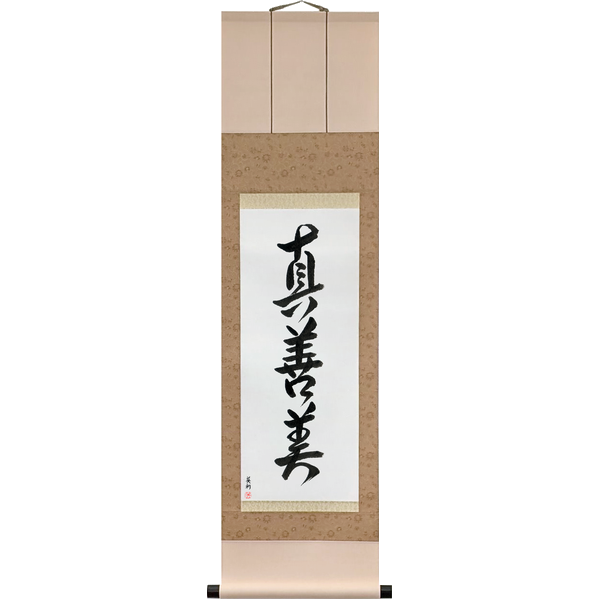
Sold as Truth, Goodness, Beauty · Read shin zen bi, three characters, three on-readings · Oldest witness the West's triad in Japanese: in Cousin's order, 真美善, in a Ministry of Education translation of 1874; in the order the language kept, on the cover of 三宅雪嶺's The Japanese in March 1891 · Sense the three ends of the mind, knowing, doing and beholding: the true, the good and the beautiful; in kyūdō, the discipline's declared aim, and the target and the archer alike.
The words
Three characters, each old, joined new. 真 is true and real; the dictionary has it from a sutra commentary of 611, and in Zhuangzi it is the nature Heaven gives, the 真人 who has passed through death. 善 is good; from the Record of Rites and the ninth-century Nihon ryōiki, and as a noun, the encyclopedia says, a philosopher's word, Plato's to agathon. 美 is beautiful; from the twelfth-century Konjaku, and its philosophical sense, the character of the object of aesthetic intuition, the big dictionary first cites from 三宅雪嶺's book of 1891 with the three characters on its cover. The characters 善 and 美 are one family in the old script, the ram offered to the gods. Together, 真善美 is what the dictionaries define as the true of knowledge, the good of ethics and the beautiful of taste; the highest state in which the ideal is realized, the three subjects of logic, ethics and aesthetics, or one value seen three ways. The encyclopedia gives the German behind it, das Wahre, das Gute, das Schöne, and says that pairing the true and the good is ancient but setting all three side by side is modern, from Kant: Victor Cousin's Du vrai, du beau et du bien (1853), the neo-Kantians' stock phrase, and from them, probably, the Japanese word. The standard Japanese-English dictionary gives the true, the good, and the beautiful.
A history, from the earliest witness
In Cousin's order, 1874 to 1893. The three came into Japanese in the French order, beauty second. 箕作麟祥's translation of an American treatise on school management for the Ministry of Education (1874) says that the ignorant cannot know in their hearts 想設ノ眞美善ノ三者, the three imagined things, the true, the beautiful and the good, and so cannot enjoy them without schooling; 此真美善ノ三者ヲ眼アルモ見ル能ハス, with eyes they cannot see the three that surround them [2][2]. 中江兆民's translation of Véron's Aesthetics (1884), on Plato's soul before birth: it once flew free among the essences and touched everything of the true, the beautiful and the good directly, 一切眞美善ノ類皆直チニ之ニ接シテ, and that is why we now love 善美眞ノ三ノ物, those three things [3]. 井上円了's Introduction to Zen Philosophy (1893) still has the French order: logic belongs to the intellect, aesthetics to feeling, ethics to the will; scholarship aims at the true, art at the beautiful, morals at the good, and together these are called 眞美善; and above the three he sets a fourth, 妙, the marvelous, which is religion's [7].
The order the language kept, 1890 and 1891. A pedagogy compilation of 1890 has the three in the order they have since kept: imagination gives us high ideals and is the force that drives progress in each of the realms of the true, the good and the beautiful, 眞善美ノ各界ニ於テ [4]. Then the book. In March 1891 the philosopher and journalist 三宅雄二郎, Setsurei, published a forty-leaf treatise called 『日本人』, The Japanese, with the political society 政教社, and on its cover, above the title, he set three characters, 眞善美 [5]. In the sequel he published two months later he explains: 本年三月一書を公にし、稱して日本人と云ふ。表紙に眞善美の三字を題せるを以て、時に眞善美日本人と呼はる, in March this year I published a book called The Japanese; because I set the three characters 真善美 on its cover, people call it The Japanese: Truth, Goodness, Beauty; this one, by contrast, I name The Japanese: Falsehood, Evil, Ugliness [6]. The argument, as the Yomiuri reviewer bound into the same volume put it: 日本人の特色を發揮して世界の眞善美に補すべき, the Japanese are to bring out what is theirs and so contribute to the world's truth, goodness and beauty; they are not an inferior race; and the first task is to attain the true [5]. It was a manifesto against the westernizing fever of the 1880s, and the reprint of 1919 took the popular name for its title and called it an essay that made a great stir when it appeared in 1891 [11]. The dictionaries still cite it: the first philosophical use of 美 they give is 三宅's to perfect the beautiful, cultivate the many inclinations that spring from the idea of beauty.
A commonplace, 1901 to 1946. The national index finds the three characters in a hundred books of the 1890s, four hundred and sixty of the 1900s, and over a thousand in each of the 1920s and 1930s, most of them pedagogy, ethics and Buddhism. 与謝野晶子, in Tangled Hair (1901): かくてなほあくがれますか真善美わが手の花はくれなゐよ君, and still you long for truth, goodness, beauty? The flower in my hand is crimson, my love [Aozora card 51307; text] — the dictionary's first citation, a poem set against the triad. 木村鷹太郎 founded a Truth-Goodness-Beauty Society and titled his collected essays 『真善美』 (1907): I do not claim to be true or good or beautiful, but what I hope for is the three and their union, and he names the ancestor of 真善美, Plato, with the Republic and the Symposium [9]. Titles follow: False Architecture and Truth, Goodness, Beauty (1916), 西田幾多郎's The Point Where the True, the Good and the Beautiful Unite (1921), 出口王仁三郎's Truth, Goodness, Beauty, Love (1924), a magazine called 『眞善美』 in 1946. The university added a fourth, 聖, the holy, from Windelband (367 pre-war books). After the war the three characters went over school gates: the Japanese Wikipedia names 真善美 among its examples of a 校訓, a school motto, beside 至誠, 質実剛健, 敬天愛人 and 文武両道.
The martial arts. Two books among the thirty-seven hundred, and each in its own way. 宗像逸郎's Judo (1913), the book that first printed 嘉納's 順道制勝, lists 眞善美勇 among its maxims and explains: judo makes body and mind 順正、有効、自在、强健, correct, effective, free and strong; and correctness is truth, effectiveness is goodness, freedom is beauty, strength is courage, so judo is the way that makes body and mind true, good, beautiful and brave [10] — the triad with a fourth. Kyūdō took it in a schoolbook. 竹内尉's Kyūdō Reader (1937), answering the examination question describe the spirit of kyūdō: 弓道は弓によりて道を行ふことであるから、實行の哲學である … 眞と善と美とが弓道を行ふことによりて解決されるのが理想である, kyūdō is walking the Way by means of the bow, a philosophy of practice; the ideal is that the true, the good and the beautiful are resolved by practicing it; 尺二寸の紙的は眞、善、美を形式化したもの, the paper target of one shaku two sun is truth, goodness and beauty given form; 的が眞善美であると共に射人自體が眞善美でなければならぬ。これを天地に合一するといひ、人天一如といひ、身心を合一するといふ, the target is truth, goodness, beauty, and the archer himself must be; this is called being one with heaven and earth, man and heaven as one, body and mind as one; it is the utmost of the draw and the utmost of a life [12]. No other pre-war kyūdō book on the index carries the three characters. The federation made it the discipline's aim. The All Nippon Kyudo Federation's page The Heart of Kyūdō says today: 弓道は高い指標「真・善・美」を掲げています, kyūdō raises the high standard of truth, goodness and beauty, and glosses each: 真 — the bow does not lie, for there is a saying 正射必中, a correct shot always hits, and the target is the teacher that tells us whether our shot was true; 善 — lives in the composed mind, for in the world of the bow there is no enemy but one's own wavering heart; 美 — is the crystal of the two, appearing when the form of truth and the heart of goodness become one [kyudo.jp/howto/, fetched 2026-09-07; the federation's 1953 manual not opened]. Aikidō's founder used the same three: 植芝盛平's art, in John Stevens's English, is a divine path inspired by the gods that leads to truth, goodness, and beauty, and a student of his student recalls that O-Sensei often spoke of shin zen bi, and brushed it [archive.org; snippets].
The sense across time
One sense, with the order and the fourths as the story. From 1874 the philosophers' triad, first in Cousin's order, beauty second, then from 1890 in the order 三宅's cover fixed. The sense never moved: the three ends of knowing, doing and beholding, one ideal seen three ways, which a poet could refuse and a school could adopt. What changed was who claimed it: a university added the holy; a judo writer added courage; kyūdō, in a 1937 schoolbook and then the federation, made the three the discipline's aim and read them into the target and the archer. The catalogue's three pillars of kyūdō is that last claim, and it is the federation's own.
What is not a source
Not Chinese: Chinese Wikisource's hits are twentieth-century, and the Chinese Wikipedia's page for the three characters begins with the philosophical triad and continues with the Taiwanese title of The Sound of Music. Not Buddhist, though the Buddhist shelf used it freely from the 1890s. Not kyūdō's own: the archers took a philosophers' word that was fifty years old, and one 1937 textbook is the pre-war record. Not 宗像's four: the judo 真善美勇 stayed his.
The text in English
Two English lineages, and the house has the better one. The scholarship on 三宅 gave the title its English: Kenneth Pyle's The New Generation in Meiji Japan (1969), Shin-zen-bi Nihonjin (The Japanese: Truth, Goodness, and Beauty), and the phrase has been used for the book since [archive.org newgenerationinm0000kenn; snippets]. Goldstein and Shinoda's Tangled Hair (1971; Tuttle 1987) leave the poem's word in romaji and gloss it in the philosophers' order, the good, the true, and the beautiful [snippet]. The kyūdō lineage is Onuma Hideharu's, with Dan and Jackie DeProspero, Kyudo: The Essence and Practice of Japanese Archery (Kodansha 1993), whose first chapter, What is Kyudo?, opens with Truth, Goodness, and Beauty — The Search for Truth, and which makes them three of six elements, truth, goodness, beauty, balance, humility, and perseverance [kyudoessenceprac00onum_0; snippets]; DeProspero's Illuminated Spirit (1997) continues it [snippet]. The aikidō lineage is Stevens's Budo (1991) and Holiday's Journey to the Heart of Aikido (2013). A third English, Truth, Virtue, and Beauty, belongs to 岡田茂吉's church (Lemler 1993) and to an economist (Tsuru 1999); the catalogue's virtue for 善 is theirs. Today the house's Truth, Goodness, Beauty is Pyle's and Onuma's and is right; this history keeps it.
A reading
The catalogue names the right tradition and leaves out the word's own story, which is the better one for a buyer of a martial scroll. 真善美 is the West's triad, Plato's through Kant and Victor Cousin, in Japanese dress. It came into the language in Cousin's order in a Ministry of Education translation of 1874, and took the order it has kept when 三宅雪嶺 set the three characters over the title of his manifesto against westernization in March 1891, a book the dictionaries still cite for the philosophical sense of beauty. By 1901 a poet could set her crimson flower against it; by the 1920s it was in a thousand books a decade; after the war it hung over school gates. The martial arts took it late and each in its own way: 嘉納's judo with a fourth character, courage; kyūdō in one 1937 textbook, the target is truth, goodness and beauty, and so must the archer be, and then the federation, which made it the discipline's high standard and glossed the three as the bow that does not lie, the composed mind and the crystal of the two. The scroll is right as brushed, in the modern glyph. The page should say the word is Meiji and Western, name 三宅 and Cousin, give the 1937 sentence and the federation's three glosses, and drop literally, because the three characters are a translation. Signed, 典, 2026-09-07, s58.
How this was read
As text at the National Diet Library's next-generation digital library, the scan number part of each address and derived from the library's OCR bundle: 箕作麟祥 訳『学校通論』1874 (pid 3464112, scan 201) and 1876 (pid 808280, scan 125); 中江兆民 訳『維氏美学』下 1884 (pid 849695, scan 356); 森慎一郎 編『教育論略』上 1890 (pid 808611, scan 29); 三宅雄二郎『日本人』1891 (pid 900485, scans 76, 77; the cover, scan 1, as an image); 『偽悪醜日本人』1891 (pid 900414, scan 4); 井上円了『禅宗哲学序論』1893 (pid 823235, scans 57, 58); 木村鷹太郎『真善美』1907 (pid 889115, scans 2–4); 宗像逸郎『柔道』1913 (pid 936789, scans 12, 178); 三宅雪嶺『眞善美日本人』1919 (pid 980637, scans 4, 5, 7); 竹内尉『弓道読本』1937 (pid 1052433, scan 96). A leaf named as pid P, scan N has its text at lab.ndl.go.jp/dl/api/page/P_N. By the library's full-text index on the three characters walked whole, with the old glyph, the two other orders and the fourth 聖, the classical facet and the subject classes read on each. As text: kotobank's entries for 真善美, 真, 善 and 美 whole; JMdict; the national catalogue by title with dates; eight Japanese Wikipedia articles and the search; the Chinese Wikipedia and Wikisource; Aozora's text of Tangled Hair at the poem; the federation's page. By the Internet Archive's full-text index on the romaji and the English triad, thirteen books read as snippets with their metadata, and Cousin's editions by catalogue. By eye: the template and the 1891 cover. Not opened: the federation's 1953 manual; 三宅's chapters; Cousin, Wickersham, Pyle, Onuma, Stevens and Holiday at the page; 『哲学字彙』; 西田 1921; the 1946 magazine. The full apparatus, with every address, is in the account.
References
- Cousin, Cours de philosophie … du vrai, du beau et du bien; Du vrai, du beau et du bien (1836; 1853) — archive.org coursdephilosoph00cous_1 · duvraidubeauetdu00cous (catalogue)
- 箕作麟祥 訳『学校通論』(Wickersham) (1874 (1876)) — NDL pid 3464112 koma 201; pid 808280 koma 125 (OCR) ↩
- 中江兆民 訳『維氏美学』下 (Véron) (1884) — NDL pid 849695 koma 356 (OCR) ↩
- 森慎一郎 編『教育論略』上 (1890) — NDL pid 808611 koma 29 (OCR) ↩
- 三宅雄二郎『日本人』(政教社) (1891-03) — NDL pid 900485 koma 1 (image, by eye) · komas 76–77 (OCR) ↩
- 三宅雄二郎『偽悪醜日本人』 (1891-05) — NDL pid 900414 koma 4 (OCR) ↩
- 井上円了『禅宗哲学序論』 (1893) — NDL pid 823235 komas 57–58 (OCR) ↩
- 与謝野晶子『みだれ髪』 (1901) — Aozora card 51307 (text); 日国 初出
- 木村鷹太郎『真善美』(真善美協会) (1907) — NDL pid 889115 komas 2–4 (OCR) ↩
- 宗像逸郎『柔道』 (1913) — NDL pid 936789 komas 12 · 178 (OCR) ↩
- 三宅雪嶺『眞善美日本人』(天佑社) (1919) — NDL pid 980637 komas 4 · 5 · 7 (OCR) ↩
- 竹内尉『弓道読本:中等教科』 (1937) — NDL pid 1052433 koma 96 (OCR) ↩
- 全日本弓道連盟, 弓道の心 ((2026)) — https://www.kyudo.jp/howto/ (fetched 2026-09-07)
- Pyle, The New Generation in Meiji Japan (1969) — archive.org newgenerationinm0000kenn (snippets)
- Goldstein & Shinoda, Tangled Hair (1971 (1987)) — archive.org tangledhairselec0000yosa_e6z4 (snippet)
- Stevens, Budo (Ueshiba) (1991 (1996)) — archive.org budoteachingsoff0000uesh (snippet)
- Lemler, Transformation through Flowers (1993) — archive.org transformationth0000leml (snippet)
- Onuma & DeProspero, Kyudo: The Essence and Practice (1993) — archive.org kyudoessenceprac00onum_0 (snippets)
- DeProspero, Illuminated Spirit (1997) — archive.org illuminatedspiri0000depr (snippet)
- Holiday, Journey to the Heart of Aikido (2013) — archive.org journeytoheartof0000holi (snippet)
- kotobank 真善美 · 真 · 善 · 美 () — https://kotobank.jp/word/… (text)
- ja.wikipedia 校訓 · 三宅雪嶺 · 木村鷹太郎 () — ja.wikipedia (text)
- Template M1070SSVB4A () — takase-images (by eye)