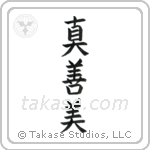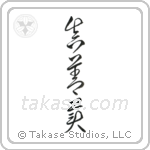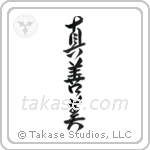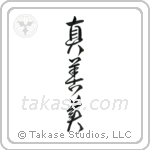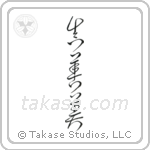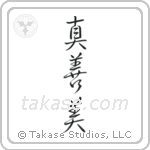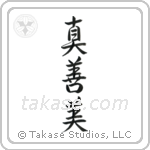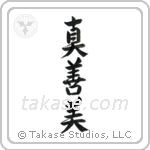

The three ends a mind can aim at are what knowing seeks, what doing seeks and what beholding seeks. The word sets them side by side as one ideal. Its sense has not moved since the word was made. What has changed is who claimed it. A school hangs it over its gate as a motto. An archer hangs it as the declared aim of kyūdō. The All Nippon Kyudo Federation names the three as the discipline's high standard. 真 is the bow that does not lie, 善 the composed mind, and 美 the crystal the two form when they become one. A person who wants the ideal whole has the philosophers' word. A person who wants the archer's has the same three characters, read on the target. The choice is yours.
真善美 is composed of 真 (read shin) meaning "truth", 善 (read zen) meaning "goodness", and 美 (read bi) meaning "beauty".
The three characters translate the Western philosophers' triad of the true, the good and the beautiful, from Plato through Kant and Victor Cousin; they entered Japanese in the Ministry of Education's translations of 1874, were written as one word by 1889, and Miyake Setsurei made the word famous on the cover of his manifesto of 1891.
We want you to be as happy with the meaning as you are with Master Takase's art. To learn more, visit Philology of 真善美.