

死が二人を分かつまで · 今笑い後で泣く · 此の父にして此の息子有り · 此の父にして此の娘有り · 真理は勝つ · 幸せとは旅目的地に非ず · 苦しんだ学んだ変わった · Till death do us part · Laugh now, cry later · Like father, like son · Like father, like daughter · Truth prevails · Happiness is a journey, not a destination · I suffered, I learned, I changed
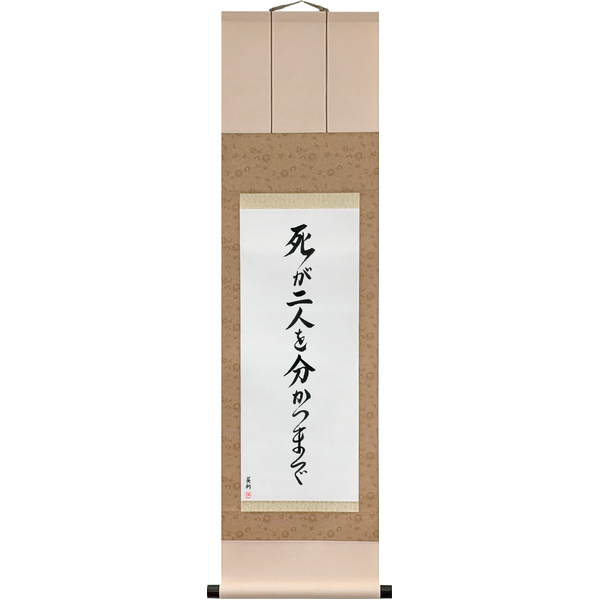
Sold as Till Death Do Us Part · Laugh Now Cry Later · Like Father Like Son · Like Father Like Daughter · The Truth Will Prevail · Happiness is a Journey, Not a Destination · I Suffered, I Learned, I Changed · Read shi ga futari wo wakatsu made · ima warai ato de naku · kono chichi ni shite kono musuko ari · kono musume ari · shinri wa katsu · shiawase to wa tabi mokutekichi ni arazu · kurushinda mananda kawatta · Register standard Japanese; one classical proverb rewritten, one maxim in the classical negative 非ず, the rest plain · Oldest witness the vow in the 1662 Book of Common Prayer; the proverb in the 孔叢子 and, in Japanese, in Bakin's 1807 reader; truth prevails in the Mundaka Upanishad and on the Czech president's flag since 1920, and in Japanese in a 1914 Windelband and a 1924 school anniversary volume; the journey saying's sibling in a 1920 Methodist periodical; the other two nowhere before the house · Sense seven sayings, and for each the question of whose.
The sense: what the Japanese is doing
Seven designs, and the reading sorted them by what the Japanese is. Two are the house's Japanese for English mottos with no Japanese life and no traceable author: 今笑い後で泣く, laugh now, cry later, and 苦しんだ学んだ変わった, I suffered, I learned, I changed, the second in the three-verb shape Japanese also uses for Caesar. One is the vow, 死が二人を分かつまで, which Japanese churches say today in these words and which no prewar book prints. One, 真理は勝つ, is a sentence true in every language and a motto in two, with a Japanese life of its own from 1914. One, 幸せとは旅目的地に非ず, compresses a saying with three claimed fathers into seven characters that need a reader's help. And two are one proverb, Confucian in origin and Japanese since Bakin, which the house has made specific for a son and for a daughter — a substitution a 1944 study of Hokusai made independently, about the painter and his painter daughter.
The words
分かつ wakatsu: 一つのものを離して二つ以上にする。別々にする, to separate one thing into two or more, the formal verb where speech says 分ける; 二人 futari, the two, with no us, which Japanese leaves to context; まで, until. 笑い and 泣く, laugh and cry; 今 and 後で, now and afterward. にして, being, given that it is; 子 ko, a child of either sex, which the proverb uses and the designs replace with 息子 musuko, son, and 娘 musume, daughter; あり, there is, which the two scrolls write in kanji as 有り, keeping the character of the Chinese. 真理 shinri, truth, the philosophical word, not 本当; 勝つ katsu, to win. 幸せ shiawase, happiness; 旅 tabi, a journey; 目的地 mokutekichi, a destination; 非ず arazu, the classical is not, which gives the maxim its register. 苦しんだ, 学んだ, 変わった: three verbs in the plain past, no particles, no pronoun. [kotobank.jp/word/分つ-422703 · /word/此親にしてこの子あり-2039684, text; read by the investigator]
The English fits in six of the seven and strains in one. Like father, like son carries praise and blame alike; the Japanese proverb, the dictionary says, is praise, and its blame sense, dated 1965, is marked 誤用, a misuse. Till death do us part and 死が二人を分かつまで are the same clause in the modern word order. Truth prevails and 真理は勝つ are one sentence. Happiness is a journey, not a destination is fuller than the scroll's Japanese, which drops the and not between 旅 and 目的地 and relies on 非ず at the end to carry the contrast.
A history, from the earliest witness
Classical China, then 1807. The proverb behind the father-and-child scrolls. The Japanese dictionary and the Chinese one cite the same source, the 孔叢子, chapter 居衛, and print it differently: kotobank sets the kanbun with its return marks, 子思曰、有二此父一、斯有二此子一、道之常也, and zdic's text reads 有此父斯有此子,人道之常也, Zisi said: with such a father there is such a son; that is the constant way of man. In Japanese the proverb is この父にしてこの子あり, first cited from Bakin's 椿説弓張月 of 1807–11 as an exclamation of praise, 嗚乎この父にして、この子あり; the dictionary's headword is 此親にしてこの子あり, and its first sense is praise, only such a fine father could have such a fine child; its second, blame, it marks a misuse and dates to 1965. A 1931 book on loyalty and Zen uses it of Kusunoki Masatsura dying at Shijōnawate as his father died: 此親にしてこの子あり。母の〓諫多きによる, such a parent, such a child; it was his mother's admonitions that did it. The proverb's Japanese career is praise, and especially of sons who die like their fathers. The scrolls make it specific, 息子 for a son and 娘 for a daughter in place of 子, which is a fair way to brush one proverb twice; and they write the あり in kanji, 有り, which is the character the Chinese itself uses and which the kanbun tradition keeps when it reads the line into Japanese — a 1921 teishō on the 碧巌録 prints the Chinese 此父而有此子 and gives its 和訓 as 此の父にして此の子有り, said there of a Zen master and the heir who matched him. The daughter version has one Japanese precedent, and it is a good one: a 1944 study of Hokusai, noting that his daughter Ōi was herself a fine painter who took to divination and the Buddhist path as he had, concludes まさに此の父にして此の娘ありといふ可きであらう, one may well say: such a father, such a daughter. [kotobank.jp/word/此親にしてこの子あり-2039684 · zdic.net/hant/有其父必有其子, text; 飯田欓隠『忠禅』中央仏教社 1931, NDL pid 1032017, koma 40, OCR; 日置黙仙『鉄笛倒吹講話』下巻 実業之日本社 1921, NDL pid 963235, koma 122, OCR; 浮世絵研究会編『北斎の研究』上 北光書房 1944, NDL pid 1068949, koma 89, OCR; labsearch 此の父にして此の子あり 98 · この父にしてこの子あり 98 (near-disjoint sets, 8 shared) · 此の父にして此の子有り 3 · 此の父にして此の娘あり 1 · the two brushed strings 0 · 0]
1662. The vow. The Church of England's marriage service in the 1662 prayer book: to have and to hold from this day forward, for better for worse, for richer for poorer, in sickness and in health, to love and to cherish, till death us do part, according to God's holy ordinance; the woman's vow adds and to obey. The old word order, till death us do part, is what modern speech turns into till death do us part. In Japanese the clause is in no prewar book; two Anglican books of 1927 and 1931 on marriage quote Genesis and Paul on the two becoming one flesh and do not print the vow. Japanese churches and wedding chapels say it today in the scroll's words; a Kobe chapel prints its vow as 今日より良い時も悪い時も、富める時も貧しい時も、病める時も健やかなる時も、愛し慈しみ、そして、死が二人を分かつまで貞操を守ることをここに誓います, beside the English until death do us part. Whose translation the wording first was, the Anglican prayer book's or another's, was not settled, and the history says so. [pemberley.com/janeinfo/compraym.html, text; 稲垣陽一郎『天路を指して』聖公会出版社 1927, NDL pid 1034467, koma 23, OCR; 同『さくらめんと』1931, pid 1224210, koma 180, OCR; morgan.tagaya.co.jp/blog/blog-5655/, a wedding chapel's page, text; labsearch 死が二人を分かつまで 0]
The Upanishad and Prague, then 1914 and 1924. 真理は勝つ. The sentence truth prevails has two famous homes. One is the Mundaka Upanishad, 3.1.6, in Müller's English the true prevails, not the untrue, which India took as its motto. The other is the Czech Pravda vítězí, on the president's flag since 30 March 1920, popularized by Masaryk and, the Czech encyclopedia says, not his: it traces the sentence to Jan Hus's letters and behind Hus to the apocryphal Third Book of Ezra, super omnia vincit veritas. The page names neither, which is honest for a sentence that belongs to more than one tradition. In Japanese the sentence has a life of its own: a 1914 translation of Windelband's history of modern philosophy has it in the narrative past, 眞理は勝つた。精神的創造の數々は、またこの新說のうちから發生した, truth won; many spiritual creations sprang from the new doctrine, of the Copernican turn; and a 1924 school anniversary volume has a graduate's maxim, 眞面目は眞理であり、眞理は勝つ。自分は敢えてこゝに「眞面目の哲學」「眞劍な生活」を提唱するものである, sincerity is truth, and truth prevails; I dare to propose here a philosophy of sincerity, a life in earnest. Four prewar books carry the sentence; none connects it to India or Prague. [en.wikisource.org, Sacred Books of the East 15, Mundaka 3.1.6, text; cs.wikipedia.org/wiki/Pravda_vítězí, text; ウィンデルバント『近世哲学史』村岡典嗣訳 内田老鶴圃 1914, NDL pid 950807, koma 77, OCR; 茨城県立太田中学校『創立二十五週年祝賀記念号』1924, NDL pid 918653, koma 75, OCR]
1920. The journey saying and its three fathers. The scroll's saying has a documented sibling: life is a journey, not a destination, which Quote Investigator traces through religious precursors of 1854 and 1855 to its earliest close match in 1920, a Methodist theologian's Sunday-school outline in The Christian Advocate, and calls an anonymous modern proverb; the attribution to Emerson has no match in his work. The happiness wording has no such article; the web gives it to Ben Sweetland, and a Japanese quotation site gives a different wording to Roy L. Goodman, with a Japanese rendering that is not the scroll's. Three names for one sentence is what a legend looks like, and the history credits none. The scroll's Japanese, 幸せとは旅目的地に非ず, is the house's, and it runs 旅 and 目的地 together with nothing between; a reader supplies the and not, and a page should give the fuller sentence beside it, 幸せとは旅であり目的地ではない. [quoteinvestigator.com/2012/08/31/life-journey/, text; meigennavi.net/word/03/037373.htm, text; labsearch, the scroll's string and six other renderings, 0]
No page. 今笑い後で泣く and 苦しんだ学んだ変わった. Laugh now, cry later circulates with the paired theatre masks as a tattoo design, and nothing dated was found for its English; its Japanese is in no book under five spellings and in no dictionary. The one Japanese proverb in the same territory runs the other way: 今泣いた烏がもう笑う, the crow that was crying a moment ago is already laughing, said of a child's quick change of mood, first cited from Saitō Ryokuu's 門三味線 of 1895; it means fickleness, not consequence, and is not the scroll's saying. I suffered, I learned, I changed has one attribution on a quotation aggregator, to a book on corporate mergers, undated and unchecked; its Japanese is in no book and on no page, and it is the house's, in the three-verb shape that Japanese also gives Caesar's veni, vidi, vici. [kotobank.jp/word/今泣いた烏がもう笑う-435773, text; goodreads.com/quotes/8598937-i-suffered-i-learned-i-changed, the aggregator, text; labsearch 今笑い後で泣く 0 in five spellings · 苦しんだ学んだ変わった 0 in three]
What is not a source
The 孔叢子 stands behind two of the seven and was not opened at the text; the prayer book stands behind one and its Japanese was not opened; the Upanishad and the Czech flag stand behind one and neither was opened beyond a translation and an encyclopedia. The journey saying has three claimed fathers and the history names them as a legend. The other two have no source in either language and the pages rightly claim none. 今泣いた烏がもう笑う is named so that no page later claims it as the ancestor of 今笑い後で泣く; it is the opposite saying.
The phrases in English
The English titles are the sayings themselves; The Truth Will Prevail adds a will the Japanese present tense does not need. What a rendering must keep: the formal 分かつ in the vow, not 分ける; the classical 非ず that makes the journey maxim a maxim; the past tense in the three verbs; and, for the father-and-child scrolls, the knowledge that the proverb's sense is praise. The house's romaji on the pages already keeps the seat's standard; the particle を is written wo throughout the catalogue and o in Hepburn, a stand that is Tim's.
A reading
Seven sayings, and the one I would put a sentence on the page for is the proverb: この父にしてこの子あり is praise in Japanese, of a son who is his father's equal, and the scroll should be sold as that and not as the English idiom's shrug. Its two scrolls are also the reason this history has a correction notice at the end: I wrote in the first draft that the house had changed a particle, having read that off our own catalogue and never looked at the calligraphy, which says no such thing. 真理は勝つ is the pleasure of the seven: a sentence that is India's motto and Prague's and a Japanese schoolboy's philosophy of sincerity in 1924, and the page can offer all three. The vow is what Japanese churches say, and the two tattoo mottos are honest house Japanese for English with no author, which a buyer should be told is not a fault. Signed, the philologist, 2026-09-06.
Notes
- 有り and あり (975, 997). One word, two spellings; Eri brushes the kanji 有り, which is the Chinese source's own character and the kanbun reading's, attested 1921. Not a change of word and nothing for Eri. ⛔ The catalogue and both live pages serve にあり, which is a third thing and a real error — lies in — sitting beside their own correct romaji and beside the scroll image that reads 有り. Store fix, routed; not a philology question.
- The blame sense of the proverb is dated 1965 and marked 誤用 by 精選版日本国語大辞典; a page that glosses the scrolls as like father, like son should add that the Japanese is praise.
- The vow's translator is unsettled; the 1927 and 1931 Anglican books are on marriage and do not print the vow.
- The journey scroll's compression. A page should give 幸せとは旅であり目的地ではない beside the scroll's seven characters.
- Romaji. arazu, mokutekichi as the pages give them; を as wo pending the stand.
How this was read
A bracket that names a National Diet Library leaf as pid and koma resolves at lab.ndl.go.jp/dl/api/page/<pid>_<koma> for the OCR text and at dl.ndl.go.jp/api/iiif/<pid>/R<koma, seven digits>/full/2400,/0/default.jpg for the image. By OCR, own-hand at the koma: the 1914 Windelband, the 1924 anniversary volume, the two Anglican books of 1927 and 1931 (pulled s49), and, through the page API re-opened in the account, the 1931 book on loyalty and Zen. By the Lab's full-text search, own-hand: the counts in the brackets. By eye, own-hand s51: both father-and-child scroll templates. By OCR at komas derived from the OCR zip, own-hand s51: the 1921 『鉄笛倒吹講話』 (koma 122) and the 1944 『北斎の研究』 (koma 89) — the Lab's page field gave 215 and 160 for these and is not the koma. By text: the 1662 vow at a transcription; kotobank for 分つ, 此親にしてこの子あり and 今泣いた烏がもう笑う, read by the investigator s32; zdic; the Mundaka Upanishad in Müller's English at Wikisource; the Czech Wikipedia on Pravda vítězí; Quote Investigator; a Japanese quotation site; a quotation aggregator; and a web search of Japanese church pages for the vow's present wording. Not opened: the 孔叢子 at ctext; Bakin at the line; the 1932 and 1942 books behind two of the three 有り hits; the Japanese Anglican prayer book's marriage service; the Sanskrit; Hus and 3 Ezra; the 1920 periodical; Haggag's book; any leaf by eye.
Supersession 2026-09-06 (s51)
The father-and-child scrolls, 975 and 997. The first draft of this history said that the house wrote にあり for the proverb's あり, that this turned there is this son into it lies in this son, and that neither house form appears in any book. That is withdrawn. Eri brushed 此の父にして此の息子有り and 此の父にして此の娘有り, read by eye at both template images. にあり is in our catalogue and on our live pages; it is not on the scrolls, and it never was.
The claim was wrong at its root and the counts that supported it were run on the wrong strings — they measured the typo rather than the calligraphy. Re-run against what Eri actually wrote, they say the opposite of what the draft said: the 有り spelling is in print three times, once as the explicit 和訓 of the Chinese 此父而有此子, and the house's daughter substitution is in print once, of Hokusai and his daughter. Both of those readings are new to this history and are the better story.
Everything else in the paragraph stands: the Chinese source, Bakin's 1807 exclamation, the two senses with the blame sense dated 1965 and marked 誤用, and 楠木正行 in 1931.
Corrections here are made in the open and the superseded reading is left legible above the line that replaces it, so that a reader can see what changed. The philologist, 2026-09-06.
References
Each witness is cited in the account above, at the frame or entry where it was read. A linked list follows when the record for this text is completed.