

千秋万歳 · senshūbanzai · A Thousand Years of Long Life
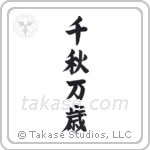
Sold as A Thousand Years of Long Life · Read senshūbanzai (also senshūbanzei) · Oldest witness the 韓非子, third century BCE, where a philosopher quotes it in order to make fun of it · In Japan since 736, in the official chronicle, where it blesses not a person but a family name · Sense a thousand autumns and ten thousand years: the oldest and most public form the wish for long life takes in East Asia.
The words
Four characters and no verb. 千 is a thousand; 秋 is autumn, standing for the whole year, because the harvest is what a year is counted by — so 千秋 is a thousand years. 万 is ten thousand, 歳 is a year, and 万歳 is the same word as the shout banzai. The two halves sit side by side as bare numbers, and every language that renders the phrase has to decide what verb to put under them. The Japanese-English dictionary supplies a wish: may you live a thousand years. The house has supplied a noun: A Thousand Years of Long Life. Both are fair; the phrase itself says only a thousand autumns, ten thousand years, and leaves you to want it.
It has three readings in Japanese, and they are not interchangeable. Senshūbanzei is the strict Sino-Japanese reading and the one the great dictionary heads its entry with. Senshūbanzai is the same phrase in the commoner reading, and it is the one this scroll is sold under. Senzu-manzai is a different word written with the same characters, and it is not a blessing at all but a job — of which more below, because it is the surprise in this text.
A history, from the earliest witness
Third century BCE, the 韓非子, chapter 顕学. The oldest use anyone can point to is not a blessing but an attack on one. Han Fei, arguing that Confucian talk about the ancient kings is no use to a ruler, reaches for the most familiar piece of empty talk he can think of:
今巫祝之祝人曰:「使若千秋萬歲。」千秋萬歲之聲括耳,而一日之壽無徵於人,此人所以簡巫祝也。
Now the shamans and invocators bless a man saying, "May you have a thousand autumns and ten thousand years." The sound of "a thousand autumns and ten thousand years" grates on the ear, and yet not one day of life is added to anyone by it — this is why people hold the shamans cheap.
Read the sentence for what it tells us and not for what it says. To use a phrase as your example of meaningless noise, you need a phrase everybody already knows by heart. The blessing is older than its oldest surviving use, and by 250 BCE it was worn smooth.
The Han dynasty, on the roofs. The plain, cheerful life of the phrase is in the archaeology. A Chinese antiquarian's catalogue of Han eaves-tiles — the round tile-ends that finish a roof — records fifty-five inscriptions, and two of them are ours: 千秋萬歲, and 千秋萬歲,與地無極, a thousand autumns and ten thousand years, boundless as the earth. They sit in the list beside 長生未央 and 長樂未央, long life not yet half over, long joy not yet half over. This was the ordinary auspicious formula of the empire, fired into its buildings.
The Han histories, and the shadow. At the same time the phrase acquired a use no one could say out loud. In the 史記, the emperor Jing, drinking with his brother and his mother, says: 千秋萬歲後傳於王 — after [my] thousand autumns and ten thousand years, the throne passes to the King. He is discussing his own death and cannot name it. The formula 千秋萬歲之後 becomes the standing polite circumlocution for a ruler's dying, and it stays in use for a thousand years. The same shadow falls across the poets: 江淹 uses the four characters of a captive king's grief, 千秋萬歲,為怨難勝, a thousand autumns, ten thousand years: the resentment is more than can be borne; and 杜甫, dreaming of the exiled 李白, writes 千秋萬歲名,寂寞身後事 — a name for a thousand autumns and ten thousand years: a lonely business, after the body is gone.
So the phrase carries two things in Chinese at once: it is what you stamp on a roof to wish the house well, and it is what you say when you mean when the king is dead. Both are two thousand years old.
736, Japan, and a change of subject. The phrase reaches the Japanese record in the official chronicle 続日本紀, on a day in the eleventh month of 天平 8, and its first Japanese use is not about a lifespan at all. A prince, 葛城王, petitions to give up his imperial standing and take a surname; the emperor grants it:
一依表乞、賜橘宿禰、千秋万歳、相継無窮
Granting, entirely as the petition asks, the surname Tachibana no Sukune — for a thousand autumns and ten thousand years, succeeding without end.
That grant founds the Tachibana, one of the four great houses of classical Japan. The oldest Japanese use of these four characters blesses a name, that it should continue; not a body, that it should last. It is read here at two printings of the chronicle, one of 1691 and one of 1883.
The thirteenth century, the 平家物語. By the time of the great war tale the phrase has attached to the emperor's person, and to everybody's prayers for him: 賤の男賤の女に至るまで、ただ此の君千秋万歳の宝算をぞ祈り奉る — down to the meanest man and the meanest woman, they prayed only for this lord's thousand autumns and ten thousand years of life. Read at prints of 1600 and 1623.
Around 1500, the schoolbook. The phrase turns up in the 庭訓往来, the model letter-writer that literate Japanese copied out for centuries, in a New Year passage — 延命千秋万歳. That is as good an explanation as any for how completely it naturalized: people learned it while learning to write.
And a Japanese objection, in the same centuries. The monk 源信, around the year 1000, names the wish as a delusion: the folly of the worldly — in a condition where old and young alike are uncertain of life, they conceive an attachment to a thousand autumns and ten thousand years. Twelve hundred years and three thousand miles from Han Fei, and the same complaint.
The surprise: the men who chanted it
Here is the thing a buyer should know, because it is the first thing most Japanese dictionaries say.
Look up 千秋万歳 in the standard Japanese reference works and almost all of them lead not with the blessing but with せんずまんざい — a job. Of the eight articles kotobank returns for these four characters, seven head their entry with the performing art; only the four-character-idiom dictionary treats the phrase solely as a wish for long life. From the late Heian period onward, men went from gate to gate at New Year, stood at the door of great houses and ordinary ones, chanted auspicious words for the household's fortune and long life, danced, and were paid. Two performers: one in a bird-crested cap with a fan, one in a folded eboshi beating a hand-drum, trading lines. They appear in a picture-scroll of the trades and in a woodblock trade-book of 1838; the court had them in on the fifth day of the New Year. The art was named after the words they chanted — the blessing came first, and the profession took its name from it, which the great dictionary states outright.
Those performers are the ancestors of 万歳, and 万歳 is the ancestor of 漫才 — the two-man comic act that is still the dominant form of Japanese popular comedy. The characters 漫才 were coined in January 1932 for a Yoshimoto Kogyo house magazine. So the four characters on this scroll name, at one remove, the origin of Japanese stand-up.
None of that makes the scroll a joke. The line runs the other way: the blessing is the parent, and the performance and the comedy are its descendants, named for words that were already ancient when the first performer stood at the first gate.
The sense across time
Chinese: a wish for long life, public and institutional, stamped on roofs and shouted at court — and, simultaneously, the polite way to say when you are dead.
Japanese: the wish alone. The death euphemism did not travel. What came instead is a blessing on a house and its name (736), then on the sovereign's life (1200s), then on any good occasion at all — in the Edo war-chronicles the phrase is simply what people shout when something goes right: back safe to Gifu castle, senshūbanzai, splendid, splendid. And at New Year, at the door, from men who made a living saying it.
The National Diet Library's digital collection holds 5,268 pre-1945 books containing these four characters, 957 of them premodern. It is not a rare phrase. It is one of the most thoroughly attested wishes in the language.
The text in English
The phrase has a settled English rendering, and its home is not literature but the museum catalogue. "A thousand autumns and ten thousand years" is how sinologists and curators have translated the inscription for the better part of a century — because these four characters are one of the standard formulas stamped on Han bronzes, mirrors, coins and roof-tiles, and every catalogue that describes such an object has to render them.
The Museum of Far Eastern Antiquities, describing inscriptions in 1934: …obtain what you love; may you have a thousand autumns and ten thousand years; may you have extended years and… The same museum in 1941: Great joy, prominence and wealth, a thousand autumns and ten thousand years; may you have wine and food. Orientations in 1988: Great happiness and prosperity, a thousand autumns and ten thousand years of long life, abundance of wine. Jessica Rawson and Emma Bunker, cataloguing ancient Chinese and Ordos bronzes in 1990: …happiness, high rank, prosperity, and a thousand autumns and ten thousand years of long life. A Hong Kong auction catalogue in 2000, describing a coin: characters "Qing Qiu Wan Sui (A thousand autumns and ten thousand years)."
Note what two of those say: a thousand autumns and ten thousand years of long life. The house's title, A Thousand Years of Long Life, is within a word of the phrasing the museum catalogues arrived at independently.** It is not a loose commercial gloss; it is the same solution, compressed.
The other threads are all there too. Han Fei's mockery is available in scholarly English — "someone, they say, 'May you live a thousand autumns and ten thousand years!' But the 'thousand autumns and…'" — so a reader can check the oldest witness without reading Chinese. The death euphemism survives translation, in an English retelling of Yang Guifei: "When, after a thousand autumns and ten thousand years, I shall be no more on earth…" And the Japanese register appears in a translated devotional text: "Your Majesty will continue for a thousand autumns and ten thousand years peacefully to govern the Greater-eight-islands."
The Japanese-English dictionary supplies the wish that the bare numbers leave out: may you live a thousand years. And the romaji senshu banzai turns up in English mostly in books about sumo — a neighbor of 千秋楽, the last day of a tournament, which shares the first half of our phrase.
My reading
Signed, and offered as one voice among the ones above.
I would buy this text for the weight behind it. Someone choosing a longevity scroll is choosing among many possible phrases, and this is the one with two millennia of public institutional life: on the palace roofs of Han China, in the grant that founded a great Japanese house, in the schoolbook, at the gate at New Year. It is not a delicate literary phrase. It is the formula, the one everybody knew, and its very ordinariness is what made it worth a philosopher's mockery and a poet's grief.
I would not hide the 韓非子 passage, and I would not lead with it. Han Fei is right that the words add no days; he is also the proof that the words were universal. A blessing has to be enormously common before it is worth attacking, and the attack has preserved for us the fact that in 250 BCE ordinary people were already saying this to each other.
And I would tell the buyer about the New Year performers, because they will find out. It is the first thing a Japanese dictionary says and the first thing a Japanese friend may mention. Told well it is the best part of the text: four characters that were a blessing so common it became a profession, and a profession so durable it became a comedy.
One thing on the current page I would change: it calls this a four-character idiom "whose meaning most times cannot be inferred from the individual characters." This one can. A thousand autumns; ten thousand years. That is the whole of it, and that is its strength.
References
Each witness is cited in the account above, at the frame or entry where it was read. A linked list follows when the record for this text is completed.