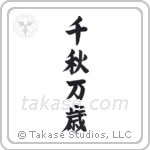
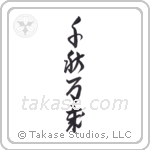
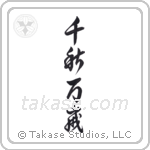
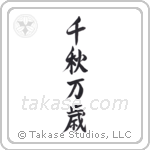
A thousand autumns and ten thousand years: two spans of time set side by side with no verb, and the reader supplies the wish, may you live a thousand years. It is an old Chinese wish for long life, and two of the Han roof-tile inscriptions a Qing scholar listed carry it. In Japan the chronicle the dictionaries call the first official history has it in a minister's congratulation to the sovereign, and the next official chronicle grants a family name with it, that the name should pass on without end. The same four characters, read senzumanzai, also name a New Year trade: performers who stood at the gates of houses, chanted words praising the household's fortune and long life, and were paid for it. The Nihon Kokugo Daijiten says the trade seems to have been named from the words. The performers came to be called manzai, and the dictionaries trace the comic double act, also manzai, to them. For the wish, the Japanese dictionaries give the four characters as forever, and as a word that wishes someone long life. Whose thousand autumns you wish is yours.
千秋万歳 is composed of the words 千秋 (read senshū) meaning "thousand years, a thousand autumns" and 万歳 (read banzai) meaning "long life and prosperity".
We want you to be as happy with the meaning as you are with Master Takase's art. To learn more, visit Philology of 千秋万歳.