

千客万来 · senkyaku banrai · Flood of Customers
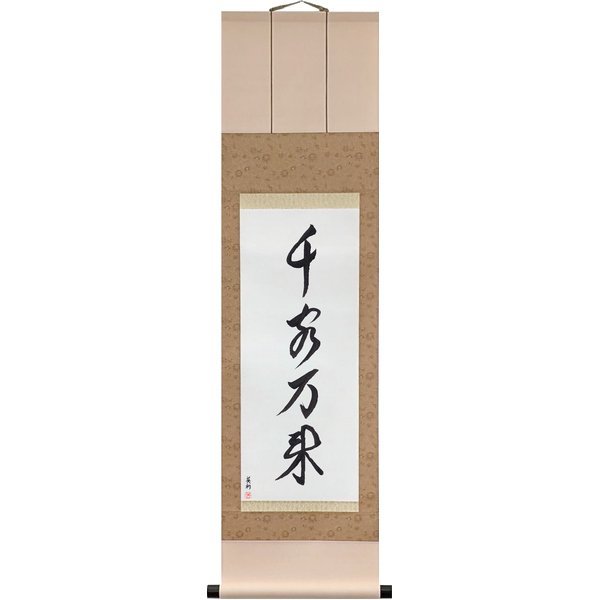
Sold as Flood of Customers · Read senkyaku banrai, also senkaku banrai · Oldest witness 1811, twice over: a showman's patter by 式亭三馬 and a senryū in the 柳多留, both about the lantern at a shop door · What it is a Japanese-made phrase of Chinese parts, a thousand guests, ten thousand comings, written on the paper lantern of tea-houses and eating-houses as a wish for trade · Not Chinese — no Chinese text has it, and a Meiji observer noted the Chinese shops write something else · In the dictionaries from 1889, when 言海 called it a phrase merchants write to wish their trade well · In English from 1896, Brinkley: a thousand guests coming ten thousand times.
The words
千 is a thousand and 万 is ten thousand, and here they are not counted but piled up, the way the dictionaries say: many customers, expressed by stacking a thousand on ten thousand. 客 is a guest, and on a shop door a customer. 来 is to come. 千客, a thousand guests, and 万来, ten thousand comings, are each real words, but the dictionaries first cite them alone sixty years after the four together, which is what a set phrase looks like: the halves fall out of it later. Two readings are equally old. Senkyaku is the dictionaries' headword and the catalogue's; senkaku, with the older Chinese reading of 客, is the one 三馬 wrote over the word in 1811, and it survives beside the other in every dictionary since.
A history, from the earliest witness
Not from China. The four characters do not appear in any Chinese text at Wikisource, under any of the three spellings. The halves do: a Tang anecdote praises a man who could face a thousand guests and never breach one's name-taboo, and a Ming poem gives a courtesan's lips to ten thousand guests. Nobody in China joined them. In 1897 a Japanese writer walking past the Chinese shops of a treaty port noticed it: where a Japanese shop would hang 千客萬來, the Chinese sign says 富客光臨, may rich guests honor us. A 1944 pocket dictionary gives the Chinese equivalent as a different phrase again. The word was made in Japan, out of Chinese parts, by people who wrote signs.
1811: the lantern. The two oldest witnesses are the same year and do not know each other. 式亭三馬, the Edo comic writer who kept a cosmetics shop and knew a signboard, gives a storytelling-hall showman this patter in his 田舎芝居忠臣蔵: the hall so full the boats overflow, the four quarters not enough — and the letters written on the back of the "lifelong safety" lantern: a thousand guests, ten thousand comings, ten thousand years; truly the Pill of Wealth and Long Life. He wrote senkaku banrai over the characters himself. And the 柳多留, the great senryū anthology, in its fifty-fifth volume the same year: a thousand guests, ten thousand comings — if they all came, that would be a problem. A joke like that only works on a phrase everyone has already seen painted, so the lantern is older than 1811; nothing found here reaches it.
1814 to 1862: what the sign-painters wrote. The illustrated popular books of the next fifty years show the phrase in its place and name the trade that put it there. A comic book of 1821: to write 千客万来 on the signboard lantern to wish the shop well is, as you know, the sign-painters' first school. A novel of 1834: "waiting room" on the hanging lantern is the sign-painter's stroke; to write 千客萬来 and "granted, and doubly" greedily is the tea-house custom. A play-book of 1831 ends its preface with the wish itself, may the shop flourish: a thousand guests, ten thousand comings, full house granted — that is the preface. Elsewhere it hangs on a rest-house, an eating-house, a courtesan's talk. Its companions on the lantern were full house granted, ten thousand years, prosperous trade and cash, no haggling, which a later textbook lists together as the famous old lines. Manuscripts of the same age put it on the 雁鍋, the goose-stew house under Ueno hill, and in the Yoshiwara, new every day and every day a thousand guests.
1876 to 1898: off the lantern, into prose. In the Meiji era the phrase leaves the door and becomes an ordinary word for a crowd that keeps coming. A merchant's letter copied into a court record in 1876 wishes a friend prosperity, and may a thousand guests come ten thousand times; a pamphlet of 1884 states it as a fact of a business; a free-trade speech of 1890 promises a port where imports pour in thousand-guests, ten-thousand-comings; an anti-brothel speaker the same year has Socrates promise a courtesan the same; a Kōchi pamphlet of 1893 uses it of the United States, a nation everyone keeps arriving in, black and white, every race mixed. The Tokyo guidebooks of 1897 and 1898 use it of the goose-stew house again and call it, with a thousand cranes and ten thousand tortoises, one of the auspicious phrases. 言海, the first modern dictionary, had entered it in 1889 with a label the later dictionaries dropped: not a noun but a phrase, a thousand guests come ten thousand times; a phrase merchants write to wish their trade well. A geisha in an 1896 novel prays it before her luck-shelf; a Buddhist of 1948 disapproves of the same shelf. By the 1930s the National Diet Library has it in two hundred and forty books a decade, and the four-character dictionaries take their example from 石川淳 in 1936.
The sense across time
The phrase has one sense and two registers. On the lantern it is a wish, in the optative: may guests come without end. In prose it is a description: guests came without end. The Meiji dictionaries keep the wish (written to wish the trade well); the modern ones keep only the description (many customers coming one after another). The joke of 1811 lives in the gap between them, and a Meiji commentator on the senryū spelled it out: the places that write 千客萬來 are always cheap eating-houses and cramped country inns; if a thousand guests actually came ten thousand times, as written, they would not be troubled, they would be trampled flat. 尾崎紅葉 saw it from inside a two-room inn in 1894: even as a lie, the lantern's "thousand guests" — a wish so far past the truth it hurts. The phrase's register is humble and hopeful: a small shop's door.
What is not a source
Not a Chinese classic: no text has it, and the Chinese shops wrote something else. Not a proverb: it teaches nothing, it wishes. Not a Buddhist or Shinto text, though it hangs on the luck-shelf beside them. Not, on any evidence found here, the maneki-neko's phrase: the dictionaries' entries on the beckoning cat and on the 酉の市 rake do not mention it, and no book in the Library's index puts the two together; the pairing may be true of modern shop goods, but it has no witness in this account and so is not claimed.
The text in English
The English met the word on the lantern and then forgot it was there. Brinkley's great Japanese-English dictionary of 1896 does not translate so much as describe: A thousand guests coming ten thousand times, a phrase often found written on a paper lantern hung up in front of tea-houses, public baths, etc. as a kind of charm for attracting customers. 斎藤 (1928) turns the wish into the English a shop would say: The public is cordially invited; Welcome to all! The 1946 Standard keeps Welcome to All Visitors and adds the prose sense, they are doing a flourishing business. 研究社's current dictionary has only the prose: be thronged with visitors; that store draws a lot of customers. JMdict gives flood of customers; roaring business, and those two glosses, word for word, are the house title and the page's own phrase. Nobody since 1946 has rendered it as the wish it was written to be.
A reading
Sell it as what it is: the oldest and most Japanese of the shop-opening texts, a sign-painter's phrase rather than a sage's, and let the buyer know there is nothing behind it to look up except a hundred paper lanterns. Flood of Customers is right for the prose sense and can stay; the lantern's own sense is Brinkley's literal, a thousand guests coming ten thousand times, or 斎藤's Welcome to all!, and one of those belongs on the page beside the title. The page's parts-gloss holds, customers for 客 being the sense on a door, and its used as a wish is exactly 言海's written to wish the trade well, which is the point: when Eri brushes it for a new shop she is doing the sign-painter's work at its highest, and the word goes back onto the door it was made for. Two readings exist and the catalogue's is the dictionaries' headword. No question for Eri: the glyphs are the modern ones and every modern dictionary writes them so. 典, 2026-09-07.
How this was read
By eye: the template file; nine pages at the scan — 三馬's patter in its 1896 typeset, three Edo leaves of 1821, 1831 and 1834, an 1888 kanbun parody, 言海 1889, Brinkley 1896, the 1811 senryū in its 1924 typeset and a 1907 commentary on it. By text at the address: the National Diet Library's full-text index on the word, pulled whole and classed by decade, every hit before 1900 windowed at the page; the Library's catalogue for the dates of 三馬's book; the local harvest of dictionaries; kotobank for six entries; Chinese and Japanese Wikisource on three spellings and both halves; the English through Brinkley at the scan, the Standard in the harvest, and EDRDG and Weblio. Not read: Hepburn's dictionary; an Edo print of the 柳多留 volume; the manuscripts beyond their OCR; 石川淳's novel; any source that puts the phrase on a beckoning cat.
References
Each witness is cited in the account above, at the frame or entry where it was read. A linked list follows when the record for this text is completed.