

世界平和 · sekai heiwa · the peace of the world
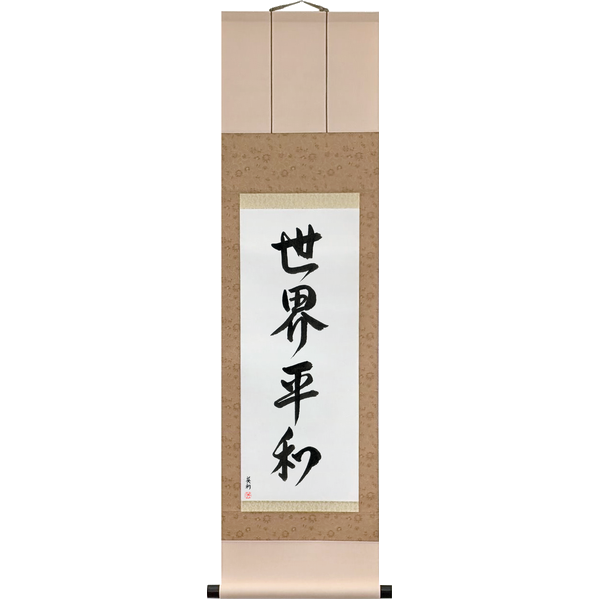
Sold as World Peace · Read sekai heiwa · What it is a Meiji compound of two translated words, 世界 the world and 平和 peace, made by translators of European political writing in 1879 to render the peace of the world, and since then the word of Christians, diplomats, nationalists, socialists, the throne, a wartime declaration and a postwar Diet · Oldest witness 1879, twice: 田口卯吉's translation of Leone Levi, carrying a sentence of John Stuart Mill, and a translation of a French treatise on government · In the dictionaries no headword in Japanese; world peace in the Japanese-English dictionaries from 1946 · Not Chinese the Chinese order is 世界和平; the Japanese order in Chinese is a loan of 1919 · Signed 典, 2026-09-07.
The words
世界 sekai began as a Buddhist word, the Chinese translation of Sanskrit lokadhātu: 世 the three times, past, present and future, and 界 the six directions. The 日本国語大辞典 first finds it in a poem of 818 and first finds the modern sense, all the countries on earth, in a Dutch-studies book of 1795, where the men of the far West send their ships to 世界万国. 平和 heiwa in its older sense meant calm or gentle: the 神道集 of about 1358 has brothers 平和 with one another, and Issa in 1816 writes wild geese lined up 平和 on the master's death-day, spelling it 平話. The sense the scroll carries, the absence of war, the same dictionary first finds in 1868, in 鈴木唯一's translation of an English book on how England is governed, where in 平和の時, in time of peace, the great barons shut themselves in their castles. That leaf was read. The reversed word 和平 wahei is older in Japanese and is the ordinary Chinese word for peace; in modern Japanese it has come to mean the making of peace rather than the state of it. 平和主義, pacifism, is 1883.
The compound 世界平和 has no entry in the national dictionaries. Weblio's usage dictionary defined it in 2012 as a state in which the whole world is free of war, famine and danger and everyone is at ease. The Japanese-English dictionaries of 1908, 1910, 1918 and 1919 do not list it; 竹原常太's dictionary of 1946 gives world peace; the world's peace, and that is what the house sells it as.
A history, from the earliest witness
1879: two translators. The National Diet Library's full-text index returns 7,189 books for 世界平和, and none of them is old: the four it marks as classical are twentieth-century manuscripts, and the three records dated before 1879 are noise in the machine reading. The two oldest real uses are both translations of 1879. 田口卯吉's version of Leone Levi's History of British Commerce closes with the sentence that the great expansion and rapid increase of international trade is the principal guarantee of 世界平和 and therefore the permanent protector of the progress of human thought, institutions and character. Levi was quoting John Stuart Mill, whose Principles of Political Economy of 1848 says that international trade, in being the principal guarantee of the peace of the world, is the great permanent security for the uninterrupted progress of the ideas, the institutions, and the character of the human race. Both texts were read at the page. The other 1879 witness is a translation of a French treatise on government, where a writer who proposes one currency for all nations says he need not fear the nickname of visionary that is given to those who aim at 世界平和 and one language for the world. The Japanese word was made to translate a European idea, from 世界 in its 1795 sense and 平和 in its 1868 sense.
The index also returns Tokutomi Sohō's Future Japan of 1886, and that is a trap worth naming: his contents page repeats the phrase 平和世界, the peaceful world, which he sets against 腕力世界, the world of force, and the machine reads 世界平和 across the boundary between two repetitions. His word is the other order.
1889–1902: the Christians, the diplomats, a nationalist, a socialist, a novelist. In 1889 the Christian reformer 中西牛郎 wrote that he had longed to make the teaching of Jesus the source of 世界平和 and spread its love and light until the four seas were calm. In 1890 the 大日本平和会 was founded at Yokohama. A boys' reader of 1892 tells the life of Elihu Burritt, the American blacksmith who learned dozens of languages and founded what the book calls a 世界平和會 to end war between nations; the leaf carries the reading せかいへいわ in small kana, the oldest furigana found. The diplomatic histories of the 1890s hand the phrase to the powers: Alexander III of Russia was called its guarantor (1895), Castlereagh sacrificed a nation's glory for it, Napoleon was its disturber, England its keeper (1897). In 1899 高山樗牛 made 世界平和の維持, the maintenance of world peace, a task of his Japanism. In 1901 幸徳秋水's Imperialism quotes Moltke against it: the hope of world peace is a dream, and not even a beautiful one; two years later his Essence of Socialism claims it for socialism. In 1902 矢野龍渓's utopian novel New Society gave it a chapter title, The future of the new society: the guarantee of world peace, the first title use found.
1907: the throne. On 19 April 1907 the Meiji emperor's rescript to the envoy he sent to the second Hague conference opened 朕常に世界平和の維持に眷々たり, We have ever been solicitous for the maintenance of the peace of the world. The leaf was read in the peace society's 1911 collection. By 1930 a schoolbook of the emperor's poems files five of them under the heading 世界平和, among them the 1904 poem written as the Russian war began, 四方の海みな同胞とおもふ世になど波風の立ちさわぐらむ, in a world where all within the four seas are brothers, why do the winds and waves rise?, and says that his devotion to 世界平和 was the concern of every day.
1919–1947: everyone's word. The Korean declaration of independence of 1919 calls Korea's freedom a necessary step toward 世界平和 and the happiness of mankind; Itagaki the same year names 人種平等世界平和 as the great ideal. The Greater East Asia declaration of November 1943 makes 世界平和確立 the ground of its argument. The Diet's resolution on the imperial will in 1945 resolves to bring 世界平和. The 1946 constitution uses neither form, writing 恒久の平和, lasting peace, and 国際平和, international peace; the 1947 education law's preamble uses the particle form, 世界の平和と人類の福祉. The mayors of Hiroshima and Nagasaki and the city declarations from 1970 keep the four characters.
Chinese reversed it. Chinese says 世界和平: Sun Yat-sen's speech of 1 April 1912 on the Chinese people's duty to promote it, the Republic's constitution, the United Nations documents. The Japanese order turns up in Chinese only in 1919–20, among the May Fourth writers who read Japanese: 李大釗 uses both orders in one essay, and Trotsky's The Bolsheviki and World Peace is cited in Chinese as Bolsheviki與世界平和. The particle form 世界の平和, the commoner in Japanese today, is later than the compound: its oldest witness is 1889.
The sense across time
The sense has not moved: the absence of war among nations, and the wish for it. What moved is who said it. A translator's phrase for Mill in 1879; a Christian society's aim in 1889; a schoolbook hero's league in 1892; the property of tsars and foreign secretaries in the 1890s; a nationalist program in 1899; the object of a general's scorn in 1901 and of a socialist's hope in 1903; an emperor's word in 1907; a declaration of war aims in 1943; a Diet's resolution in 1945; a city's motto since 1970. No school owns it, and each has used it against the others.
What is not a source
Not a proverb, not a Zen phrase, not a Chinese classic. Nothing before 1879 in a corpus of seven thousand books; the three earlier records are machine noise, checked at the page. Not Sohō's 平和世界, which is the other order. Not the constitution's phrase. Not a headword in any Japanese dictionary.
The text in English
Mill wrote the peace of the world in 1848, and universal peace was the nineteenth-century phrase in English, with a book called The Dawn of Universal Peace in 1792. World peace itself was rare in English before 1900, rises in the 1900s, becomes common in the 1910s with Trotsky's title of 1918 among the first, and peaks in 1945. The Japanese compound is thirty years older than the English currency of its usual translation. The Japanese-English dictionaries give world peace from 1946 and the peace of the world beside it.
A reading
Sell 世界平和 as what it is: a Meiji word of 1879, made from two translated parts to carry a European hope, and since then the word of every party in turn. That is the reason it can hang on anyone's wall. The page's gloss of the parts is true; harmony belongs to 和 rather than to 平和, which means the absence of war, but the gloss does no harm. World Peace is the right title, being what the dictionaries have given since 1946. If the page wants one sentence of history, it can say that the word was first written by translators of Mill and has since been used by a tsar's admirers, a socialist, an emperor and a postwar Diet, which is to say by everyone.
How this was read
By eye: the template; fourteen leaves at the scan — the 1868 translation, the two 1879 translations, Sohō's 1886 contents page, the 1889 tract, the 1892 reader, the 1895 Russian history, the 1899 essay, the 1901 Imperialism, the 1902 novel, the 1907 rescript in its 1911 print, the 1930 schoolbook at two places, the 1946 dictionary. By text at the address: the Diet Library's full-text index on 世界平和, 世界和平 and 世界の平和 pulled whole, every record before 1890 windowed at the page and sorted into real, noise and boundary artifact; Mill 1848 and Levi 1880 at the archive.org text layer; kotobank whole for 世界, 平和, 和平, 平和主義 and the Hague conference; Weblio, JMdict and jisho; Chinese Wikisource on four strings with Sun Yat-sen 1912 and 李大釗 1919 parsed whole; Japanese Wikisource with the 1919 Korean declaration, the 1943 declaration, the 1946 constitution, the 1947 education law and Wilson's fourteen points parsed; the Google Books ngram on four English phrases; the store files, both live routes. Not read: the 99 dictionary-like titles the index lists, the earliest 1906; Hepburn and Brinkley; the peace society's own papers and magazine; 内村鑑三 and 北村透谷 on the phrase; the French original of the 1879 treatise; Burritt's own writings; the OED; the 1915 national dictionary under 世界; the 1889–94 leaves of the particle form beyond their snippets. Every address is in the account.
References
Each witness is cited in the account above, at the frame or entry where it was read. A linked list follows when the record for this text is completed.