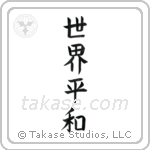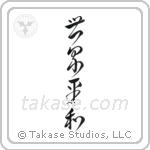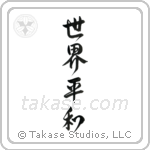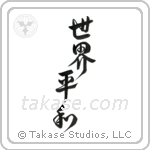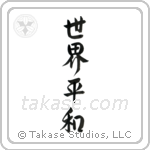

Peace among the nations and the wish for it, a word that no party owns: it has been the aim of Christian reformers and peace societies, the word diplomats gave to tsars and foreign secretaries, a nationalist's program and a socialist's hope, an emperor's word to his envoys, a postwar parliament's resolution and the motto of Hiroshima and Nagasaki, and each has used it against the others, which is why it can belong to anyone. What it means has not moved, the absence of war and the wish for it; whose wish it carries is the part that is yours. World Peace is the English every Japanese-English dictionary gives, and it is right; harmony belongs to 和 alone, and 平和 is the absence of war.
世界平和 is composed of the words 世界 (read sekai) meaning "the world" and 平和 (read heiwa) meaning "peace; harmony".
Made by translators of European political writing in 1879 to render the peace of the world, from two words that were themselves Meiji translations, 世界 for the world and 平和 for peace.
We want you to be as happy with the meaning as you are with Master Takase's art. To learn more, visit Philology of 世界平和.