

精神統一 · seishin tōitsu · Concentration
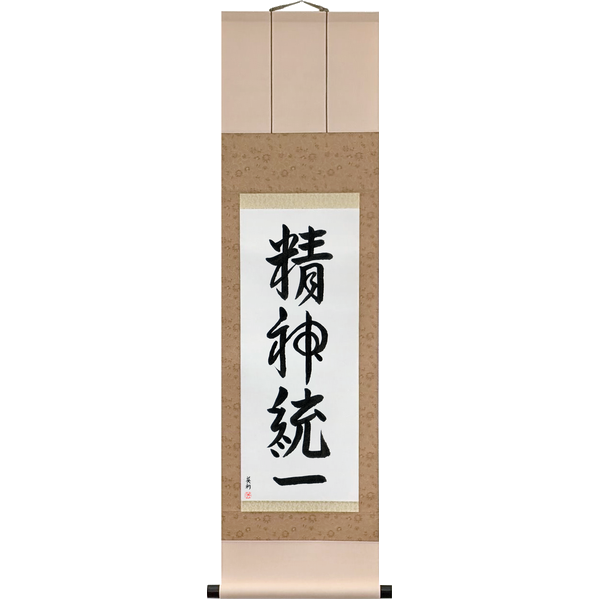
Sold as Concentration · Read seishin tōitsu, two words; the house writes it as one · Oldest witness a Japanese compound of the 1890s: the verbal form in a schools-law commentary of 1890, the four characters in a lecture on German philosophy in 1895 · Sense the mind made one: first the philosophers' unity of consciousness, then, from the 1910s, the practitioner's gathering of the mind on one thing before an act — the sense the kendō and kyūdō manuals of the 1920s and 30s settled and the dictionaries give today.
The words
Two words, one old and one new to Japanese. 精神 is the mind or spirit; the big dictionary has it from an eighth-century note in the Man'yōshū and grounds it in Zhuangzi, where the spirit flows out in all four directions, reaching up to heaven and coiling down to earth; its third sense, the will to see a thing through, 気力, is the one this compound uses, and the modern word also stands for the West's spirit, esprit and Geist. 統一 is to make one: a Chinese word the Book of Han uses of the Western Regions, many states and no unity, which the Japanese dictionary first cites from a scholar's handbook of 1783 and which took its philosophical sense, unity, in the Meiji translation dictionaries. Put together, 精神統一 is the mind made one. The compound is not a headword in the two great dictionaries; a dictionary of four-character phrases defines it as to concentrate the mind on one point when doing something and dates its first use to 1918; the standard Japanese-English dictionary gives concentration of mind; mental concentration (on some task). The Japanese Wikipedia has no article for it and sends the reader to meditation.
A history, from the earliest witness
The philosophers, 1890 to 1897. The word was made by the men who brought German philosophy and psychology into Japanese. A commentary on the elementary-schools law of 1890 asks how, without national schooling, one could 國民精神ヲ統一シ, make the nation's spirit one [3]. The four characters together appear in 谷本富's Lectures on Scientific Pedagogy (1895), a Herbartian's survey of philosophy since Kant: Fichte held Kant's categories 精神統一の義と相容れず, incompatible with the unity of the mind; the fourth question is 精神統一の事, the unity of the mind; and Wundt made apperception 精神統一の淵源, the source of the mind's unity [4]. Two years later a translation of Höffding's psychology speaks of 精神統一テフ純然タル靈魂的思想, the purely spiritual doctrine of the unity of the soul [5], and 元良勇次郎, Japan's first professor of psychology, makes it the ground of personhood in his Ten Lectures on Psychology: 統一ハ實ニ人格ノ基礎ナリ, unity is the very basis of personality; lose it and the person dissolves, as in madness; it has a rational, ordered form and a natural, emotional one, and a lecture heading promises the physiological basis of the unity of the mind [6]. In the same year a teaching manual uses it for the Herbartian idea that the school subjects should be bound into one, with moral thought at the center [7]. Three senses in one decade — the soul as one, the curriculum as one, the nation as one — and none of them yet a person sitting still.
The practice, 1911 to 1918. The national index counts seven books using the word in the 1890s, sixteen in the 1900s, a hundred and thirty-one in the 1910s. The first book with the word in its title is 渡邊歸一's The Theory of Concentration, Clairvoyance and Clairaudience (1911), from the year of the 千里眼 affair, when 福来友吉's subject 長尾郁子 said she could not 精神統一 if anyone doubted her [ja.wikipedia 福来友吉; text; the book not opened]. From then the word is the name of a method. A health manual of 1913 gives a 精神統一法 for sleeplessness, count from one to ten and again [9]; a hypnotist's textbook of the same year says hypnotism is nothing but a method of fixing the subject's attention on one point, that is, a 精神統一法, and describes the breathing exercise by which 雜念去りて精神統一し, the stray thoughts leave and the mind becomes one … which is what the Zen school calls entering samādhi [10]. 岡田虎二郎's quiet-sitting swept the decade, and his recorded words refuse the word: 無念無想になろうとか、精神統一とか、精神集中なんどは一切考えてはいけません, do not think about becoming empty of thought, or about concentration, or about focus, at all [ja.wikipedia 岡田式静座法; text]. A self-study book was titled Concentration Self-Taught in 1915 [catalogue; not opened]. The Zen side noticed. A Zen primer of 1915 says Zen has become fashionable, some say for training the will, some say for 精神統一, and they have not understood what Zen means [11]; and the Engakuji master 釈宗演, lecturing in 1918, says 近頃精神統一といふ文字が流行りますが、即ち身心統一の極に達した時はさうであります, lately the phrase 精神統一 is in fashion; it is what you reach at the limit of making body and mind one, and elsewhere defines samādhi as the point where the unity of my mind is complete [15]. A ninjutsu writer of 1917 sets the ninja against what the world calls 精神統一, which pushed far enough brings on thought-photography, clairvoyance and hypnosis, and asks instead for body and mind made one together [13]. The novelist 葛西善蔵 caught the fad in Taking the Child (March 1918): a policeman friend demonstrates his own quiet-sitting method, kept up for ten years, his upper body twisting and his forehead running with sweat, and 横井はそれを「精神統一」と呼んだ … 精神統一を練習し給え, Yokoi called it concentration … you should practice concentration — it helps him spot a suspect [Aozora card 47059; text]; this is the sentence the phrase dictionary cites as the word's first use. Beside all this the psychologists kept their sense: a 1918 translation of Coriat's Abnormal Psychology renders his mental synthesis, the opposite of dissociation, as 精神統一 [16].
The definition, 1926. 福来友吉, the psychologist of the 千里眼 affair, gave three lectures at 山口 in October 1925 and printed them as The Psychology of Concentration (1926). His definition: 精神統一とは、あらゆる一切の觀念が、一の目的實現に向つて共同一致して活動する狀態を云ふ, concentration is the state in which every idea works together toward the realization of one aim; it has two stages, 無念無想, the sweeping away of every stray thought until the mind is a clear mirror and still water, and 一念堅持, holding the one aim firmly in that stillness [19]. His examples are a jūjutsu master of Kumamoto, 星野九門, who told him that when a master pins something with a fingertip it is not the fingertip; the whole body's strength is gathered there [scans 71–72], the archer of the Liezi who learns not to blink and to see a louse as a cartwheel [scan 72], and the iai master 日比野雷風, whose draw is too fast for the eye [scan 73].
The manuals, 1919 to 1939. By the 1920s the word is the plain one in the martial and ceremonial manuals. A military psychology of shooting and fencing (1919): 射擊に於ては其精神は能く統一せらるゝを要す, in shooting the mind must be well unified, and the kiai arises when the mind is unified [17]. 堀田捨次郎's illustrated kendō manual (1922) lists among the aims of kendō training 四、精神を統一せしむ, fourth, to unify the mind, and teaches 精神を竹刀の一事に集中して精神を統一し, gather the mind on the single matter of the shinai [18]. In the volume recording the 1934 tournament before the emperor, a kendō fourth-dan from Aomori gives as the third reason he won: 勝敗を全然度外視し無欲の精神により完全に精神統一が出來, having set winning and losing wholly aside, my mind came fully together through a spirit without desire, I did not stiffen, and I fought with all I had [20]. A self-defense manual of 1935 has a sixth method, 精神統一法: count the breaths to a hundred [21]. The kyūdō textbooks make it the first condition of a correct shot. 竹内尉's Kyūdō Reader (1937): if you cling to the target, 精神の統一は亂れ, the unity of the mind is disturbed, and the target itself becomes 精神統一を破る邪魔物, the obstacle that breaks concentration; the bow to the target bank is not a prayer to hit; it is a rite toward the universe, and a rite toward the universe means making one's own mind one and holding oneself in restraint [23]. The women's kyūdō guide of 1938: 完全な精神統一を必要とする … はじめて正しい射が行はれ得る, a complete concentration is required; only with concentration, composure, calm and decision is a correct shot possible [24]. The Mushanokōji tea school's procedure book (1939) writes it into the sequence: 默禮をなして居ずまひを正し精神統一, bow in silence, settle the posture, concentrate [25]. A zazen primer of 1936: with the mind settled, 精神を統一し、不動の三昧に安住する, make the mind one and rest in unmoving samādhi, and everything is zazen [22]. The temple, the sword, the bow, the tea room: the three arts Eri's essay names, each with the word in print before the war.
After the war. The hypnotists kept the compound in their titles into the 1980s; a spiritualist society runs a 精神統一研修会; a 1962 newspaper profile of a weightlifting coach is headed concentration over strength; a 1977 play has a boy say he is seriously going to do 精神統一. The word is ordinary Japanese: a headband, the Japanese Wikipedia says, is worn when concentration or morale is needed.
The sense across time
One word, two senses in sequence. From 1890 to the 1900s, the unity of the mind: a philosopher's and psychologist's term for consciousness as one thing, the ground of personhood, the curriculum as one. From the 1910s, the gathering of the mind on one thing: a method, then a state, first in the hypnotists' and quiet-sitters' books and the 千里眼 laboratory, then, by the 1920s and 30s, in the kendō, kyūdō, tea and zazen manuals. The two senses meet in 福来's 1926 definition, every idea working as one toward one aim, and in 宗演's the limit of making body and mind one. The catalogue's Concentration is the second sense and is right.
What is not a source
Not Chinese: Chinese Wikisource has the four characters only in Republican-era political texts, and the national index's classical shelf has none. Not Zen: the Zen masters of 1915 and 1918 name the word as a fashion from outside and fold it into their own 三昧. Not 岡田虎二郎's, who disowned it. Not a maxim with an author. The classical neighbor a buyer may be thinking of is 精神一到何事か成らざらん, where the mind reaches, what can it not accomplish, from the Zhuzi yulei; a hanging scroll with its eight characters appears in a novel of 1885, and the national index finds it in over two thousand pre-war books. That phrase is on the occasion shortlist; this scroll is the modern word.
The text in English
The English is recent, and the house's own essay sits in the middle of it. The earliest found is Esquire for March 1976, a piece on the aikidō teacher Terry Dobson: the awake people are called seishin-toitsu … the Japanese spend a lot of time developing seishin-toitsu, through Zen, aikido, plus the other martial arts … a sense of unity, alertness — in other words, seishin-toitsu [archive.org esquire_1976-03_85_3; snippets; the author not derived] — a state, and, wrongly, a name for a kind of person. Joe Hyams's Playboy's Book of Practical Self-Defense (1981) repeats the sentences [snippet]. Masaaki Hatsumi's Essence of Ninjutsu (1988) has it as a heading, Ninjutsu Daihi Seishintoitsu Shuyouikkan, in the one-word romaji the house also uses [snippet]. Eri Takase's essay for Kampsport, January 1999, is next: my dictionary … says it means "concentration" or here "concentration of mind". While this definition is true, it is also unsatisfactory; the word is when my spirit (seishin) is gathered (touitsu), when my mind (seishin) is one (touitsu), reached through the temple gate, the grinding of the ink, the tea ceremony and the sword [website/content/library/seishintouitsu-concentration-of-mind.md; text]. Then the Reiki books, from 2003: Bronwen and Frans Stiene's Reiki Sourcebook (2003) and Japanese Art of Reiki (2005) give Seishin Toitsu: a unifying the mind meditation, the third part of the hatsurei-hō sequence; Penelope Quest (2002, 2007) concentration or meditation; Nina Paul (2005) attaining a unified mind; Nicholas Pearson (2018) the final stage of hatsurei [archive.org; snippets and metadata]. Of fifty-six books in the Internet Archive's full text with the romaji, the great majority are Reiki. Today: the standard Japanese-English dictionary's concentration of mind is the gloss Eri's essay and the catalogue share; this history's gloss is the mind made one, which keeps 統一's plain sense.
A reading
A word with no source is still a text with a history, and this one's is clean and short. 精神統一 was made in the 1890s by the Japanese who were making a vocabulary for German philosophy, for the unity of the mind; in the 1910s it became something one does, in the hypnotists' and quiet-sitters' manuals and the clairvoyance laboratory, a fad a Zen master named and a novelist laughed at; and by the 1920s it was the plain word in the kendō and kyūdō manuals, the tea school's procedure and the zazen primer for the gathering of the mind before an act. 福来's definition of 1926 — every idea working together toward one aim, in two stages, the mind swept clear and the one aim held — is what the scroll sells, and the kyūdō sentence of 1937, a rite toward the universe, not a prayer to hit the target, is the ground a martial buyer should read. The catalogue's Concentration is right; Focus the Spirit is a paraphrase and can go. The page already has the best thing it could have, Eri's own essay, which is itself a witness in the word's English history, three years before Reiki took the word up; what the page lacks is a date, and the one link it gives to the essay lands on the Library index instead. Signed, 典, 2026-09-07, s58.
How this was read
As text at the National Diet Library's next-generation digital library, the scan number part of each address and derived from the library's OCR bundle: 『小学校令釈義』1890 (pid 797495, scans 16, 23, 65); 谷本富『科学的教育学講義』1895 (pid 808195, scans 60, 65, 76); ヘフヂング『心理学』1897 (pid 759734, scan 27); 元良勇次郎『心理学十回講義』1897 (pid 759759, scans 7, 99, 100, 102); 土井亀之進『実験普通教授学』1897 (pid 810172, scan 9); 樫田十次郎『体力精力増進法』1913 (pid 935515, scan 16); 北川潔『科学的催眠学』1913 (pid 949389, scans 79, 107); 渡辺約山『禅学活要』1915 (pid 944036, scan 220); 伊藤銀月『忍術の極意』1917 (pid 1088342, scan 85); 釈宗演『禅海一瀾講話』1918 (pid 943659, scans 56, 101); コーリアット『変態心理学』1918 (pid 980621, scans 19, 20); 『射撃と剣術並に航空術の心理』1919 (pid 942248, scans 14, 18, 59); 堀田捨次郎『図解剣道教範』1922 (pid 965095, scans 12, 21, 160); 福来友吉『精神統一の心理』1926 (pid 981789, scans 3, 71, 72, 73); 『昭和天覧試合』1934 (pid 1232699, scan 307); 『武道極意護身術秘伝』1935 (pid 1025860, scan 130); 中根環堂『坐禅の極意』1936 (pid 1036952, scan 20); 竹内尉『弓道読本』1937 (pid 1052433, scans 44, 49); 『女子弓道指針』1938 (pid 1054810, scan 7); 『千家官休庵流点前』1939 (pid 1239799, scans 18, 78). A leaf named as pid P, scan N has its text at lab.ndl.go.jp/dl/api/page/P_N. By the library's full-text index on the phrase, its verbal forms, 精神統一法 and the neighbors, paginated whole and sorted by year, with the classical facet and the subject classes read on each. As text: kotobank's entries for 精神, 統一, 精神統一, 精神修養 and 精神一到 whole; JMdict; the national catalogue by title with dates; the Japanese Wikipedia's redirect and ten articles; Chinese Wikisource's search and Zhuangzi at the line; Aozora's text of 葛西善蔵『子をつれて』at its three uses; Eri's essay in the repository and its live address. By the Internet Archive's full-text index on the romaji, ten English books read as snippets with their metadata. By eye: the template. Not opened: the 1911 and 1915 titles; 谷本 at the page for the German term; 村上 1929; 浅野 1941; Kampsport 1999 in print; Esquire, Hyams, Hatsumi and the Reiki books at the page; any 19th-century Japanese-English dictionary; 弓道教本 1953. The full apparatus, with every address, is in the account.
References
- 莊子 刻意 () — zh.wikisource 莊子/刻意 (text)
- 朱子語類 学二 (via 日国) () — kotobank 精神一到何事か成らざらん (text)
- 日下部三之介『小学校令釈義』 (1890) — NDL pid 797495 komas 16 · 23 · 65 (OCR) ↩
- 谷本富『科学的教育学講義』 (1895) — NDL pid 808195 komas 60 · 65 · 76 (OCR) ↩
- ヘフヂング『心理学』石田新太郎 訳 (1897) — NDL pid 759734 koma 27 (OCR) ↩
- 元良勇次郎『心理学十回講義』 (1897) — NDL pid 759759 komas 7 · 99 · 100 · 102 (OCR) ↩
- 土井亀之進『実験普通教授学』 (1897) — NDL pid 810172 koma 9 (OCR) ↩
- 渡邊歸一『精神統一千里眼千里耳の學説』 (1911) — NDL Search (catalogue; not digitized)
- 樫田十次郎『体力精力増進法』 (1913) — NDL pid 935515 koma 16 (OCR) ↩
- 北川潔『科学的催眠学』 (1913) — NDL pid 949389 komas 79 · 107 (OCR) ↩
- 渡辺約山『禅学活要』 (1915) — NDL pid 944036 koma 220 (OCR) ↩
- 横井無隣『内観録:精神統一自習書』 (1915) — NDL Search (catalogue)
- 伊藤銀月『忍術の極意』 (1917) — NDL pid 1088342 komas 77 · 85 · 87 (OCR) ↩
- 葛西善蔵『子をつれて』 (1918) — Aozora card 47059 (text; 早稲田文学 1918-03)
- 釈宗演『禅海一瀾講話』 (1918) — NDL pid 943659 komas 56 · 101 (OCR) ↩
- コーリアット『変態心理学』佐藤亀太郎 訳 (1918) — NDL pid 980621 komas 8 · 19 · 20 · 30 (OCR); Coriat 1910 *mental synthesis* (archive.org abnormalpsycho00cori, snippet) ↩
- 下沢瑞世 編『射撃と剣術並に航空術の心理』 (1919) — NDL pid 942248 komas 9 · 14 · 18 · 59 (OCR) ↩
- 堀田捨次郎『図解剣道教範』 (1922) — NDL pid 965095 komas 12 · 21 · 32 · 160 (OCR) ↩
- 福来友吉『精神統一の心理』 (1926) — NDL pid 981789 komas 3 · 71 · 72 · 73 (OCR) ↩
- 『昭和天覧試合』 (1934) — NDL pid 1232699 koma 307 (OCR) ↩
- 『武道極意護身術秘伝』 (1935) — NDL pid 1025860 komas 105 · 130 (OCR) ↩
- 中根環堂『坐禅の極意』 (1936) — NDL pid 1036952 komas 20 · 47 (OCR) ↩
- 竹内尉『弓道読本』 (1937) — NDL pid 1052433 komas 44 · 49 (OCR) ↩
- 『女子弓道指針』 (1938) — NDL pid 1054810 koma 7 (OCR) ↩
- 『千家官休庵流点前』 (1939) — NDL pid 1239799 komas 18 · 78 (OCR) ↩
- 岡田虎二郎 語録 ((1910s)) — ja.wikipedia 岡田式静座法 (text)
- Esquire 85(3) (1976-03) — archive.org esquire_1976-03_85_3 (snippets)
- Hyams, Playboy's Book of Practical Self-Defense (1981) — archive.org playboysbookofpr00hyam (snippet)
- Hatsumi, Essence of Ninjutsu (1988) — archive.org essenceofninjuts00hats (snippet)
- Eri Takase, Kampsport (1999-01) — website/content/library/seishintouitsu-concentration-of-mind.md (text)
- Stiene, The Reiki Sourcebook · The Japanese Art of Reiki (2003 · 2005) — archive.org reikisourcebook0000stie · japaneseartofrei0000stei (snippets)
- Quest · Paul · Pearson (2002–2018) — archive.org (snippets; metadata)
- kotobank 精神 · 統一 · 精神統一 · 精神修養 () — https://kotobank.jp/word/… (text)
- Template M6001SSVB3A () — takase-images (by eye)