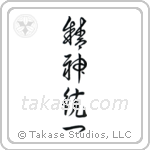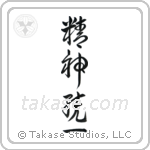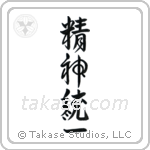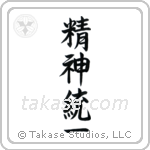

Concentration, the mind made one.
Couldn't add to cart. Please try again.
Concentration, the mind made one.
Couldn't add to cart. Please try again.
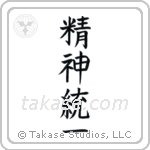
精神統一 is the whole mind gathered on a single point. 精神 is the mind or spirit, and 統一 is to make one. A Japanese psychologist of the 1920s described it in two stages: first the mind is swept clear of every stray thought, and then one aim is held in that stillness. For an archer, the silent bow toward the target before the shot is not a prayer to hit; it is the act of making one's own mind one.
精神統一 is composed of the words 精神 (read seishin) meaning "mind; spirit" and 統一 (read tōitsu) meaning "gather; unify".
| When in Japan I visit Zen temples for what is called Seishin Toitsu which my dictionary says means "concentration". While this definition is true, it is also unsatisfactory. By stepping through the temple gate, I am transported to a world of harmony and tranquility. The temple will be, perhaps, covered in early autumn. Around me the multi-colored leaves will fall like jewels to the dew covered ground. Here there is no male and female. There is no age. There is no social standing. It is this place and this state of mind I come to when my spirit (seishin) is gathered (toitsu), when my mind (seishin) is one (toitsu). Gone are the myriad distractions and all that remains is myself, focused and attentive on the here and now. All is equal and in harmony and this transcends all. To read the complete article visit Seishin Toitsu by Eri Takase. |
The compound has no Chinese source and no single author: it was made in the 1890s by the Japanese scholars building a vocabulary for German philosophy and psychology, and by the 1920s and 1930s it was the plain word of the kendō, kyūdō and zazen manuals for gathering the mind before an act.
We want you to be as happy with the meaning as you are with Master Takase's art. To learn more, visit Philology of 精神統一.
Each design is Master Japanese Calligrapher Eri Takase's hand-brushed calligraphy of the word or phrase on this page, delivered as a PDF you can print. Every PDF includes the line art, so a tattoo artist or a craftsperson can work from the outline as well as the brushed image.
Your purchase includes a personal-use license: use the design as a tattoo reference, frame it, engrave it, print it for yourself, or make it into a gift. For more information see Licensing, which also covers commercial-use options that may be purchased separately.
Your PDF is available for download the moment your order completes, and a copy is attached to your emailed receipt.
If you need your design again later, ask us for it and we will send it.
Master Takase personally brushes your scroll when you order, and it bears her red seal and her signature. The scroll has real silk borders and layered Japanese paper, so it hangs straight, and it arrives ready to display.