

精力善用 · 自他共栄 · seiryoku zen'yō · jita kyōei · The two principles of judo
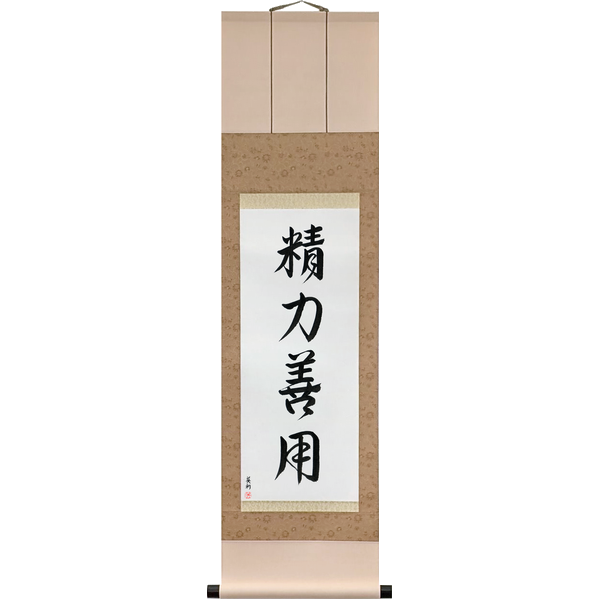
Sold as two scrolls, Maximum Efficiency Minimum Effort and Mutual Benefit, and in 2026 as one piece · Read seiryoku zen'yō, jita kyōei · Oldest witness for the pair, the Kodokan Cultural Society's statement of purpose printed in 1925; for the first four characters alone, a sociologist's chapter title of 1911 · Sense use your energy in the best way, and from that, you and others prosper together: 嘉納治五郎's two principles, the rule and its result.
The words
Two phrases of four characters. 精力善用: 精力 energy, vigor, 善用 to use well; the Kodokan's own longer form, which its founding statement uses, is 精力最善活用, the best and most living use of energy, and the four characters are its abridgement. 自他共栄: 自他 self and others, 共栄 to prosper together; the same statement gives it a longer form too, 相助相譲・自他共栄, help one another, yield to one another, prosper together. The old books write 榮; Eri brushes the modern 栄. The catalogue's glosses are right one by one. Neither phrase is in a Japanese dictionary: kotobank returns nothing for either, and the bilingual JMdict has no entry. They belong to judo and to the schools and societies that borrowed them, and their definitions are the Kodokan's.
A history, from the earliest witness
1911, 遠藤隆吉, 生活の趣味, a sociologist's book on the pleasures of living, chapter 精力善用論, read at the National Diet Library's copy. Eleven years before the Kodokan fixed the phrase, it is a chapter title: On the good use of one's energy. 人間は精力善用と云ふことが必要であらうと思ふ, I think a person needs what is called the good use of energy; every moment should develop the self, and to reach that state one must use one's own energy well: a scholar who sits all day with his books is doing what he should, but one who smokes and gazes out of the window, or rests his chin in his hand watching others exercise, or strolls about to no purpose, cannot be said to have used his energy well. The four characters were ordinary Japanese, and the library's index has three more uses between 1914 and 1920 with nothing to do with judo. What Kano did was fix them as a principle and pair them. [2]
Around 1922, 嘉納治五郎 and the 講道館文化会, the Kodokan Cultural Society. Every witness puts the fixing of the pair here: the Kodokan's own bilingual dictionary dates both phrases to 1922; a Nippon Budokan history has Kano declare at the society's council in 1922 that 精力最善活用, now referred to as seiryoku zenyō, is the principle; an American history has the society founded in 1922 on the two. The library's index agrees from its own side: 自他共栄 is absent before 1924 and in four books in that year, two of them about scientific management and civic youth rather than judo, which is what a freshly launched slogan looks like in print; the pair 精力善用自他共栄 is a primary school's lesson title in Fukushima in 1924. Kano's own books that carry them, 『精力善用国民体育』(1930) and 『柔道教本』(1931), are catalogued but not digitized and were not read. [The index; the Kodokan dictionary, Bennett and Brousse by snippet.]
1925, the society's statement of purpose, printed in the 柔道年鑑 and reprinted verbatim in the yearbooks to 1939, read at the scan. Written in the founder's first person, it is the Kodokan's own definition and the nearest thing to Kano's words opened here. The principle of judo, it says, applied to the body makes the strongest body, to the mind the best man, to food, clothing, housing and manners the people's welfare, to business its results. Then the diagnosis and the cure: 近來の我が國は、勞を厭ひ逸を追ふものが益々增加し、奢侈贅澤風をなし、到る所、個人も團體も、喧嘩、小競合ひで精力を消耗しつゝあるの現狀である。これを救ふには、一面柔道の原理を社會生活に應用した主義である精力最善活用に依て各般のことを行ふと同時に、その自然の結果として成立する相助・相讓・自他共榮主義を以て、個人、團體相互の融和、協調を圖るより外に有効なる道はないと信ずる, in recent years more and more of our people shun labor and chase ease, luxury has become the fashion, and everywhere, individuals and groups alike, energy is being worn away in quarrels and squabbles. To cure this there is no effective way but to do everything by the principle that is judo's applied to social life, the best use of energy, and at the same time, by the principle that comes into being as its natural result, helping one another, yielding to one another, prospering together, to seek harmony and concord between persons and between groups. The two are cause and effect. And the statement ends abroad: Japan, differing from the West in race, language, religion and custom, has not yet one true friend in the world, and to mend its international relations there is no means but to carry the principle of 自他共栄 through to the end. [3]
1928 to 1939, the phrase in the schools. A 1928 treatise on handicraft education quotes Master Kano's words and glosses 自他共栄 as 共存共栄, coexistence and co-prosperity; the Ministry of Education's 1932 handbook on physical education repeats the whole formula with the imperial house at its center; a town history of 1936 records a branch of the society holding up the two great spirits of 精力善用自他共栄; a teachers' college in 1939 makes its pupils apply them to every part of daily life; and the Tokyo prefecture's register of 1937 defines the society by thought-guidance and life-improvement by the 精力善用自他共栄 principle. Seventy-four books in the index carry the first phrase before 1945 and a hundred and six the second. [6][7][9][8]
Today. The Kodokan's English of 1955 fixed the slogans as Maximum-Efficiency and Mutual Welfare and Benefit, and its 2020 history renders them maximum efficient use of energy and mutual prosperity for oneself and others. No Japanese dictionary opened enters either phrase. [The Kodokan, by snippet; kotobank.]
The sense across time
One sense each, and one relation between them, unchanged since 1925: 精力善用 is a rule for the use of oneself, in the body first and then everywhere, and 自他共栄 is what follows when everyone keeps it. The first phrase had a private, almost domestic sense before judo took it, the good use of an hour; Kano made it a principle of the body and then of a nation. The second was his from the start and was aimed, in his own statement, at Japan's neighbors as much as at the dojo.
What is not a source
The 1911 chapter is a prehistory of the words, not a source of the principle; nothing opened says Kano knew it. The wartime English mutual prosperity, which the Nippon Times uses in 1943 and 1944 for the Greater East Asia sphere, translates a different Japanese, 共栄圏, and is not this phrase, though it shares the character 栄 and the translators' word; the coincidence is worth knowing because the same English words carry both. 共存共栄, coexistence and co-prosperity, is a neighbor the 1928 gloss offers, not an origin.
The text in English
No Meiji dictionary enters either phrase; they reach English with judo itself. 1945–46, the Budokwai, Judo Quarterly Bulletin, vol. 1, London. A contents line, Judo: Maximum Efficiency and …, the earliest English found. [snippet.] 1955, the Kodokan, Judo, Tokyo. Professor Kano summarized the above teaching in the slogans, Seiryoku-Zen'yō, the Maximum-Efficiency, and Jita-Kyōei, the Mutual Welfare and Benefit. The Kodokan's own English, and the standard since. [snippet.] 1963, Richard Bowen, Judo, Collins, and The Key to Judo. The motto Jita Kyoei (literally "mutual welfare and prosperity"), the literal that the house's catalogue text repeats. [snippets.] 1974, Judo Handbook. An examination question: Explain the meaning of Seiryoku-Zen-yo, Jita Kyoei, and how it affects one in daily life. [snippet.] 1987, Pat Harrington, Judo: A Pictorial Manual, David & Charles, ISBN 071538984X. Seriyoku-zenyo (maximum efficiency) and jita-kyoei (mutual welfare and benefit), with a reproduction of Dr Kano's handwriting of both. [snippet.] 1986, Kanō Jigorō, Kodokan Judo, Kodansha International, the 1994 printing, ISBN 4770017995. The founder's manual in English, with a chapter on Principles and Aims. [contents only.] 1995, John Stevens, Three Budo Masters, Kodansha, ISBN 4770018525. Kano's other essential principle, jita kyoei, "mutual aid and co-operation." [snippet.] 2005, Takahashi Masao, Mastering Judo, Human Kinetics, ISBN 073605099X. "Seiryoku zenyo" (maximum efficiency with minimum effort) and "jita kyoei" (mutual welfare and benefit), the expansion the house's first title uses. [snippet.] 2005, Murata Naoki, ed., Mind Over Muscle: Writings from the Founder of Judo, Kodansha, the 2013 printing, ISBN 1568364970. Seiryoku zenyo (maximum efficiency) and jita kyoei (mutual prosperity). [snippet.] 2009, Alexander Bennett, ed., Budō: The Martial Ways of Japan, Nippon Budokan. "Seiryoku-zenyo" (the most efficient use of energy), "Jita-kyoei" (mutual prosperity), and the note that Kano's 1922 wording was the long form. [snippet.] 2020, The Legacy of Kano Jigoro: Judo and Education, Japan Publishing Industry Foundation, ISBN 9784866581361. Seiryoku zen'yo (maximum efficient use of energy) and jita kyoei (mutual prosperity for oneself and others). [snippet.] Kano's own English, in his lecture The Contribution of Judo to Education at the University of Southern California, printed in the Journal of Health and Physical Education in November 1932, is cited by a dozen later books and was not opened.
Today. The English forms are the judo world's, not any one translator's: maximum efficiency, alone or with minimum effort, for the first; mutual welfare and benefit, mutual prosperity, mutual benefit for the second. The house's Maximum Efficiency Minimum Effort is Takahashi's 2005 wording without its with, and its Mutual Benefit the plain form of the teaching books; both are the house's choices among current forms, made for Takase Studios. A rendering must keep the first as a rule about energy, not effort, and the second as together, not for others.
A reading
The two scrolls are right and the pages under them say the one thing that matters, that these are Kano's principles. What a buyer should also know is the grammar: in the Kodokan's own sentence the second phrase is not the companion of the first but its consequence, the rule and what follows from keeping it, and the 2026 special that put both on one piece had that grammar right. Two smaller things are worth a line each: the first phrase was ordinary Japanese before judo, a sociologist's chapter title in 1911, so what Kano made was a principle, not a coinage; and the second was aimed, in his own statement, at a Japan without one true friend in the world, which is a larger claim for a dojo wall than the English mutual benefit lets on. No change to either design, reading or title.
How this was read
By OCR at the National Diet Library's next-generation digital library, the scan number part of each address: the 1925 judo yearbook (pid 964759, scan 16, and scans 18–19 and 33 for the Kodokan's own history); 遠藤's 1911 book (pid 898530, scans 10 and 113); the 1937 Tokyo prefectural history (pid 1686821, scan 306); Kano's 1928 『攻防式国民体育』(pid 1099530), grepped and found not to carry either phrase. A leaf named as pid P, scan N has its text at lab.ndl.go.jp/dl/api/page/P_N and its image at dl.ndl.go.jp/api/iiif/P/R<N as seven digits>/full/full/0/default.jpg. From the index alone, scan not derived: the yearbooks of 1928–1939, the 1924 and 1926–1939 school and civic books, the 1935 library catalogue. As text: kotobank's four probes (all empty) and JMdict through the gokanji database (empty); the library's full-text index on eight spellings, every early hit read in its highlight; the Internet Archive's index on the romaji and four English renderings, snippets only, the books dated from their scan records. By eye: the two scroll templates. Not opened: Kano's 1930 and 1931 books; the 作興 magazine; his 1932 lecture; the studies of Niehaus and 老松; the English judo books at the page.
References
- The designs (ours) (—) — templates M1025SSVB5A · M1081SSVB5A, by eye; cultural_works 448 · 500
- 遠藤隆吉『生活の趣味』, chapter 精力善用論 (1911) — NDL pid 898530 scan 113, OCR; contents at scan 10; reprinted in 『常識百話と生活の趣味』1918 (harvest pid 959103, komas 161 · 244 · 246) ↩
- 講道館文化会, the statement of purpose, in 『柔道年鑑』大正14年度 (1925 (the statement reprinted verbatim in the yearbooks of 1928, 1930, 1933, 1935, 1937, 1939)) — pid 964759 scan 16, OCR; image `dl.ndl.go.jp/api/iiif/964759/R0000016/full/full/0/default.jpg`; the 1928 yearbook (pid 1121921) adds that the 作興 magazine *clarifies each issue the sense of 精力善用・自他共榮 that Master Kano has preached for many years* ↩
- 小学校に於ける新教育の実際 (1924) — pid 939413, highlight; the earliest pairing of the two four-character forms in the index
- 国松豊『科学的管理法に就て』· 石井常造 (1924) — pids 978947 · 981735 · 981736, highlights: the phrase outside judo in its first year
- 鈴木定次『手工教育学原論』 (1928) — pid 1279662, highlight ↩
- 文部省『現代体育の施設と管理』 (1932) — pid 1119716, highlights ↩
- 東京府『東京府史』行政篇, the 文化会's entry (1937) — pid 1686821 scan 306, OCR (the founding year reads 大正二 in the OCR; the Kodokan's own dictionary gives 1922) ↩
- 御影町誌 · 学校体操教授指針 · 宮城県師範学校 (1936 · 1936 · 1939) — pids 1257877 · 1461801 · 1278088, highlights ↩
- 天理図書館図書分類目録 (1935) — pid 1236650, highlight; the book itself NOT on the Lab
- kotobank · JMdict (current) — probes 404; gokanji.db none
- The NDL Lab full-text index, pre-1945 (1911–1944) — `labsearch_*.json`
- The Budokwai, *Judo Quarterly Bulletin* vol. 1 (April 1945 – January 1946), London (1945–46) — archive.org `budokwai.-1946.-judo-quarterly-bulletin-vol.-1-nos.-1-4…`, snippet; the earliest English found
- Kodokan, *Judo* (the Kodokan's own English handbook) (1955) — `judo0000kodo`, snippet
- Richard Bowen, *Judo* (Nutshell Books 19), Collins · *The Key to Judo* (1963) — `judonutshellbook0000rich` · `keytojudo0000unse`, snippets
- *Judo Handbook* (1974) — `judohandbook0000unse`, snippet
- Pat Harrington, *Judo: A Pictorial Manual*, David & Charles (Tuttle 1992) (1987 (ISBN 071538984X)) — `judopictorialman0000harr`, snippets
- Hamada Hiroyuki, *Spirit of Japanese Classical Martial Arts* (1990 (ISBN 0840360398)) — `spiritofjapanese0000hama`, snippet
- Kanō Jigorō, *Kodokan Judo*, Kodansha International (1986 (the 1994 printing, ISBN 4770017995; 2013, 9781568365398)) — `kodokanjudo0000kanj` · `kodokanjudo0000kano`, contents only
- John Stevens, *Three Budo Masters*, Kodansha (1995 (ISBN 4770018525)) — `threebudomasters0000stev`, snippet
- Kawamura Teizō, ed., *Kōdōkan New Japanese-English Dictionary of Judo* (2000) — `kodokan-new-japanese-english-dictionary-of-judo-etc.`, snippet (the OCR garbled)
- Takahashi Masao, *Mastering Judo*, Human Kinetics (2005 (ISBN 073605099X)) — `masteringjudo0000unse`, snippet
- Michel Brousse, *Judo in the U.S.*, North Atlantic (2005 (ISBN 1556435630)) — `judoinuscenturyo0000brou`, snippet
- Murata Naoki, ed., *Mind Over Muscle: Writings from the Founder of Judo*, Kodansha (2005 (the 2013 printing, ISBN 1568364970)) — `mindovermusclewr0000kanj`, snippet
- Alexander Bennett, ed., *Budō: The Martial Ways of Japan*, Nippon Budokan (2009) — `martialwaysofjap0000alex` · `budomartialwayso0000unse`, snippets
- *The Legacy of Kano Jigoro: Judo and Education*, Japan Publishing Industry Foundation (2020 (ISBN 9784866581361)) — `legacyofkanojigo0000seit`, snippet
- Kanō, "The Contribution of Judo to Education", *Journal of Health and Physical Education*, November 1932 (1932) — `american-journal-of-psychotherapy_1988-07_42_3` and eleven later books, snippets; the lecture NOT opened
- The house (2026) — the live pages