

再生 saisei Rebirth
This is a philological study of 再生 (saisei), following the word from a Buddhist treatise on a tooth that grows back and the Chinese tales of the dead who return, through a Japanese boy who remembered a former life, into the English word rebirth.
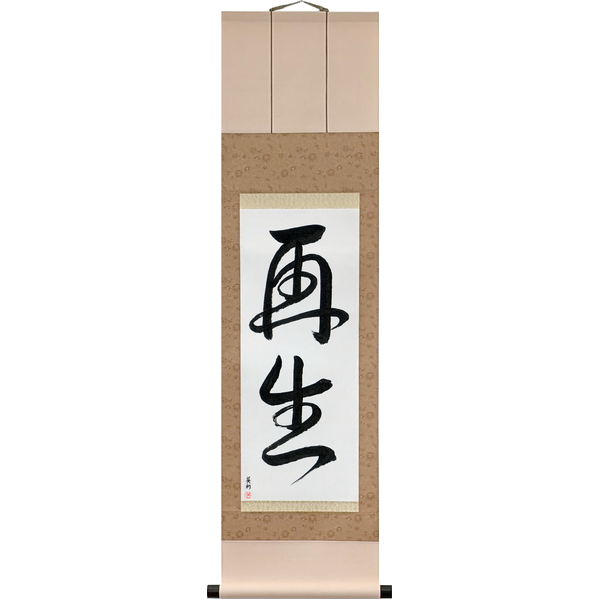
Abstract
再生 (saisei) is a Sino-Japanese compound, 再 again and 生 to live, to be born, whose Japanese senses begin with coming back to life and with starting one's life over, which every modern dictionary puts first, and go on to being born into this world again, the Christian new birth, and the modern senses of recycling, biological regeneration and playback. The word is Chinese and old: a Buddhist treatise translated by Kumārajīva in 406–12 uses it for a tooth that grows back and then denies that the old tooth grows at all, and a Song compendium of tales files the dead who return in their own bodies under 再生 while keeping those who remember a former birth under another heading. The history below finds that the sense an English reader hears in rebirth, a new birth remembered from inside the next life, became famous in Japanese with the case of the boy Katsugorō 勝五郎 in 1823 and reached English through Lafcadio Hearn's The Rebirth of Katsugorō in 1897, while the Meiji dictionaries filed born again into the world under other words; the Zen phrase 枯木再生花, the withered tree flowers again, shares the image and not the word.
Overview
The sense. A standard word of every register, common in modern speech, a noun and, as 再生する, a verb. デジタル大辞泉 gives seven senses, and the first three are the word's life: 衰え、または死にかかっていたものが生き返ること。蘇生, the coming back to life of what was failing or near death; resuscitation; 心を改めて正しい生活に入ること。更生, mending one's heart and entering an upright life; reform; and 再びこの世に生まれること。再誕, being born into this world again; then recycling, playback, the regrowth of lost tissue, and, in psychology, recall [1]. 精選版 日本国語大辞典 gives eight senses in the same order and dates them: the first, 死にかかったものが生きかえること … 絶体絶命の状態から助かること, coming back to life … being saved from a desperate plight, from a novel of 1807–11; the second, 心を入れかえて新しい生活をすること, turning one's heart and beginning a new life; the third, 再びこの世に生まれること, from the dictionary 文明本節用集 of the mid-Muromachi and a book of 1875; the fourth, the Christian 神の恵みにより、霊的に新しく生まれかわること, being spiritually born anew by the grace of God; the revival of what was lost and the psychological recall from 1886, biological regeneration from 1887, recycling from 1960 and playback from 1966 [1]. The 日国 also enters a second reading, さいしょう, with the one sense 再びこの世に生まれてくること, being born again into this world, from a chronicle entry on 1225 [1]. English rebirth is narrower and leans the other way. The ブリタニカ entry that heads 再生 with the English rebirth defines it as いったん死んだのち再び生き返ること, coming back to life after once dying, and then names what it means in religion: the rites of passage, each stage of a life understood as death and rebirth; the conversion that Paul, Augustine and Luther described as a second birth; and the belief in being born again after death, in this world or another, which joins it to the ideas of 輪廻 and 転生, the round of births and transmigration [1]. So rebirth covers the third and fourth Japanese senses and the second loosely; it does not say the first, which English calls revival or resuscitation, or the technical senses, which English calls recycling, regeneration and playback. Where an English reader means the Buddhist round of lives, the Japanese words are 輪廻 and 転生; the dictionaries' own neighbors for 再生 are 蘇生 for coming back to life, 更生 for reform, 再誕 for a new birth in this world and 新生 for the Christian one [1].
The words. 再 is again, a second time, and 生 is to live, to be born, to grow: the compound is literally living again, and which of 生's senses a writer means decides which 再生 is on the page. The reading is saisei in every modern dictionary, in James Curtis Hepburn's of 1867 and in the ruby of a print of 1807 [1][2][3]; the 日国's second reading, saishō, rests on a chronicle entry whose typeset of 1905 prints no furigana [1][4], and a printing of 1931 of Inoue Enryō 井上円了's 妖怪学, the study of the uncanny, has both, 再生兒 read さいせいじ for the children in its reports and 六道再生 read さいしやう for rebirth in the six paths [5]. The Princeton dictionary of Buddhism gives saishō as the Japanese of Sanskrit punarjanman, birth again [6]. The Zen phrase 枯木再生花 sets the two characters side by side without the compound in it: it is read 枯木再ビ花ヲ生ズ, the withered tree again puts forth flowers, 再 an adverb and 生 a verb whose object is 花, and the Zen dictionary of 1915 prints the reading mark that says so [7]. The design writes 再生.
The text in English. Hepburn's dictionary of 1867 glosses 再生 To return to life, to revive [2]; his second edition of 1872 Living again, returning to life, to revive, and its English index sends restore to life and resurrection to it [8]; his third of 1886 adds regeneration, restoring to life [9]. Frank Brinkley's dictionary of 1896 has living again; returning to life; reviving; regeneration [10]; Kenkyūsha's of 1942 puts new birth first, before regeneration; resuscitation; regrowth [11]; Andrew N. Nelson's character dictionary of 1966 adds rebirth, reincarnation after the revival senses [12]; and Kenkyūsha's edition of 1974 gives resuscitation first and then, as a second sense, rebirth; a second birth; a reincarnation [13]. JMdict today has seven senses, restoration to life first and rebirth; reincarnation sixth [14], and Kenkyūsha's current 新和英中辞典 gives (a) rebirth; regeneration for 生まれ変わること, being reborn, and turn over a new leaf for the verb [15]. Through the whole Meiji record born again into the world was the gloss of other words, 再來 and 再誕 [2][8][9], and the English rebirth came to 再生 by another road, through Hearn's translation of the Katsugorō documents [16].
The historical record
406 to 412, the 成實論, translated by Kumārajīva, the chapter 非一心品. The earliest dated witness, in an argument that the mind is a stream of like moments and not one thing: 如齒名再生,而先齒實不再生,以相似者生故名再生, as a tooth is called "grown again," though the first tooth does not in fact grow again: because a like one grows, it is called "grown again" [17]. The word names regrowth, and the text stops to say what regrowth is: continuity without identity.
437, the 阿毘曇毘婆沙論, fascicle 50. Of a being in the formless attainments: 而彼眾生或再生空處, and that being may be born a second time in the sphere of space [18]. A second birth in a realm.
651 to 654, the 俱舍論, translated by Xuanzang 玄奘. Two uses in one book. A verse quoted from a sutra addresses a Brahmin as 再生, twice-born: 再生汝今過盛位,至衰將近琰魔王, twice-born, you have passed your prime; nearing decline, you approach King Yama [19]. And the account of the first age tells how the rice, once people began to hoard it, 無復再生, no longer grew again [20].
Tang, Huilin 慧琳, the 一切經音義. The canon's glossary uses the word twice, both times of plants: for shoots that grow again, and for 櫱, the sprout on a stump [21].
978, the 太平廣記, compiled under Li Fang 李昉, fascicles 375 to 387. The Song compendium of tales, presented to the throne in 太平興國三年, 978 [22], files twelve fascicles under the heading 再生, 再生一 to 再生十二: the dead who come back to life in their own bodies [23]. In the tale of Wei Feng 韋諷's maid, drawn from the 通幽記, the family 得遺文,記再生之事。時武德二年八月也, found the writing he left, which recorded the matter of her return to life; the time was the eighth month of 武德 2, 619 [23]; in the tale of Liu Kai 劉凱, from the same book, the man back from the dead says 以功業得再生, for my merit I was granted life again [23]. The next fascicle takes a new heading, 悟前生, remembering a former birth [24]. The compilers kept the two apart: 再生 was the dead returned, and the one who remembers another life was something else.
Northern Song, Su Shi 蘇軾, a colophon on a letter of General Yu 庾征西. 庾征西初不服逸少,有家雞野鶩之論,後乃嘆其為伯英再生, General Yu at first would not grant Wang Xizhi 王羲之 his due, and spoke of the house chicken and the wild duck; later he sighed that Wang was Zhang Zhi 張芝 reborn [25]. The master of cursive come again in a later hand. The 字通 gives this line as its example of the word and glosses it 復活する。生まれ代わり, to revive; a reincarnation [1].
1225, the 吾妻鏡, a chronicle compiled after the events, on the death of Hōjō Masako 北条政子, in the typeset of 1905. Under the eleventh day of the seventh month of 嘉祿元年: 前漢之呂后同而令執行天下給。若又神功皇后令再生。令擁護我國皇基給歟, like Empress Lü 呂后 of the Former Han she governed the realm; or perhaps Empress Jingū 神功皇后 was born again in her, to protect the foundations of our imperial line [4]. The typeset prints the line with reading marks between the characters, left out here, and with no furigana. The earliest known Japanese witness is already the sense of being born into this world again: a great woman read as an empress of legend come back.
1741, Mujaku Dōchū 無著道忠, the 禪林象器箋, under 連珠喏. A dictionary of Zen monastic usage explains a chain of greetings by a Song tale from the 夷堅志: an old man of 崑山 bought a boatload of turtles, untied them all and let them go into the water; that night he dreamed of several hundred men in armor at his gate calling out greetings one after another, and 驚出視之。相率列拜。謝再生之恩, startled, he came out to look; they bowed together in rows and thanked him for the grace of life given again [26]. 再生之恩 is the debt owed to whoever gives a life back.
1807, Kyokutei Bakin 曲亭馬琴, the novel 椿説弓張月, with pictures by Katsushika Hokusai 葛飾北斎, the first print. The 日国's earliest example of the first sense, on the leaf かく再生の恩澤を蒙りながら, with the ruby さいせい on the word [3], and in the 日国's fuller quotation かく再生の恩沢を蒙りながら、いかでか一言の礼謝を述ざるべき, having received the favor of life given again, how could I not say one word of thanks? [1]. The same debt, in Japanese: a life saved.
1823, Hirata Atsutane 平田篤胤, the 勝五郎再生記聞, and Ikeda Kanzan 池田冠山, the 勝五郎再生前生話. The sense of being born into this world again, in its most famous Edo telling. A farmer's son of 中野村 in the 多摩 district of 武蔵, Katsugorō said that he had been Tōzō 藤藏 of 程窪村, dead of smallpox at six in 1810, and had been born again into the house of Genzō 源藏 in 1815 [16]. The 国書解題 of 1904 enters Hirata's book as さいせいきぶん 再生記聞 and says that it 同國同郡中野村源藏の家に再生して勝五郞と名づけたる事を記したるもの, records how he was born again into the house of Genzō of 中野村 in the same province and district and was named Katsugorō, from records dated the fourth and fifth months of 文政六年, 1823 [27]. The 国書データベース dates the book by its colophon to 1823 and reads the title かつごろうさいせいきぶん [28]; the National Diet Library's manuscript carries the slip 再生記聞 平田篤胤著 全 [29]. The same documents went about under the daimyo Ikeda Kanzan's name as 勝五郎再生前生話, read かつごろうさいせいぜんしょうばなし, the story of Katsugorō's rebirth and former life [30]. The Waseda copy's title slip reads 児子再生前世話 and its first page 武州多摩郡中野村勝五郎再生前生話, with the family list, 勝五郎 当未九才, 文化十二乙亥年十月十日出生, Katsugorō, nine this year of the ram, born on the tenth day of the tenth month of 文化 12; its colophon is dated 文政六未年三月八日 [31]. Here 再生 is what the Song compilers had filed apart under 悟前生: a new birth remembered from inside the next life.
1875, Fukuzawa Yukichi 福沢諭吉, 文明論之概略, in his collected works of 1898. The 日国's earliest example of the third sense: 假に今日に在て弘法大師を再生せしめ, suppose we were to bring Kōbō Daishi 弘法大師 back to life today [32], and have him proclaim the wonders with which he once bewitched the people; few of the Meiji, Fukuzawa goes on, would believe it. The dead master brought back into the present world, as a thought experiment on the progress of religion.
1891, Natsume Sōseki 夏目漱石, a letter to Masaoka Shiki 正岡子規 of 3 August, on the death of his sister-in-law. さはれ平生仏けを念じ不申候へば、極楽にまかり越す事も叶ふ間じく、耶蘇の子弟にも無之候へば、天堂に再生せん事も覚束なく, and yet, since she never called on the Buddha, she can hardly go on to paradise, and since she was no child of Jesus either, her rebirth in heaven is uncertain too [33]. The Buddhist paradise and the Christian heaven stand side by side, and 再生 is the word for the second: a new birth after death, in another world.
1891, 1904 and 1921, the Christian new birth. The washing of regeneration of Titus 3:5 came into Japanese Christian print as 更生の洗, with the ruby うまれかはり on 更生, being born anew: a catechism of 1891 asks why the Holy Spirit calls baptism 「更生の洗」 [34], and the revised New Testament of 1921 keeps 更生の洗と … 聖靈による維新とにて, by the washing of regeneration and the renewal of the Holy Spirit [35]. A catechism of 1904 notes that the Greek has 再生の洗盤, the laver of regeneration [36]. The 日国's fourth sense is this use: 再生 as one of the words for the Christian second birth, beside 更生 and 新生 [1].
1931, Inoue Enryō, the 妖怪学, in a printing of that year. The survey of the uncanny collects reports of 再生兒, reborn children, with the ruby さいせいじ, and prints 六道再生, rebirth in the six paths, with the ruby さいしやう [5]. The reported children take the modern reading and the doctrine keeps the old one.
The withered tree. 枯木再生花, the withered tree flowers again, is a Song capping phrase, and it is where a reader of the Zen books meets 再 and 生 side by side; but the phrase does not contain the word. Yuanwu Keqin 圜悟克勤 set it in the 碧巖錄 (1125) among his interjections on Xuedou Chongxian 雪竇重顯's verse for the second case, Zhaozhou 趙州's the Way is not difficult: a line after 一死更不再活, once dead, never alive again, comes 枯木龍吟銷未乾 … 咄。枯木再生花。達磨遊東土, the dragon's song in the withered tree has not yet dried away … Bah! The withered tree flowers again. Bodhidharma wanders the eastern land [37], which Thomas and J. C. Cleary render Bah! The dead tree blooms again. Bodhidharma travels through the eastern land [38]. Cishou Huaishen 慈受懷深, opening the winter hearth for the fourth time, 直教枯木再生花,任是寒灰重起焰, make the withered tree flower again, let the cold ashes blaze up again [39]; Huayao Zhipeng 華藥智朋, declining a governor's summons in old age, ended his verse 寄語甬東賢太守。難教枯木再生花, a word to the worthy governor of 甬東: it is hard to make the withered tree flower again, and died soon after [40][41]. The Japanese phrase book 禪林句集 enters it among the five-character phrases beside 達磨遊東土, in Yuanwu's order [42], and cross-refers it under the couplet 枯木生花、鐵樹抽枝 [43], which Victor Sōgen Hori renders The dead tree flowers, the iron tree extends branches [44]. The Noh commentary 謡抄, compiled in 1595 [45], hears it in the play 三井寺, where a mother searching for her lost child prays to Kannon: 枯れたる木にだにも、花咲くべくはおのづから。いまだ若木のみどり子に、再びなどか、逢はざらん, if even a withered tree may flower, why should I not meet my young green sapling of a child again? [46]. The 謡抄 glosses the line 枯木再生花ト云事古句ニ多用之, the phrase "the withered tree flowers again" is much used in old verses, adds that the scriptures agree 一切諸佛降誕ノ時枯タル木ニ花咲, at the birth of every buddha the withered trees flower, and ends 此子ハ若木ノミトリ子ナレハ觀音ノ慈悲利生ニテ再逢ヘシト云義ナルヘシ, since this child is a young green sapling, the sense must be that by Kannon's compassion they will meet again [47]. The Zen dictionary of 1915 reads the headword コボク フタタビ ハナヲ シヤウズ and defines it 是れ情識滅盡して、而も見聞覺知の作用ありて死中に活を得るを云ふ, when discriminating consciousness is wholly spent and seeing, hearing and knowing still work: this is gaining life in the midst of death [7]. Every reading of the phrase says 再, again, and 生, put forth; none says 再生. The image is the word's kin, and no more.
What is not a source. The Zen phrase for coming back to life after the great death, 絕後再蘇 or 絕後再甦, reviving again after being cut off, turns on 蘇 and 甦, not on this word [48]. 死と再生, death and rebirth, the phrase of the ブリタニカ entry [1], is the vocabulary of modern religious studies, in which 再生 answers the English rebirth; it reads the word through English and is not a witness to its history.
The word in English
1867, James Curtis Hepburn, A Japanese and English Dictionary, page 366. SAI-SEI, サイセイ, 再生, (f'tatabi ikiru), To return to life, to revive, and the phrase — no omoi wo nasz, to feel as if one had come to life again [2]. What an English reader would call rebirth stands on the same page under another word, SAI-RAI 再來, Coming again into the world, the second coming (only of Amida, or the soul of the dead), transmigration or metempsychosis [2].
1872, Hepburn, second edition, page 424. Living again, returning to life, to revive; and in the next column SAI-TAN 再誕, Borne again into the world, (Bud.), so spelled [8]. The English index sends two words to 再生: RESTORE, — to life, yomi-gayeru, sai-sei, and RESURRECTION, Haka kara yomigayeru, sai-sei suru, to come back from the grave [8].
1886, Hepburn, third edition, page 521. Living again, returning to life, to revive; regeneration, restoring to life, and SAITAN 再誕, Born again into the world (Bud.) [9]. Regeneration is new; English uses it both for the Christian new birth and for the regrowth of living tissue, the 日国's fourth and sixth senses.
1896, Frank Brinkley, An Unabridged Japanese-English Dictionary, page 1159. Living again; returning to life; reviving; regeneration, with the phrases Saisei no on 再生ノ恩 and Saisei no omoi 再生ノ想 [10]. The debt of the saved life, 再生の恩, in an English dictionary.
1897, Lafcadio Hearn, Gleanings in Buddha-Fields, "The Rebirth of Katsugorō", pages 267–276. The earliest known English print to render 再生 as rebirth. Hearn gives the translation of an old Japanese document — or rather series of documents — very much signed and sealed, made from a manuscript copy discovered in a private library in Tokyo, and within it a Relation of the Rebirth of Katsugorō written, the copyist says, by Matsudaira Kwanzan Sama, with a note dated the twenty-first day of the Fourth Month of the Sixth Year of Bunsei, which the book dates in its own brackets to 1823; the family list that follows has the boy Born the 10th day of the 10th month of the twelfth year of Bunkwa, the date of the Waseda copy's list. Hearn prints the documents for what they show of not the higher Buddhism, but what is incomparably more difficult for any Occidental to obtain a glimpse of: the common ideas of the people concerning preexistence and rebirth [16]. Rebirth here is the English of the 再生 in 勝五郎再生前生話, and preexistence of its 前生.
1942, Takenobu Yoshitarō, Kenkyusha's New Japanese-English Dictionary, page 1552. New birth; regeneration; resuscitation; regrowth [11]. New birth now stands first.
1944, Arthur Rose-Innes, Beginners' Dictionary of Chinese-Japanese Characters, American edition, page 15. Under 再, Saisei revival; regeneration [49].
1966, Andrew N. Nelson, The Modern Reader's Japanese-English Character Dictionary, second edition (revised), page 48. Under 再, saisei regeneration, resuscitation, return to life; rebirth, reincarnation; narrow escape; reclamation; regrowth; on the same page sairai 再来 has return; second coming; Second Advent; reincarnation [12]. The earliest known bilingual dictionary to print rebirth and reincarnation for 再生, which it gives after the revival senses and beside the same English for 再来.
1968, Charles Corwin, A Dictionary of Japanese and English Idiomatic Equivalents, page 155. Under the heading 悔い改め, repentance, beside umarekawari, new birth; complete reformation (be born again): saisei no omoi ga suru 再生の思いがする, feel like a new man [50]. The phrase Hepburn glossed in 1867 as to feel as if one had come to life again is now an idiom of reform.
1974, Kenkyūsha, fourth edition, page 1419. 1 resuscitation, with a narrow escape and a cross-reference to sosei; 2 rebirth; a second birth; a reincarnation (of); then reclamation, playback and regrowth [13]. Rebirth stands second, after the revival the Japanese dictionaries put first.
2014, Robert E. Buswell Jr. and Donald S. Lopez Jr., The Princeton Dictionary of Buddhism, pages 680 and 708. punarjanman. (T. yang skye; C. zaisheng; J. saishō; K. chaesaeng 再生). In Sanskrit, lit. "birth again."; and under rebirth, An English term that does not have an exact correlate in Buddhist languages, rendered instead by a range of technical terms, such as the Sanskrit PUNARJANMAN (lit. "birth again") and PUNARBHAVA (lit. "re-becoming") [6]. The dictionary gives the East Asian form and no canon address for it; the canon's own uses, above, are the twice-born, regrowth and a second birth in a realm.
Today. JMdict gives restoration to life; coming to life again; resuscitation; regeneration first and rebirth; reincarnation sixth of seven [14], and the current Kenkyūsha (a) rebirth; regeneration [15]. The design is sold as Rebirth (saisei), with the line Rebirth: to be born again, to begin again, which is Timothy L. Jackowski's for Takase Studios. The title is Hearn's English for the word, and the bilingual dictionaries give it after the revival senses from 1966; the line holds two of the word's senses, the new birth of the third and the new beginning of the second. This history's gloss, living again, is the Meiji dictionaries' and differs from the title because the first sense in every Japanese dictionary is coming back to life, which living again says and rebirth does not. A rendering must keep that the word means life given again, in this life as often as in another.
A reading
再生 says again and live, and what each age meant by it turns on what comes back. The oldest witness answers most exactly. Kumārajīva's treatise calls a tooth that grows where one was lost 再生, and then corrects the word it has just used: the first tooth does not grow again; a like one grows, and so the growing is called growing again. At its first appearance the word names a continuity without identity, and I read the rest of its history through that sentence. The Song compilers used it for the dead who wake in their own bodies; the turtles in the Song tale owed their 再生 to the man who untied them, and in Bakin's novel the favor of 再生 is a life saved; Wang Xizhi was Zhang Zhi 再生, a like hand come again in a later century. None of these is the same life resumed untouched, and none is, in the doctrinal sense, another life after death.
The sense an English reader hears first in rebirth came to the word late and from outside the dictionaries. The chronicle of 1225 imagined a legendary empress born again in Masako; the Japanese of 1823 put the boy who remembered being Tōzō under 再生, where the Song compilers would have put him under another heading; and Hearn read those documents and wrote rebirth, while Hepburn, thirty years before him, had kept born again into the world for 再來 and 再誕. The belief the documents record is real and old in Japan, and Hearn was right to call it the common ideas of the people rather than doctrine; the Buddhist round of lives has its own words. I read rebirth as a good English word for 再生 on one condition, that it keep the tooth's lesson: what comes back is like and not the same, and it comes back in this life as often as in the next. An English rendering needs begin again beside born again, because the Japanese dictionaries put coming back to life and starting over first, and a reader who hears only reincarnation has heard one sense of five.
On the Zen phrase I sign this: 枯木再生花 is the word's nearest neighbor in the Zen books and is not the word. Its 再 is an adverb and its 生 a verb that takes 花, as the dictionary of 1915 marks and as Hori's English of the sister couplet reads. But it is the right neighbor. Yuanwu set it a line after once dead, never alive again; the Noh commentator of 1595 heard in it a mother's hope of finding her child; the dictionary of 1915 read it as life gained in the midst of death. The flower on the dead branch is not last year's flower. It is the tooth again.
Notes
- The 日国 dates its さいしょう example to 嘉祿元年 (1225) 七月八日 [1]; in the typeset of 1905 the entry for the eighth ends before the line, which stands under the eleventh, the day of Masako's death [4].
- The 1807 print writes 恩澤 where the 日国 quotes the modern 恩沢 [3][1].
- Hepburn's second edition prints SAI-TAN's gloss Borne again into the world; the third prints Born [8][9].
- In the 1889 禪林句集, 枯木再生花 in the 坤 volume is a small note under 枯木生花、鐵樹抽枝, and the head-note beside that entry concerns the old edition's errors in its characters, not the phrase [43].
- The 慈受懷深禪師廣錄 carries the couplet twice; the sermon at the hearth ends 寒灰重起焰, and an earlier sermon 寒灰重放焰 [39].
References
- 「再生」, デジタル大辞泉, 精選版 日本国語大辞典 (さいせい and さいしょう), 字通, ブリタニカ国際大百科事典 小項目事典, at kotobank. https://kotobank.jp/word/再生-3637
- J. C. Hepburn, A Japanese and English Dictionary; with an English and Japanese Index, American Presbyterian Mission Press, Shanghai, 1867, p. 366, s.vv. SAI-SEI and SAI-RAI. Internet Archive japaneseenglishd00hepb. https://archive.org/details/japaneseenglishd00hepb
- 曲亭馬琴 作, 葛飾北斎 画『椿説弓張月』, 1807 (文化4). National Diet Library pid 2557124, scan 101. https://dl.ndl.go.jp/pid/2557124/1/101
- 『吾妻鏡』, 嘉祿元年七月十一日, in 『国史大系』第4巻, 1905. National Diet Library pid 991111, scan 433. https://dl.ndl.go.jp/pid/991111/1/433
- 井上円了『妖怪学』, 1931. National Diet Library pid 1048958, scans 785–787. https://dl.ndl.go.jp/pid/1048958/1/785
- Robert E. Buswell Jr. and Donald S. Lopez Jr., The Princeton Dictionary of Buddhism, Princeton University Press, Princeton, 2014, pp. 680 and 708, s.vv. punarjanman and rebirth.
- 山田孝道『禅宗辞典』, 1915, s.v. 枯木再生花. National Diet Library pid 936741, scan 298. https://dl.ndl.go.jp/pid/936741/1/298
- J. C. Hepburn, A Japanese-English and English-Japanese Dictionary, 2nd ed., American Presbyterian Mission Press, Shanghai, 1872, p. 424, s.vv. SAI-SEI and SAI-TAN, and the English index, s.vv. RESTORE and RESURRECTION. Internet Archive japaneseenglishe00hepb_0. https://archive.org/details/japaneseenglishe00hepb_0
- J. C. Hepburn, A Japanese-English and English-Japanese Dictionary, 3rd ed., Maruya, Tokyo, 1886, p. 521, s.vv. SAISEI and SAITAN; the printing of 1888 at the Internet Archive, japaneseenglishe00hepbuoft, leaf 563. https://archive.org/details/japaneseenglishe00hepbuoft
- F. Brinkley, F. Nanjō and Y. Iwasaki, An Unabridged Japanese-English Dictionary, Sanseidō, Tokyo, 1896, p. 1159, s.v. Saisei. Internet Archive cu31924082117288. https://archive.org/details/cu31924082117288
- Takenobu Yoshitarō, Kenkyusha's New Japanese-English Dictionary, American edition, Harvard University Press, Cambridge, 1942, p. 1552, s.v. saisei.
- Andrew N. Nelson, The Modern Reader's Japanese-English Character Dictionary, second edition (revised), Charles E. Tuttle, Rutland and Tokyo, 1966, printing of 1968, p. 48, s.v. 再.
- Kō Masuda, editor, Kenkyusha's New Japanese-English Dictionary, fourth edition, Kenkyusha, Tokyo, 1974, p. 1419, s.v. saisei.
- JMdict, 「再生」, at jisho.org. https://jisho.org/api/v1/search/words?keyword=再生
- 「再生」, 研究社 新和英中辞典, at Weblio 英和・和英辞典. https://ejje.weblio.jp/content/再生
- Lafcadio Hearn, Gleanings in Buddha-Fields: Studies of Hand and Soul in the Far East, Kegan Paul, Trench, Trübner, London, 1897, chapter X, "The Rebirth of Katsugorō", pp. 267–276. Internet Archive gleaningsinbuddh00hearuoft. https://archive.org/details/gleaningsinbuddh00hearuoft
- 『成實論』, tr. Kumārajīva, 卷5, 非一心品, Taishō 32, no. 1646, p. 279a27–28, at CBETA. https://cbdata.dila.edu.tw/stable/juans?work=T1646&juan=5
- 『阿毘曇毘婆沙論』, 卷50, Taishō 28, no. 1546, p. 374b12, at CBETA. https://cbdata.dila.edu.tw/stable/juans?work=T1546&juan=50
- 『阿毘達磨俱舍論』, tr. 玄奘, 卷8, Taishō 29, no. 1558, p. 45b22–23, at CBETA. https://cbdata.dila.edu.tw/stable/juans?work=T1558&juan=8
- 『阿毘達磨俱舍論』, tr. 玄奘, 卷12, Taishō 29, no. 1558, p. 65c07–08, at CBETA. https://cbdata.dila.edu.tw/stable/juans?work=T1558&juan=12
- 慧琳『一切經音義』, 卷56 and 卷82, Taishō 54, no. 2128, pp. 676b05, 679c04 and 841a24, at CBETA. https://cbdata.dila.edu.tw/stable/search/kwic?q=再生&work=T2128&juan=56
- 『太平廣記』 (四庫全書本), 提要, at Wikisource. https://zh.wikisource.org/wiki/太平廣記_(四庫全書本)
- 李昉 等編『太平廣記』, 卷第375, 再生一, at Wikisource. https://zh.wikisource.org/wiki/太平廣記/卷第375
- 李昉 等編『太平廣記』, 卷第387, 悟前生一, at Wikisource. https://zh.wikisource.org/wiki/太平廣記/卷第387
- 蘇軾「跋庾征西帖」, from the 東坡全集, at Wikisource. https://zh.wikisource.org/wiki/跋庾征西帖
- 無著道忠『禪林象器箋』, 卷10, 連珠喏, 大藏經補編 19, no. 103, p. 394b01, at CBETA. https://cbdata.dila.edu.tw/stable/juans?work=B0103&juan=10
- 『国書解題』, 1904, s.v. 再生記聞. National Diet Library pid 992388, scan 420. https://dl.ndl.go.jp/pid/992388/1/420
- 「勝五郎再生記聞」, 国書データベース, 国文学研究資料館, work 18417. https://kokusho.nijl.ac.jp/api/workDetail/18417
- 平田篤胤『再生記聞』, manuscript. National Diet Library pid 2539319, scan 1. https://dl.ndl.go.jp/pid/2539319/1/1
- 「勝五郎再生前生話」, 国書データベース, 国文学研究資料館, work 807125. https://kokusho.nijl.ac.jp/api/workDetail/807125
- 池田冠山『勝五郎再生前生話』 (題簽 児子再生前世話), manuscript, colophon 文政6 (1823), pp. 1, 2 and 12. 早稲田大学図書館 ヘ13 00361. https://archive.wul.waseda.ac.jp/kosho/he13/he13_00361/he13_00361.pdf
- 福沢諭吉『文明論之概略』卷之三, in 『福沢全集』, 1898. National Diet Library pid 898729, scan 278. https://dl.ndl.go.jp/pid/898729/1/278
- 和田茂樹 編『漱石・子規往復書簡集』, 岩波書店, Tokyo, 2002, letter 漱20 (明治24年8月3日), pp. 85–86.
- 『聖教信徒問答』, 1891. National Diet Library pid 824705, scan 30. https://dl.ndl.go.jp/pid/824705/1/30
- 『新約聖書 対註改訳』, 1921, テトス書 3:5. National Diet Library pid 963349, scan 533. https://dl.ndl.go.jp/pid/963349/1/533
- 『聖洗礼式問答』, 1904. National Diet Library pid 824772, scan 17. https://dl.ndl.go.jp/pid/824772/1/17
- 圜悟克勤『佛果圜悟禪師碧巖錄』, 卷1, 第二則, Taishō 48, no. 2003, p. 142a08–10, at CBETA. https://cbdata.dila.edu.tw/stable/juans?work=T2003&juan=1
- Thomas Cleary and J. C. Cleary, The Blue Cliff Record, Shambhala, 1977; the paperback of 2005, Boston, p. 13.
- 『慈受懷深禪師廣錄』, 卷1, 卍新纂續藏經 73, no. 1451, pp. 105b04–05 and 106c05–07, at CBETA. https://cbdata.dila.edu.tw/stable/juans?work=X1451&juan=1
- 『續傳燈錄』, 卷17, 衡州華藥智朋禪師, Taishō 51, no. 2077, p. 582a14–15, at CBETA. https://cbdata.dila.edu.tw/stable/juans?work=T2077&juan=17
- 『五燈會元』, 卷14, 卍新纂續藏經 80, no. 1565, p. 299c04–05, at CBETA. https://cbdata.dila.edu.tw/stable/juans?work=X1565&juan=14
- 『増補頭書 禪林句集』 乾, 1889, the five-character phrases. National Diet Library pid 899715, scan 48. https://dl.ndl.go.jp/pid/899715/1/48
- 『増補頭書 禪林句集』 坤, 1889, s.v. 枯木生花、鐵樹抽枝. National Diet Library pid 899716, scan 67. https://dl.ndl.go.jp/pid/899716/1/67
- Victor Sōgen Hori, Zen Sand: The Book of Capping Phrases for Kōan Practice, University of Hawai'i Press, Honolulu, 2003, entry 8.165.
- 「謡抄」, 国書データベース, 国文学研究資料館, work 13387. https://kokusho.nijl.ac.jp/api/workDetail/13387
- 『謡曲二百番』, 1909, 三井寺. National Diet Library pid 876563, scan 162. https://dl.ndl.go.jp/pid/876563/1/162
- 『諷抄』 (謡抄), the section 三井寺, a print of the 慶長 era. National Diet Library pid 1288185, scan 67. https://dl.ndl.go.jp/pid/1288185/1/67
- 「絕後再蘇」 and 「絕後再甦」 across the canon, at CBETA. https://cbdata.dila.edu.tw/stable/search?q=絕後再蘇
- Arthur Rose-Innes, Beginners' Dictionary of Chinese-Japanese Characters, American edition, Harvard University Press, Cambridge, 1944, p. 15, s.v. 再.
- Charles Corwin, A Dictionary of Japanese and English Idiomatic Equivalents, Kodansha International, Tokyo, 1968, p. 155, s.v. 悔い改め.
Books Cited
Books this article cites that can be ordered today.