

王女戦士 · ōjo senshi · Warrior Princess
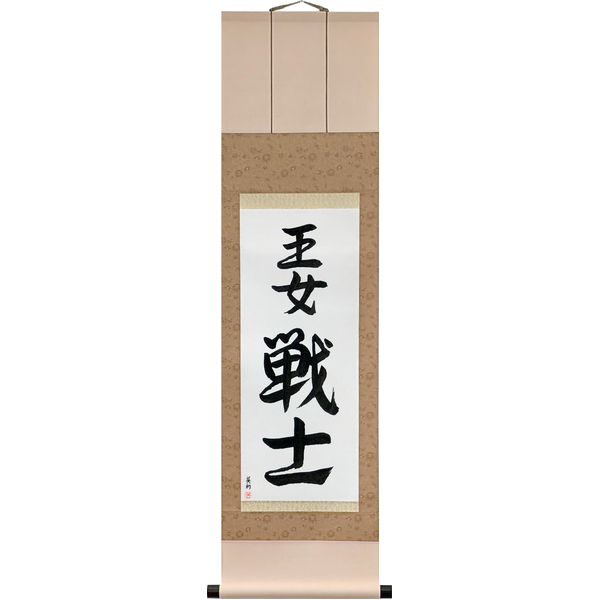
Sold as Warrior Princess · Read ōjo senshi, two words of two characters · Register a coinage: two dictionary words, a king's daughter and a fighting man, set in the English order; no Japanese source carries the compound · Sense a warrior who is a princess, and a Japanese reader takes it that way on sight.
The word
王女 is a king's daughter. The 日国's first citation is the 今昔物語集 of about 1120, and it notes the convention that an emperor's daughter is 皇女 and a king's is 王女; the 大辞泉 gives it in three characters, 王の娘, with 王子, prince, as its pair. 戦士 is a man who fights, a soldier on the field, cited from the 平治物語 of about 1220 and the 史記, and it has a second sense the dictionaries date to 島崎藤村 in 1906: one who fights on the front line for a cause, the sense in 企業戦士, corporate warrior. The scroll's word is the first sense with the second in reach.
Put together in this order they are not a word Japanese has made for itself. The compound is in no dictionary, in none of the 9,870 books of the harvest archive, and on no Japanese page one search could find; the series that made the English phrase a title, Xena: Warrior Princess (1995–2001), was released in Japan as 『ジーナ』, the heroine's name and nothing more. A Japanese writer wanting the idea says 戦う王女, a princess who fights, or 女戦士, a woman warrior. But 王女戦士 reads, and reads the right way round: a Japanese reader parses it as 企業戦士 is parsed, a warrior who is a princess, because 戦士 as the head of a compound is what the word's second sense already does. It is the house's coinage, and it is a clear one.
Where it is used
Nowhere but here, on the evidence read. The two halves have their own lives: 王女 is the word for a foreign princess in every newspaper, and 戦士 is the word for a soldier, a cause's fighter, and the corporate warrior of the 1980s. No religious or moral shade attaches to either.
The word in English
Warrior princess is an English phrase older than the series, whose earlier history was not read for this page; from 1995 it is the series' subtitle, and the archive's English full text returns tens of thousands of hits, the dated ones among the first hundred all Xena books of 1997 and 1998. The house's title is the phrase itself. What a rendering must keep is the head: it is the princess who is the warrior, and 王女戦士 keeps that, where 戦士王女 would make her a princess of warriors.
A reading
An honest coinage, and the page should say so once: the words are old and real, the order is the English one, and the compound reads as a warrior who is a princess to anyone who reads Japanese. What it must not imply is that the phrase exists in Japanese apart from us; it does not, and the show it comes from was sold in Japan under a name alone. Keep the design. Signed, 典, 2026-09-08.
How this was read
By eye: the template. By text: the two dictionary entries at kotobank, whole; the Japanese encyclopedia's search result for the series. By OCR: the harvest archive on disk, zero of 9,870 books; the archive's English full text on the phrase, the first hundred hits dated. By search: one Japanese web search for the compound, none. Not opened: the NDL Lab's own index (one probe in the pending run); the English phrase's history before 1995; any book about the series, which the scroll does not need.
References
- The scroll (ours), template M1064SSVB4A, by eye (—) — takase-images/templates/scrolls/martial-art/M1064SSVB4A-…-template.jpg
- The catalogue (ours) (current) — cultural_works 485; the live page (curl)
- 大辞泉, 王女 (current) — kotobank (TEXT)
- 精選版日国, 王女・皇女 (current) — kotobank (TEXT)
- 大辞泉, 戦士 (current) — kotobank (TEXT)
- 精選版日国, 戦士 (current) — kotobank (TEXT)
- ja.wikipedia, ジーナ (current) — API search (TEXT)
- The local archive (9,870 books) — search_ndl_archive.py
- The archive's English full text (2026-09-08) — be-api fts