

道真理命 · michi shinri inochi · The Way, The Truth, The Life
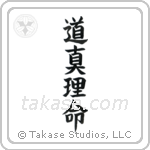
Sold as John 14-6 The Way, The Truth, The Life · Read michi shinri inochi, three words in four characters · Oldest witness the Gospel of John, and in Japanese the katakana John of 1837, which says the middle word as ホントノコト, the true thing · Sense one: the three things Jesus says he is; the design keeps the nouns and drops the sentence around them, as the Latin motto via veritas vita has done for centuries.
The words
道 is michi, the way, and the 日本国語大辞典 lists it under one headword with three other spellings, 道・路・途・径; among its senses are the course a person should take, the standard for one's conduct and the teaching of gods, buddhas and sages. The Bible of 1880 wrote it 途; the revision of 1917 wrote it 道, and 道 is what a reader now expects for a way of life.
真理 is shinri, truth, and it is older in Japan than Christianity by eleven centuries: the 懐風藻 of 751 uses it in the Buddhist sense, the true and unchanging principle, and the ordinary sense, the real state of things, the true reason, is cited from 1810. In the Japanese Bible the word was heard differently. The 1837 John wrote ホントノコト, the true thing. The 1880 Bible wrote a single character, 眞, and read it makoto. The 1917 revision wrote 眞理 and kept the reading makoto in its ruby, and so did the hymnals of 1910 and 1922, which sing まことと いのちと みちなる エス. The Catholic Bible of 1910 read it shinri, and the colloquial Bible of 1955 prints 真理 with no ruby at all, so shinri is what a reader says of it today.
命 is inochi, life, the oldest of the three in Japanese, 伊能知 in the 古事記 of 712. The Bibles before the war wrote it 生命 and read it inochi; the colloquial Bible of 1955 wrote 命; the 新改訳 writes いのち in kana. For a design sold to be worn the dictionary has one more sense worth knowing: from the 色道大鏡 of 1678, lovers tattooed the single character 命, or a name with 命, on the upper arm, pledging themselves for two lives and three. The character has a Japanese tattoo history of its own, as a pledge.
A history, from the earliest witness
The verse is John 14:6. Thomas has asked how they can know the way, and Jesus answers: Ἐγώ εἰμι ἡ ὁδὸς καὶ ἡ ἀλήθεια καὶ ἡ ζωή, I am the way and the truth and the life. The Vulgate's ego sum via et veritas et vita gave Europe the three nouns as a formula, and English has had them in the same order since Wycliffe (Y am weie, treuthe, and lijf, about 1395), Tyndale (I am ye waye ye truthe and ye life, 1526) and the King James Bible (I am the way, the truth, and the life, 1611).
Chinese gave Japan its characters. The Delegates' Version of 1852 wrote 我卽途也、眞理也、生命也, and when the Japanese committee finished its New Testament in 1880 it kept two of the three, 途 and 生命, and shortened the middle one to 眞. That Bible reads 我は途なり眞なり生命なり, and its ruby says michi, makoto, inochi: three native words, which is how the verse sounded in Japanese for seventy-five years. The 1904 annotated printing shows the ruby on the page; a 1896 household anthology quotes the verse whole; the Protestant hymnal of 1910 sets it as the epigraph to Thou art the Way, to Thee alone.
The 1917 revision changed two characters and no readings: われは道なり、眞理なり、生命なり, with the ruby michi, makoto, inochi still on the page in a 1927 printing. The Catholic Bible of Émile Raguet had already, in 1910, written 道 and 眞理 and read them shinri and seimei (on the transcription; the page is not yet opened). Writers had run ahead of the revisers too: a commentary of 1893 and a study of 1911 already quoted 途なり眞理なり, and the 1910 hymnal's own verses wrote 眞理 with the ruby makoto while its epigraph kept the Bible's 眞. In the harvest archive of 9,870 prewar books the Meiji wording appears in 14 books from 1896 to 1932 and the revised wording in 36 from 1907 to 1964.
The colloquial Bible of 1955 wrote わたしは道であり、真理であり、命である. Those are the scroll's three words, character for character: 道, 真理, 命. The 新改訳 (1970; the 2017 text was opened) writes the third in kana, わたしが道であり、真理であり、いのちなのです, and that sentence is the one the house's page romanizes. The 新共同訳 of 1987 is reported to read as the 1955 Bible does, 命; the site that carries it refuses a plain fetch, so that stands as reported.
The Union Version of 1919 gave Chinese 道路 for the way, and the Catholic 思高 Bible of 1968 kept it; the Japanese 道 of 1917 is not that but the Japanese word already used in verses 4 and 5 for the way Thomas asks about.
The sense across time
One sense, and the commentators reach for the same thing: the 1904 annotator says the truth is God himself and the life is the wellspring of life, not three virtues; 倉長巍 in 1916 lists the verse among the Gospel's I am sayings and notes in passing that the Logos of John 1 is also translated 道; 金子白夢 in 1922 reads it as Christ himself being what religion is. What changed was the sound. For the first hundred years the three nouns were native words, michi, makoto, inochi, sung in two hymnals; the postwar Bibles, printing without ruby, let 真理 be read as the Chinese-derived shinri, and the catalogue's reading is that one.
What is not a source
The four characters together. 道真理命 as a run-together string is in none of the 9,870 books of the archive, is not a dictionary headword, and returns no page on the Japanese web; the near-misses are a different formula, the 一貫道 sect's 道真理真天命真. Japanese writes the three words with commas when it lifts them from the verse, 道、真理、命, as a Yokohama church and a Bible channel title their sermons and as the Catholic bishops wrote in 1997. The scroll's arrangement, four characters without a separator, is the house's.
The text in English
The verse is in every English Bible, and the three-noun formula has served as a motto since the Middle Ages: the University of Glasgow's arms carry Via, Veritas, Vita (formalized in the 1890s on roots the university dates to the fifteenth century), James Drummond's Hibbert Lectures of 1894 took it as a title, and a dozen schools from Chicago to Singapore use it. The Internet Archive's full text holds the English phrase 184,430 times, which measures a corpus of religious publishing and not a fashion. As a design phrase the English is common: a search for it as a tattoo returns shirts and cut files, the verse with a cross. The house's title, The Way, The Truth, The Life, is the King James order with the articles, and needs no source but the verse.
A reading
The design is not a paraphrase, as the page says, but a reduction, and an honorable one: the three nouns in the Greek order, as the Latin motto does. What the history adds is that the three characters have a date. Before 1955 no Japanese Bible wrote 道真理命's characters; the Meiji Bible had 途・眞・生命 and the 1917 revision 道・眞理・生命, and both read the middle word makoto. The colloquial Bible gave the scroll its characters and, with them, the reading shinri. Both readings are true of the characters. I would keep the catalogue's, because it is what the characters say unglossed today, and give the buyer the older voice here: michi, makoto, inochi, three native words, is how a Japanese Christian's grandparents heard this verse. The page should print its Japanese sentence in text rather than in an image that no longer loads, name the translation it quotes, and stop calling the design a paraphrase. Keep the design. Signed, 典, 2026-09-08.
How this was read
By eye: the template; the Gützlaff John of 1837 at the Doshisha reproduction, page 45; the 1904 annotated New Testament at its page for the Meiji verse and ruby; a 1927 printing of the 1917 revision at its page; the hymnals of 1910 and 1922 at the hymn; 倉長's lectures of 1916 and 三谷's apologetics of 1893 at the page. By text: the three dictionary entries whole; the Greek in eight editions on one page, the Vulgate, five early and four modern English Bibles; the Chinese Bibles of 1852, 1919 and 1968; the Meiji and 1917 Bibles and the Catholic Bible of 1910 in transcription; the 1955 and 新改訳 texts at two sites; the hymn's English original. By OCR: the harvest archive on nine forms, the hits listed in the account. By search: the Japanese web for the four characters and the three words; the Internet Archive for the English formula and the Latin motto. Not opened: the Hepburn–Brown John of 1872; Morrison 1823 and Bridgman & Culbertson 1863; the 聖書協会共同訳 of 2018; the NDL Lab's own index, whose counts wait on Tim's run; the Raguet Bible at a page image.
References
- The scroll (ours), template C3069SSVB4A, by eye (—) — takase-images/templates/scrolls/christian/C3069SSVB4A-…-template.jpg
- The catalogue (ours) (current) — cultural_works 71; the live word page (curl); whole_designs C3069SSVB4A draft
- Greek, Nestle 1904 (and WH 1881, NA27/UBS4, RP 2005, TR 1550/1894, Tischendorf: identical in the nouns) (1st c.) — biblehub/text/john/14-6 (TEXT)
- Vulgate (4th c.) — vulgate.org (TEXT)
- Wycliffe (c. 1395) — textusreceptusbibles (TEXT)
- Tyndale (1526/34) — textusreceptusbibles (TEXT)
- Geneva (1560) — textusreceptusbibles (TEXT)
- King James (1611) — biblehub (TEXT)
- Revised Version / ASV (1881 / 1901) — biblehub (TEXT)
- RSV · ESV · NRSV · NIV (1952–2011) — biblegateway, biblehub (TEXT)
- Delegates' Version 委辦譯本 (1852) — zh.wikisource (TEXT)
- Bridgman & Culbertson (1863) — —
- 和合本 (1919) — zh.wikisource (TEXT)
- 思高聖經 (1968) — ccreadbible (TEXT)
- Gützlaff 約翰福音之傳 (Singapore) (1837) — the Doshisha typeset reproduction, p. 45 (EYE, rendered from the PDF)
- 明治元訳, in 三浦徹『新約全書略註』 (1880 (printing 1904)) — pid 825539 k218, p. 374 (EYE)
- 明治元訳, 旧新約全書 (1907 · 1914) — 992555 k713 · 904729 k711 (OCR)
- 明治元訳, wikisource transcription of the 1915 reprint (1880) — ja.wikisource (TEXT, investigator A)
- 大正改訳, 1927 printing (1917) — pid 1053815 k142, p. 277 (EYE)
- ラゲ訳 (Catholic, Raguet) (1910) — ja.wikisource (TEXT, A; not yet by eye)
- 大正改訳, wikisource (1917) — ja.wikisource (TEXT, A)
- 口語訳 (1955) — wordproject (TEXT, A)
- 新改訳 (2017 text; the 1970 wording not separately opened) (1970 / 2017) — seishonyumon.com (TEXT, A)
- 新共同訳 (1987) — bible.com/bible/1819 (A, unverified)
- 聖書協会共同訳 (2018) — —
- The local archive (9,870 books) — search_ndl_archive.py