

起死回生 · kishi kaisei · Miraculous Comeback
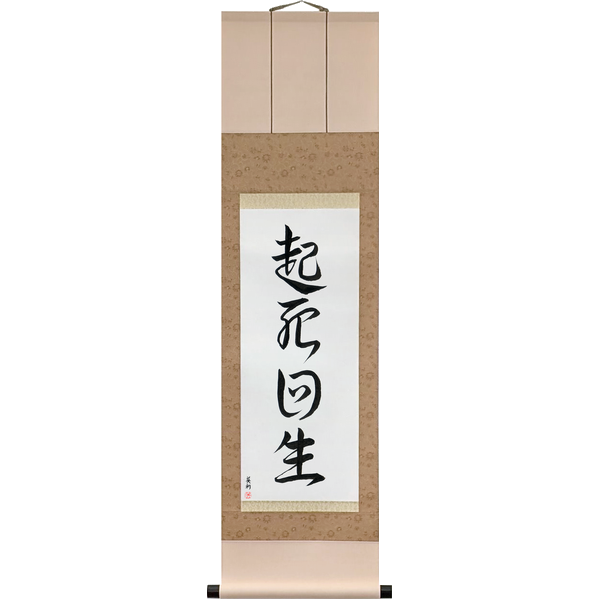
Sold as Miraculous Comeback · Read kishi kaisei · Oldest witness a physician's recipe in the 千金要方 (7th century as edited in 1066), then the preface to China's forensic classic, dated 1247 · What it is the praise of a great doctor: he raises the dying and returns the dead to life · In Japan from 1650, when 中江藤樹 named the four great physicians · Worn as a brand by a Meiji patent medicine, 1877 · Used of a nation by Ozaki Yukio, 1886 · The home run postwar, and undated here.
The words
起死 is to raise the dying. The 史記 tells how the world said the physician 扁鵲 could bring the dead to life, and how he answered: I cannot bring the dead to life; this one was going to live, and I made him rise. That verb, rise, is the 起 of the scroll; the catalogue's wake up is the wrong sense. 回生 is to return to life, a word Dōgen used of the endless cycle of dying and being born again. Together they say the same thing twice, for strength, and the dictionaries record two senses: to bring a dying patient back, and, from that, to bring back what was about to be lost.
A history, from the earliest witness
China, 7th to 13th century: the doctor's praise. The oldest text found with the four characters is a recipe. In the 千金要方 of 孫思邈, as the Song editors of 1066 print it, a remedy blown into the nose of a dying man ends this drug raises the dying and returns the dead to life; whether the sentence is the Tang author's or the Song editor's is not settled here. A tenth-century collection of marvels says it of a woman immortal who worked thirty-six arts, raised the dead, and saved people beyond counting. The first firmly dated use is a magistrate's: 宋慈, prefacing his handbook for coroners in 1247, hopes that its washing away of wrongs may have the same use as raising the dead to life. [千金要方 卷39, 太平廣記 卷59, 洗冤集錄 序, zh.wikisource]
China, 15th to 18th century: ministers, monks and novelists. A Ming minister closes his 1468 preface to the great Song materia medica with the wish that the art of raising the dead may have something to rely on. A Yuan Zen master answers the koan this mind is Buddha with a verse: the numinous wolf-poison raises the dead, and not a dose is used up. Wang Yangming turns it on the state: the realm is like a body wasted with long illness; those who are to raise it from death are you gentlemen, and if you cannot cure your own ailments, how will you cure the realm's? In the 西遊記, Sun Wukong crosses the eastern sea seeking a way to raise the dead for a withered ginseng-fruit tree, and Guanyin draws the four characters as a charm in his palm with willow and sweet dew. A Ming storyteller praises a healer as the 扁鵲 of old reborn: raising the dead is a lift of his hand. The sceptics use the phrase too; a physician of 1757 asks whether the famous doctor really has the art of raising the dead. [證類本草 1542 print, pid 2557898 koma 4; 陽明先生文録, pid 2576595 koma 45; 環溪和尚語録, pid 2537831 koma 81; all by eye]
Japan, 1650: the four physicians. The word's first Japanese book is 中江藤樹's 翁問答, and no earlier one is found. Arguing that a general who has read every book of war but cannot adapt is like a doctor who has read every book of medicine but cannot cure, he names the models: the famous physicians 扁鵲, 倉公, 東垣 and 丹溪, who mastered medicine, trained the four diagnoses, cured every illness and won the merit of raising the dead. The word stays with the doctors through the Edo period: the court physicians at Hideyoshi's deathbed in 1598 offered the art of raising the dead in a 1659 chronicle; the biographies of the court doctors 山脇玄心 and 頴川入徳, a naturalized Chinese pediatrician, use it as their formula for two hundred years; a smallpox prescription is named for it. [翁問答, 1910 typeset, pid 756192 koma 58, by eye]
Meiji: the quack, the brand, the nation. In the 1880s the word belongs to medicine and its shadow: a cholera treatise, a translated exposé of American patent-medicine puffery (revive and prolong life, raise the dead, one drug for every disease), a treatise on schools in which the physician who works the art of raising the dead makes his name at once, an illustrated 西遊記, and a Merchant of Venice in which Antonio's rescue is the debt of a life raised from death. Two uses in the same decade set the word's two modern senses. A patent medicine took it for a name: 守田治兵衛's 寶丹, a restorative sold at Ueno since 1862, was exhibited as 起死回生寶丹 in 1877 and advertised in 1880 with a full page of workmen hoisting its characters on scaffolding under the heading 起死回生. And Ozaki Yukio's political novel of 1886 says of Japan: the chance to raise the dead is today only; once it is gone it will not come again. The library's curve rises from a dozen books in the 1870s to 737 in the 1930s, a quarter of them in medicine and the rest in society, history, religion and fiction. [東京商人録 1880, pid 779945 koma 219; 新日本 1886, pid 992908 koma 25; both by eye]
The dictionaries, and the home run. The Meiji dictionaries carry it as an example (under to revive, 1897; under 回生, 1906) and bracket it as a phrase in 1908: to bring the dead back to life. The 日国 keeps the doctor first and the figure second; 大辞泉 today has only the figure, to set on its feet what was about to be lost. The baseball use the catalogue reaches for, a game-winning home run, has no hit in the public-domain corpus and is postwar. [実用新辞典 1908, pid 862944 koma 466, by eye]
The sense across time
The word has two lives, and the dictionaries have chosen between them. The first is the physician's, from the Tang recipe and the 1247 preface through 藤樹's four doctors to the biographical dictionaries of 1921: what a great doctor does, and what a drug is praised or mocked for doing. The second is the figure: Wang Yangming's sick realm, Ozaki's Japan, the modern 策 and 秘策, the home run. The figure is old, Ming at the latest, and in Japan it arrives in the same decade as the patent-medicine slogan. What both lives keep is 扁鵲's correction: he did not raise the dead; he raised the one who was going to live. That is why the word is a comeback and not a resurrection.
What is not a source
Not a Buddhist term: the Zen verse borrows the doctor's phrase, and 回生 alone is Dōgen's. Not the 史記 verbatim: the 史記 gives the idea and the verb, not the four characters. Not a Japanese coinage: every part of it is Chinese and the phrase is in Chinese medical books centuries before 1650. Not a baseball word by origin: the home run is the newest sense, not the oldest.
The text in English
The English met the word late and as a figure. 斎藤和英 (1928): resuscitation; revival, with a medicine to revive the dead; a magical medicine. 研究社 keeps the medicine (a wonderful medicine capable of reviving the dead; a miracle drug) and adds the two modern examples: hit a homer to pull the game out of the fire and devise a means of pulling back from the brink of disaster. JMdict: revival from the brink of death; recovering from a hopeless situation; resuscitation; revitalization. None carries miraculous comeback; that is the house's English, and its home run is 研究社's example.
A reading
Sell it as the physician's word and let the comeback follow. Miraculous Comeback is right for the buyer, and the page should say where the miracle comes from: 扁鵲's I made him rise, which is why the word fits a recovery and not a funeral, and 藤樹's four physicians, the word's first Japanese company. The literal gloss should be raise the dying, return the dead to life, not wake from death. For a story the page can have the Ming minister's preface and the Zen verse, or the 1880 advertisement with the workmen on the scaffolding; both are true. No question for Eri: the glyphs are the modern ones and every dictionary writes them so. 典, 2026-09-07.
How this was read
By eye: the template file; seven pages at the scan, from a 1542 print of a Song materia medica to a 1908 dictionary. By text at the address: the National Diet Library's full-text index on the word, pulled whole and classed by year and subject, with the classical facet windowed in fifteen books and every modern hit of 1860–1895 at the page; the local harvest's 352 books for the dictionaries; kotobank for six entries; the 史記, the 千金要方, the 太平廣記, the 洗冤集錄, the 西遊記 and the 警世通言 at zh.wikisource; the English through EDRDG and Weblio. Not read: the 翁問答 in an Edo print; the 千金要方 in a pre-Song witness; the Meiji books but two at the scan (OCR only); 研究社 at its own page; the baseball use at a dated source. Every address is in the account.
References
Each witness is cited in the account above, at the frame or entry where it was read. A linked list follows when the record for this text is completed.