

斬捨て御免 · kirisute gomen · Cut down, and pardoned for it
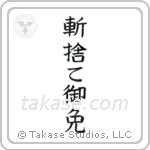
Sold as Kirisute Gomen · Read kirisute gomen · Oldest witness Fukuzawa Yukichi's An Encouragement of Learning, part two, 1873, two years after the privilege it names was abolished · Sense the Edo samurai's license to cut down a commoner for insolence and go unpunished; from the year it ended, a byword for power that answers to no one.
The words
Two verbs and a pardon. 切る or 斬る is to cut; 斬 is the character reserved for cutting a person down. 捨てる is to throw away, to leave, so 切捨 is cut and leave, to cut someone down and walk on; Hepburn's dictionary of 1872 already has the verb, KIRI-SUTE, to cut and throw away, to kill and leave. 御免 (gomen) is pardon, license, the honorific of 免, as in 天下御免, licensed by the realm; it is also the everyday excuse me, which is the joke a modern ear hears in the term. The whole is a noun, the license itself. Four spellings share it: the dictionaries write 切捨御免 or 斬捨御免 with no okurigana, later books 切り捨て御免, and the scroll 斬捨て御免, with okurigana on the second verb only; they are one word. The institution's other name is 無礼討 (bureiuchi), killing for insolence.
A history, from the earliest witness
The institution, before the word. The reference works agree on every point. 精選版日本国語大辞典: 江戸時代、武士に与えられていた特権の一つ。町人、農民などが武士に対し雑言など無礼を働いた場合、武士が止むを得ず切り殺しても処罰されなかった。この特権は足軽にも認められていたが、みだりに切り殺したときや、無礼の証拠の説明ができないときは処罰された, an Edo-period samurai privilege: when a townsman or farmer offered a samurai abuse or other insolence, a samurai who had no choice but to cut him down was not punished; the privilege extended to foot soldiers, but killing wantonly, or failing to prove the insolence, was punished. The 世界大百科事典 gives the law: the shogunate 《公事方御定書》の殺人・傷害の条項中に先例を成文化し, codified the precedent in the killing-and-wounding clauses of the Kujikata Osadamegaki (the criminal code of 1742), so that a samurai, even a foot soldier, who cut down a commoner for 法外の雑言など不届きな行為, outrageous abuse or other unpardonable conduct, bore no criminal liability, provided the circumstances were clear and witnessed; in practice 切り捨ててもとどめをささぬ慣行が生じ、抑制もされて、みだりに行われたわけではない, the custom arose of cutting without finishing the man, it was restrained, and it was not freely exercised. It broke down at the Namamugi incident of 1862, survived into the provisional code of 1868, was left out of the 新律綱領 of 1870, and its abolition was confirmed in 1871. Britannica names the clause: 御定書の「人殺しならびに疵付け御仕置の事」の条; Japanese Wikipedia cites it as 公事方御定書 71条追加条 (its reference list names the 下巻). [4]
1873. 福澤諭吉『學問ノスヽメ』, part two (二編), the afterword. The oldest print of the word found, in the book whose 1880 collected edition says its seventeen parts appeared between February 1872 and November 1876, and already in the past tense: ○又右ノ議論ヲ世ノ中ノ事ニ當ハメテ云ハン舊幕府ノ時代ニハ士民ノ區別甚シク士族ハ妄ニ權威ヲ振ヒ百姓町人ヲ取扱フコト目ノ下ノ罪人ノ如クシ或ハ切捨御免ナドノ法アリ此法ニ據レバ平民ノ生命ハ我生命ニ非ズシテ借物ニ異ナラズ (the OCR reads 取し扱フ〓 for the leaf's 取扱フコト), to apply the argument to the world: under the old shogunate the gap between samurai and commoner was extreme; the samurai threw their weight about and handled farmers and townsmen like criminals beneath their eyes, and there was a law called kirisute gomen, under which a commoner's life was not his own but a thing on loan. Part two carries the license date 明治六年十一月, November 1873. [NDL pid 808242 (the 1880 collected edition), koma 17, pp. 24–25; read by eye at width 3600; the part's colophon at koma 21; text at lab.ndl.go.jp/dl/api/page/808242_17]
1874. The same book, part six (六編), On the dignity of national law. ○古ハ日本ニテ百姓町人ノ輩士分ノ者ニ對シテ無禮ヲ加フレバ切捨御免ト云フ法アリコハ政府ヨリ公ニ私裁ヲ許シタルモノナリ, in old Japan, when farmers or townsmen were insolent to a man of samurai rank there was a law called kirisute gomen, and this was the government publicly licensing private justice; the passage is Fukuzawa's example of 私裁, taking the law into one's own hands, set beside the vendetta of the forty-seven rōnin. Part six is licensed 明治七年二月, February 1874. [NDL pid 808242, koma 53, pp. 96–97; read by eye; the colophon at koma 58]
1874–75. 小川為治『開化問答』, a dialogue on civilization. The dictionary's first citation: 又武士には切捨御免抔といふ法がありて, and the samurai had a law called kirisute gomen or the like. The four volumes are digitized and their OCR does not find the line; the leaf was not read. [精選版日国 at kotobank, 初出の実例; NDL pids 798420–798423 (丸屋善七, 1875), not located at the page]
1876. 中島勝義 ed.『俗夢驚談』, a political polemic. The word as a figure for tyranny, within five years of abolition: 我々人民タル者ヲ牛羊同様ニ思ヒ毫モ政事ニ關與スルコトヲ得セシメズ其甚ダシキニ至テハ切捨御免等ノ特例ヲ設ケ官吏タル者ハ我々人民ヲ切ルコト恰モ豆腐カ大根ノ如クニ思ヒ, they thought of us the people as cattle and sheep, let us take no part in government, and at the worst set up special privileges like kirisute gomen, so that an official thought cutting one of us down was like cutting tofu or a daikon. [3]
1879. 内田勇吉『民権一班浪津社談』, a people's-rights tract. The only Meiji witness found that quotes the law itself, from memory: 猶甚シキハ切捨御免ト云トカ … 徳川氏ノ律書ニ足輕体ニ候共町人百姓ノ分トシテ … 法外ノ雜言等不届ノ仕方ニテ不得止切殺シ候者ハ吟味ノウヘ … 紛レ無之候ハヽ無搆事トアリ (the OCR reads 猫音 for 雜言 and 修者 for 候者; read so here), worse still was what they called kirisute gomen … the Tokugawa law-book says that even a man of foot-soldier rank who, for outrageous abuse or other unpardonable conduct on the part of townsmen or farmers, could not avoid cutting them down, shall on inquiry, if there is no doubt of it, be held blameless. The wording tracks the reference works' summary of the 1742 clause. [NDL pid 783708, koma 29; OCR, in a katakana text the OCR reads unevenly; the quoted run is what the OCR carries]
1881. 渡辺修次郎『民情如何』. As the OCR carries it: 往時行ときたる切捨御免の掟の如た今より之きを追想そるも實〓我々をして悚然たらしむる … 平民の生合は輕きくその如く低うよ大根の如く, read 往時行はれたる切捨御免の掟の如き今より之を追想するも實に我々をして悚然たらしむる … 平民の生命は輕きこと … 大根の如く, the statute of kirisute gomen as it was once practiced makes us shudder even to recall … a commoner's life was as light as … a daikon, and 此野蠻法, this barbarous law, which the OCR has clean. The daikon figure of 1876 is now stock. [NDL pid 798688, koma 29; OCR; the leaf not opened]
Today. 日本大百科全書: 当時、武士の特権は刀に象徴されたが … 無制限の切捨が許されたわけではなく、事後に取調べがあり … その意味で、このことばは武士の特権を象徴的に表したものである, the samurai's privilege was symbolized by the sword … but unlimited cutting-down was never allowed; there was an inquiry after the fact … in that sense the word is the symbolic expression of the samurai's privilege. 旺文社日本史事典 calls it 不文律として明治初年まで続いた, an unwritten rule that lasted into the first Meiji years. [kotobank, as above; text]
The sense across time
Two senses, and the year 1871 divides them. Before it, an institution: a status privilege, codified, limited, witnessed and restrained, which the historians are at pains to say was not a license to kill at will. After it, a word: every print found begins after the abolition, the first in Fukuzawa's past tense, and within five years the term is a figure for arbitrary power in the people's-rights pamphlets, with a commoner's life as tofu or daikon. The scroll sells the word, and the word has carried the second sense longer than the institution carried the first.
What is not a source
The house page tells the buyer the term is known in America through Ian Fleming's You Only Live Twice (1964), whose villain asks Bond whether he has heard the expression, and describes its modern use as subtle humour in offering what amounts to an unsympathetic apology. Fleming's novel was not opened; the page's own pointer for the description is the English Wikipedia article, and the article as read on 2026-09-06 no longer contains that sentence. Fleming is a witness to the word's reception in English, not to the institution.
The term in English
1872. J. C. Hepburn, 和英語林集成, second edition. No entry for the compound; the verb is there, in an OCR run whose word order is scrambled: KIRI-SUTE,-ru … cut and throw away,キリステル, tokill and切捨, leave, read KIRI-SUTE, 切捨, to cut and throw away, to kill and leave. [NDL pid 993689, koma 140; OCR; the leaf not opened]
1964. Ian Fleming, You Only Live Twice. The house page quotes the villain: Have you ever heard the Japanese expression kirisute gomen? and Bond's reply, Spare me the Lafcadio Hearn. Not opened; the quotation is the page's. [no ASIN collected]
Today. The house leaves the term untranslated, and that is right: there is no English for a legal license to kill for insolence. The gloss a rendering owes the buyer is the institution's limits as the reference works give them, since the phrase on its own says only cut down, pardoned.
A reading
A scroll that sells a legal term for licensed killing, to people who mostly know it from a Bond villain. What the history can give them is the institution as the historians describe it, narrower and stranger than the villain's line, and the word's second life, which began the year the first ended and has been the word's real meaning ever since: power that cuts and is excused. The scroll's spelling is one of four and the rarest in print; nothing turns on it. The Fleming line is the page's business, not the word's; the page's subtle humour sentence has lost its source and should either find one or go. Romaji kirisute gomen, two words, no macron. Signed, 典, 2026-09-06.
How this was read
By eye, at the National Diet Library page images at width 3600: Fukuzawa's two passages in the 1880 collected edition, and the 1876 polemic. By OCR at the page API: the 1879 and 1881 tracts, Hepburn's entry, and the four volumes of 開化問答 (searched, not found). By text at the address: the two kotobank pages carrying six reference works, and Japanese Wikipedia for the clause number. Not opened: the 公事方御定書 at its clause, which is the one address that would let a reader check the law in its own words (no digitized text of it was found at Japanese Wikisource); 開化問答 at the page the dictionary cites; the first printings of Fukuzawa's parts two and six, which the 1880 edition's colophons date; Fleming's novel; English Wikipedia's article history for the sentence the page quotes. A leaf cited as pid P, koma N resolves as text at lab.ndl.go.jp/dl/api/page/P_N and as an image at dl.ndl.go.jp/api/iiif/P/R<N, seven digits>/full/3600,/0/default.jpg. The full apparatus, with every address, is in the account.
References
- The scroll (ours) (—) — M1096SSVB4A; cultural_works 515
- 小川為治『開化問答』 (1874–75) — 精選版日国, 初出 (kotobank 1159878); not opened
- 中島勝義 編『俗夢驚談』 (1876) — NDL pid 783427 koma 8 ↩
- 精選版日国 · 世界大百科 · 日本大百科 · 山川 · 旺文社 (current) — kotobank 1159878 ↩
- ブリタニカ (current) — kotobank 53661
- NDL corpus (to 1946) — search counts