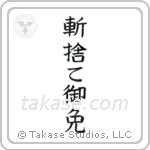
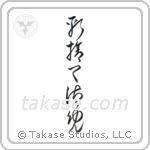
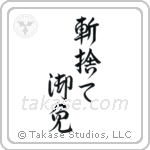
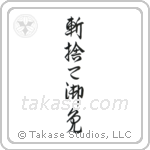
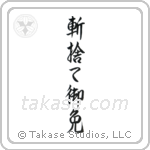
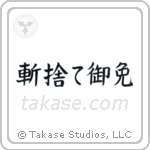
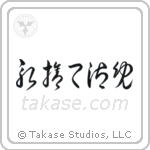
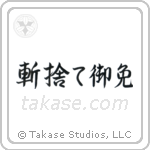
斬捨て御免 (kirisute gomen): cut down, and pardoned for it. 斬る is to cut, with the character reserved for cutting a person down; 捨てる is to leave, to throw away, so 斬捨 is to cut someone down and walk on; 御免 is pardon or license, the honorific of 免, and also the everyday excuse me, which is the joke a modern ear hears in it. The whole is a noun: the license itself. Under the Tokugawa shogunate a samurai who cut down a townsman or farmer for outrageous insolence bore no criminal liability, a precedent the criminal code of 1742 wrote down, with conditions the histories are at pains to state: an inquiry after the fact, the insolence proven, witnesses required, and a custom of cutting without finishing the man. It broke down at the Namamugi incident of 1862 and its abolition was confirmed in 1871. Every print of the word found begins after that: Fukuzawa Yukichi uses it in 1873, already in the past tense, and within five years it is a byword in the people's-rights pamphlets for power that answers to no one, a commoner's life cut like tofu or a daikon. In Ian Fleming's You Only Live Twice the villain asks Bond whether he has heard the expression, and Bond answers, Spare me the Lafcadio Hearn. The term stays untranslated on this page; there is no English for it.
Each design is Master Japanese Calligrapher Eri Takase's hand-brushed calligraphy of the word or phrase on this page, delivered as a PDF you can print. Every PDF includes the line art, so a tattoo artist or a craftsperson can work from the outline as well as the brushed image.
Delivery
Your PDF is available for download the moment your order completes, and a copy is attached to your emailed receipt.