

花鳥風月 · kachō fūgetsu · Flowers, birds, wind, and moon
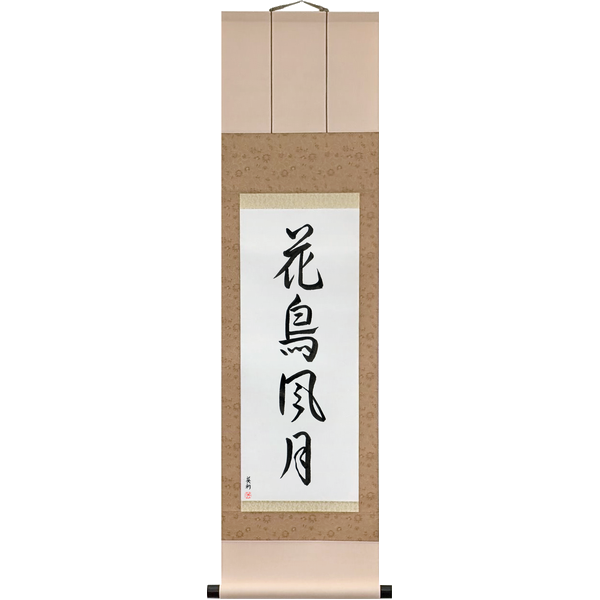
Sold as Beauties of Nature · Read kachō fūgetsu · Oldest witness 世阿弥's treatise on acting, the 風姿花伝, 1400–02, where it is already a set phrase · Sense the beautiful things of nature, and the elegant pastime of enjoying them and making poems of them; a Japanese pairing of two Chinese pairs, six centuries old.
The words
Four characters in two pairs. 花鳥, flowers and birds, is the painter's genre and the poet's spring, in Japanese from the 後撰集 of the tenth century; 風月, wind and moon, is the clear breeze and bright moon of Chinese verse, in Japanese from the 懐風藻 of 751, and by extension the making of poems under them. The pairs are Chinese; the four together are Japanese, and no Chinese text before the twentieth century sets them as one phrase. The dictionaries read the four as representatives, the first pair of the things one looks at and the second of the scene they sit in, and they number two senses: the beautiful things of nature, and the refined pleasure of enjoying them and writing about them, 風流韻事. The second is the older, and the catalogue's elegant, tasteful is it; Beauties of Nature is the first. The older Japanese phrase for the same idea is 雪月花, snow, moon, flowers, from a line of 白居易's, and the dictionaries give it as the synonym. The order is fixed; 風月花鳥 exists and reads as the same phrase turned around.
A history, from the earliest witness
1400–02, 世阿弥, the 風姿花伝, second book, on playing a warrior, read as three modern typesets carry it. The oldest text in the dictionaries' record, and the phrase is already a set expression for the elegant world a play should be made of. Warrior plays, 世阿弥 says, are rarely interesting; 但し、源平などの名のある人の事を花鳥風月に作り寄せて、能よければ、何よりもまた面白し, but if you take a famous man of the Genji or the Heike and compose him into flowers, birds, wind and moon, and the play is good, it is more interesting than anything. [2][2][2]
1416, 花光坊長弁, the 私案抄, a Tendai monk's collection of model letters, read at the scan. A letter of condolence for a dead pupil, dated in its own text to the third month of 応永 23, describes what he left: the books and brushes, and 従花鳥風月之学窓、短冊懐紙余札, the poem-cards and papers from the window of his studies in flowers, birds, wind and moon. The four characters as the name of a young man's literary education. [3]
1477, 蓮如, a pastoral letter of the ninth month of 文明 9, read at the scan. The founder of the modern 本願寺, writing to his followers about the shortness of life: 夫秋モサリ春モサリテ年年ヲヲクルホドニ昨日モスギ今日モスグ、イツノマニカハ年老ノツモルラントモオボエズシラザリキ。シカルニソノウチニハサリトモアルヒハ花鳥風月ノアソビニモマジハリツラン、マタ歡樂苦痛ノ悲喜ニモアヒハンベリツラン, autumn goes and spring goes and the years pass; yesterday is gone and today goes, and we do not notice when age has piled up. And yet in the meantime we must have joined in the amusements of flowers, birds, wind and moon, and met with the joys and sorrows of pleasure and pain. The four characters as the sum of a life's pleasures, in the same breath as its griefs, both forgotten. [4]
The fifteenth century, 宗祇, the renga master, as an 1890 haikai writer quotes him. 只連歌は日夜朝暮に花鳥風月人間の有爲無常のすがた常に心にかけて, renga is simply this: day and night, morning and evening, to keep always in mind flowers, birds, wind and moon, and the shape of human impermanence. The poet's daily subject, with its shadow. [5]
1664, 松江重頼, the 佐夜中山集, and 1694, 井原西鶴, the 西鶴織留, read at the scan. The haikai founder: a poet of the way of waka must think of the world's impermanence in the sleepless night, put compassion first, be gentle, never behave harshly even in jest, and discern the feeling of flowers, birds, wind and moon; so the ancients taught in ink (花鳥風月の情をわきまふへしと先哲翰墨に残してをしへたまひき). And 西鶴, of a prodigy: はや三歳にて習はずして花鳥風月の大文字書ば, at three, untaught, he wrote the four great characters 花鳥風月; the child dies in the next sentence. [6]
Before 1703, 浪化, the 俳諧正語抄, read in the 1829 print. The haikai critic on the vertical in a hokku: 昔より和歌に用来る花鳥風月の定たるをいふ也 … 此故に花鳥風月を俗語になして疵付る事なかれと也, it means the fixed matter of flowers, birds, wind and moon that waka has used since of old; and so one must not wound flowers, birds, wind and moon by turning them into vulgar words. [8]
The Muromachi tale, and the Edo commonplace. There is a story with the four characters as its title, in which 花鳥 and 風月 are two shamaness sisters from 羽黒 called to a fan-matching party to divine a mysterious painting; they summon 業平, 光源氏 and 末摘花 to speak through a mirror, and the tale is a primer of the 伊勢 and the 源氏 dressed as a ghost story, surviving in many copies (one at the British Museum, one at 東洋文庫). A storyteller could split the phrase into two women's names, which is a measure of how ordinary it was. By the Edo period it names a comic-poem anthology illustrated by Hokusai (1824), a print series by Kunisada (1823–25), and a top-spinning game whose eight faces read 春夏秋冬花鳥風月; a Meiji proverb collection puts Victor Hugo into it, love uses flowers, birds, wind and moon as its messengers. The National Diet Library's index has the phrase in 2,966 books before 1945, 118 of them pre-modern. [世界大百科; the index; the harvest.]
1942, 松崎覚本, the 揮毫辞典, a dictionary for calligraphers, read at the leaf. Under the phrase: 賞玩スル心。タノシム事件, the mind that savors; things enjoyed, and beside it 謝霊運's four things hard to have at once, 良辰、美景、賞心、樂事, a fine day, a beautiful scene, a mind to enjoy them, a pleasant occasion. [10]
Today. 大辞泉: 1 自然の美しい風物。「花鳥風月を友とする」 2 風雅な趣を楽しむこと。風流韻事; the examples the yojijukugo dictionary gives are 長与善郎 in 1924 and a wartime officer in 阿部知二's novel of 1957 who sneers that painting flowers, birds, wind and moon in the nation's crisis is a carefree business. [kotobank, whole entries.]
The sense across time
Two senses, both present from the start and never separated: the things, and the elegant attention paid to them. 世阿弥 means the second, the world a play is composed of; 長弁 the schooling in it; 蓮如 the pleasure of it, as vanity; 宗祇 and 重頼 the poet's discipline in it; 浪化 the fixed subjects themselves; the Edo print-makers the things, on paper; the modern dictionaries both, numbered. The phrase has always named a way of looking as much as what is looked at, and the second sense is what Beauties of Nature leaves out and elegant, tasteful puts back.
What is not a source
The two Chinese pairs are older than the phrase and are not its source as a set; the Chinese Wikisource has the four together once, in a twentieth-century gazetteer. 雪月花 is the elder cousin, not the origin. 謝霊運's four things are the calligrapher's dictionary's pairing. The Muromachi tale takes the phrase as its title and is a witness to it, not a source.
The text in English
The phrase reaches English through prints before it reaches it through poetry. 1923, Walpole Galleries, Japanese Color Prints, New York. An Utamaro titled "Kacho Fugetsu". [snippet.] 1966 and 1980, Jack Hillier, Hokusai Drawings and The Art of Hokusai in Book Illustration, ISBN 0520041372. Kyoka Shinsen Kacho Fugetsu Shu, 'A New Selection of Kyoka on Flowers, Birds, Wind and Moon', 1824. [snippets.] 1971, The Japan Times. Emphasis on "kacho-fugetsu" meant an emphasis on artistic beauty even in crafts and design. [snippet.] 1976, Anne Kent Rush, Moon, Moon, Random House, ISBN 0394732308. Kacho-fugetsu … comes to mean beautiful natural scenery. [snippet.] 1978, Traditions, and 1984, The East, a translation of 世阿弥. If a play about the Genpei is good and is composed of flowers, birds, wind, and moon, it can be more interesting than anything: the four-word literal, which has been the standard since. [snippets.] 1978 and 1989, Richard Lane, Images from the Floating World (ISBN 0399121935) and Hokusai: Life and Work (ISBN 0525244557). Poems on Birds, Flowers, Wind and Moon; the somewhat wider connotation of 'nature art', kacho-fugetsu. [snippets.] 1993, Karatani Kōjin, Origins of Modern Japanese Literature, Duke, ISBN 082231312X. "Flowers, birds, wind, and moon" (kacho fugetsu). [snippet.] 1995, Japan: Profile of a Nation, Kodansha International, ISBN 4770018908. The beauty of nature, embodied in the term kacho fugetsu ("flowers, birds, wind, and moon"). [snippet.] 2020, Matsuoka Seigō, Flowers, Birds, Wind, and Moon: The Phenomenology of Nature in Japanese Culture, Japan Publishing Industry Foundation, ISBN 9784866581392. The phrase as a book's title. [snippet.]
Today. The four-word literal is the English, and beauty of nature the gloss; the house's Beauties of Nature is the gloss in Kodansha's words and its own. A rendering must keep four things in that order and should let the second sense, the pleasure taken in them, be heard.
A reading
The scroll is right and the page is right and thin. What it lacks is the phrase's age and company: a Japanese pairing of two Chinese pairs, first written down by the man who made Noh as what a play should be made of, and used in the same century and a half by a monk for a scholar's window, by a sect's founder for a life's vanities, by the greatest renga master for the poet's daily mind, and by the haikai critics for waka's fixed subjects that must not be vulgarized. By the Edo period it was ordinary enough to be a game, a print series and two shamanesses' names. A buyer should be told the two senses, the things and the pastime, and that the word is 世阿弥's. No change to the design, the reading or the title; the four-word literal belongs beside it.
How this was read
By OCR at the National Diet Library's next-generation digital library, the scan number part of each address: the 私案抄 (pid 2533513, scan 37); the 御文章 (pid 820687, scan 12); the 佐夜中山集 (pid 2550657, scan 21); the 西鶴織留 (pid 2554438, scan 14); the 俳諧正語抄 (pid 2540297, scan 10). From the seat's harvest of the same library: the 揮毫辞典 (pid 1884879, komas 138 and 159); the 俳諧無心の効用 (pid 875535, koma 17) for 宗祇; the 金諺一万集 and 明治節用大全 for the Hugo line; the 言海. A leaf named as pid P, scan N has its text at lab.ndl.go.jp/dl/api/page/P_N and its image at dl.ndl.go.jp/api/iiif/P/R<N as seven digits>/full/full/0/default.jpg; the pre-1868 books answer a signed address only with -L. From the index alone, scan not derived: the 風姿花伝 in the 1898 花伝書, 能勢 1944 and 野上 1948; the 御伽草子's mentions; the 1891 社会事彙. As text: kotobank's six entries, whole; the library's index on nine spellings; the Chinese Wikisource; the Internet Archive's index on the romaji and the literal English, forty books dated from their scan records, snippets only. By eye: the scroll template. Not opened: the 風姿花伝 at a manuscript or leaf; the 御伽草子; 宗祇's own text; the prints; the English books at the page.
References
- The design (ours) (—) — template O6000SSVB3A, by eye; cultural_works 706; whole_designs.csv:44
- 世阿弥『風姿花伝』第二 物学条々, 修羅 (1400–02) — 花伝書 1898 (pid 902428), 幽玄論 1944 (pid 1127093), 花伝書研究 1948 (pid 1125589), highlights; the 日国's 初出 ↩
- 花光坊長弁『私案抄』 (応永23 (1416), from the text's own date) — pid 2533513 scan 37, OCR ↩
- 蓮如『御文』四帖, the letter of 文明9 (1477) 9月27日 (1477) — pid 820687 scan 12, OCR ↩
- 宗祇, as quoted (15th c. (quoted 1890)) — 俳諧無心の効用 1890, harvest pid 875535 koma 17; the source not opened ↩
- 松江重頼 編『佐夜中山集』 (寛文4 (1664)) — pid 2550657 scan 21, OCR ↩
- 井原西鶴『西鶴織留』巻四 (元禄7 (1694)) — pid 2554438 scan 14, OCR
- 浪化『俳諧正語抄』 (before 1703 (printed 文政12, 1829)) — pid 2540297 scan 10, OCR ↩
- the 御伽草子『花鳥風月』(『扇合物語』) (Muromachi) — 世界大百科 (徳江元正); mentioned in ちりひねり (pid 2552271) and 偐紫田舎源氏 (1829, pid 2605046); a copy at the British Museum (Or. 12897, c. 1660–70) and one at 東洋文庫 (late Muromachi or early Edo) by snippet; NOT read
- 松崎覚本『揮毫辞典』 (1942) — harvest pid 1884879, OCR ↩
- kotobank, 花鳥風月 (current) — https://kotobank.jp/word/花鳥風月-464023
- kotobank, 風月 · 花鳥 (current) — https://kotobank.jp/word/風月-615781 · …/花鳥
- The NDL Lab full-text index, pre-1945 (1416–1944) — `labsearch_*.json`
- The Chinese Wikisource (—) — zh.wikisource search
- Walpole Galleries, *Japanese Color Prints*, New York (1923) — archive.org `japanesecolorpri00walp_21`, snippet
- J. Hillier, *Hokusai Drawings* · *The Art of Hokusai in Book Illustration* (1966 · 1980 (ISBN 0520041372)) — `hokusaidrawings0000jhil` · `artofhokusaiinbo0000hill_p2q5`, snippets
- The Japan Times (1971-10-15) — `sim_japan-times_1971-10-15_26148`, snippet
- Anne Kent Rush, *Moon, Moon*, Random House (1976 (ISBN 0394732308)) — `moonmoon00rush`, snippet
- *Traditions* 2.2 · *The East* 20.6 (a 風姿花伝 translation) (1978 · 1984) — `traditions0002mori_e5w0` · `sim_east_1984-12_20_6`, snippets
- Richard Lane, *Images from the Floating World* · *Hokusai: Life and Work* (1978 (ISBN 0399121935) · 1989 (ISBN 0525244557)) — `imagesfromfloati0000lane` · `hokusailifework0000lane`, snippets
- Karatani Kōjin, *Origins of Modern Japanese Literature*, Duke (1993 (ISBN 082231312X)) — `originsofmodernj02kara`, snippet
- *Japan: Profile of a Nation*, Kodansha International (1995 (ISBN 4770018908)) — `japanprofileofna0000unse`, snippet
- Matsuoka Seigō, *Flowers, Birds, Wind, and Moon: The Phenomenology of Nature in Japanese Culture*, JPIC (2020 (ISBN 9784866581392)) — `flowersbirdswind0000mats`, snippet
- The house (2026) — the live page