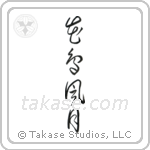
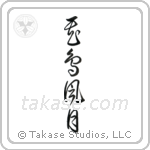
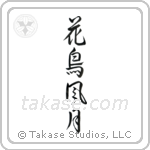
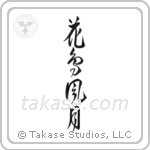
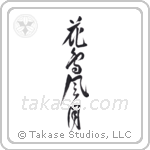
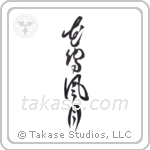
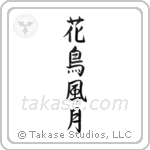
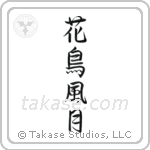
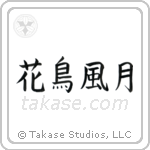
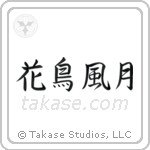
花鳥風月 (kachō fūgetsu)
花鳥風月, read kachō fūgetsu: flowers, birds, wind and moon. Two Chinese pairs, the painter's flowers and birds and the poet's wind and moon, joined in Japan into one phrase with two senses that have never come apart: the beautiful things of nature, and the elegant pleasure of looking at them and making poems of them. The first to write it down was Zeami, the maker of Noh, who said a warrior play is worth watching only when its hero is composed into flowers, birds, wind and moon. Within a century and a half a monk used it for a dead pupil's studies, Rennyo for the pleasures a life forgets along with its griefs, the renga master Sōgi for what a poet keeps in mind day and night beside the impermanence of things, and the haikai masters for the fixed subjects of verse that must not be made vulgar. By the Edo period it was a game, a print series and two shamanesses' names in a tale. The English title is the gloss; the four-word literal is the standard rendering, and the second sense, the pleasure taken, is what the title leaves out and this page puts back. This is a particularly beautiful expression as it is composed of four of nature's most beautiful creations which are 花 (read ka) meaning "flowers", 鳥 (read chō) meaning "birds", 風 (read fū) meaning "wind", and 月 (read getsu) meaning "moon".
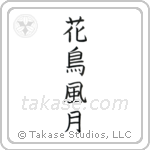
This is a very popular phrase and this art makes an excellent gift especially for a Japanese Tea Ceremony enthusiast, Bonsai artist or Ikebana artist.
Verify: 花鳥風月 in the Japanese-English Dictionary
Couldn't add to cart. Please try again.