

自分を信じる · 新たな始まり · 希望は最大の宝 · 危険を冒す · jibun wo shinjiru · aratana hajimari · kibō wa saidai no takara · kiken wo okasu · Believe in yourself · A new beginning · Hope is the greatest treasure · Take the risk
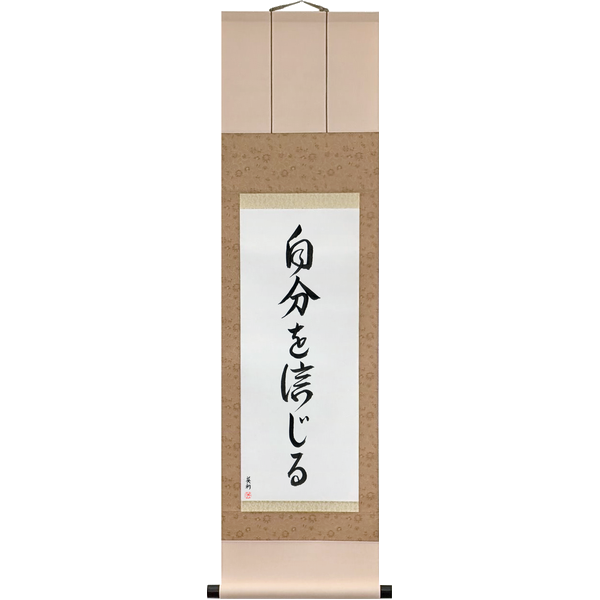
Sold as Believe in Oneself · A New Beginning · Hope is our greatest treasure · Take Risks · Read jibun wo shinjiru · aratana hajimari · kibō wa saidai no takara · kiken wo okasu · Register standard Japanese; 危険を冒す is a set expression with its own dictionary entry, the others are free phrases · Oldest witness 危険を冒す in an 1884 translation of an American etiquette manual and an 1889 lecture on life insurance; 自分を信じる in Ozaki Kōyō's 金色夜叉, 1903 edition; 新たな始まり once, in a 1948 Feuerbach; 希望は最大の宝 in no book to 1946 · Sense four sentences a person says to themselves before acting.
The sense: what each one asks
These are the sentences of a decision. 自分を信じる, believe in yourself, is a verb with its object, and the object is the reflexive 自分, oneself, so the sentence works for any speaker, which is why it can hang on a wall. 危険を冒す, brave the danger, is the Japanese idiom for taking a risk, and its verb 冒す is the one used of defying weather and profaning the sacred, so the phrase has more edge than the English take risks: it is what a person does knowing the cost. 新たな始まり, a new beginning, is a noun phrase and reads as a title; 希望は最大の宝, hope is the greatest treasure, is a maxim in the plainest possible form, subject, wa, predicate. Two of the four have a Japanese life before the house, and it is the two a buyer might least expect: the risk idiom from the 1880s in books on riding and on insurance, and believe in yourself on the lips of Kan'ichi, the wronged lover of Meiji Japan's most famous novel.
The words
自分 jibun: デジタル大辞泉 反射代名詞。その人自身。おのれ, the reflexive pronoun: the person himself, oneself, with 自分を省みる, to look at oneself; 精選版日本国語大辞典 cites the reflexive from a 1724 puppet play and the first-person use from 1425. 信じる shinjiru, to believe, is the modern one-step form of the older 信ずる; the dictionary's first citation for the new form is Uchida Roan in 1902, which means the verb in the design's spelling and Kōyō's sentence below are of one decade. [kotobank.jp/word/自分 · /word/信じる, text; read by the investigator]
危険 kiken, danger, cited from the 続日本紀 of 737 in the spelling 危嶮; 冒す okasu: 危険や困難を覚悟のうえで、あえてする, to do a thing knowingly in the face of danger or difficulty, then to defile what is sacred, then to take another house's name; the bilingual dictionary gives the whole phrase 危険を冒す as an expression, to brave a danger; to take a risk. 希望 kibō, hope: first the wish for a thing to come true, cited from an 1872 newspaper, then 将来に対する期待。また、明るい見通し, expectation of the future, a bright outlook, cited from 1875, with the note that the word was read kemō in the old Buddhist reading before the modern kibō. 最大 saidai, greatest, cited from the 宝物集 of about 1179. 宝 takara, treasure, whose first citation is a poem in the 万葉集, 銀も金も玉も何せむにまされる多可良子にしかめやも, silver, gold, jewels, what are they to me; what treasure surpasses a child, which is the oldest Japanese sentence of the form X is the greatest treasure; the dictionary cites it as 万葉集 5.803 and does not name the poet, and the identification of it as Yamanoue no Okura's is the seat's, from the poem's number. 新た arata, new, is in the 万葉集 too, and 始まり hajimari, a beginning, is the noun of the verb to begin. [kotobank.jp/word/危険 · /word/冒す · /word/希望 · /word/最大 · /word/宝 · /word/新た · /word/始まり · jisho.org/word/危険を冒す, text; read by the investigator]
The English overlaps cleanly. Believe in yourself and 自分を信じる are the same verb and the same object; Japanese adds nothing and loses nothing. Take risks is the one place the languages part: English takes a risk as one takes a chance, and Japanese braves it, 冒す, so the Japanese is a shade more serious, and the plural of the English title has no counterpart, since 危険 is neither singular nor plural. Hope and 希望 match in both senses, the wish and the outlook. [jisho.org/word/自分 · /word/希望 · /word/新た, text]
A history, from the earliest witness
1884 and 1889. 危険を冒す in the useful books of Meiji. The idiom's oldest dated page in the library is an etiquette manual translated from the American, on horses: a gentleman must not offer a lady a horse he has not tried himself, 甞て乘り試みさる馬を婦人に進むるを實に危險を冐すの虞あきい, for that is truly to run a risk, as the OCR reads it; read 試みざる, 進むるは, 虞あり. [ヒル『西洋礼式』坂部録三訳 博聞社 1884, NDL pid 759140, koma 77, OCR, the line garbled around the phrase]
Five years later it is a term of art in the first Japanese treatise on life insurance, among the conditions under which insurance can work: 同樣の危險を冒す人の多人數なる〓と、危險を冐す人の多人數なるに比して實際出來事に過ふ人の割合に少なき〓と, that those who run the same risk be many, and that those who actually meet the event be few in proportion to those who run the risk. Two undated Waseda correspondence-course texts of the same generation show where the phrase came from: a commercial-English lesson glosses the English idiom, Runs great risk. runarisk熟語である.「危險を冐す」「危險に逢ふ」等の意味である., as the OCR sets it, and an economics lecture uses it of the entrepreneur, 危險を冐す多き者は其受くる所隨て多く, he who runs the greater risk receives accordingly the more. 危険を冒す is Meiji Japanese for the English run a risk, and it entered through business before it reached the wall. [藤沢利喜太郎『生命保険論』文海堂 1889, NDL pid 800566, koma 7, OCR; 今井友次郎講述『商業英語』早稲田大学出版部, undated, pid 1082660, koma 19, OCR; 天野爲之講義『經濟原論』東京専門学校出版部, undated, pid 1082462, koma 88, OCR; the 〓 in the 1889 line is the OCR's mark for the ligature こと]
1903. 自分を信じる, in 金色夜叉. In the eighth chapter of Ozaki Kōyō's novel, on the beach at Atami, Kan'ichi says to Miya, who is leaving him for a rich man: 「宮さん、お前に限つては然云ふ了簡は無からうと、僕は自分を信じるほどに信じてゐたが、それぢや依樣お前の心は慾だね、財なのだね。」, Miya, I believed, as surely as I believe in myself, that you of all people would never think that way; so after all your heart is greed, is money. The phrase's first page in the library is not a maxim; it is the standard against which a betrayal is measured. [尾崎紅葉『金色夜叉 前編』春陽堂 1903, 第八章, printed pp. 148–149, NDL pid 886443, koma 78, by eye]
1908 and 1920. The tanka poet Kubota Utsubo, commenting on a poem, writes the sentence a self-help book would: 自分を信じるといふ事は、理窟としては、如何にもたやすい事のやうであるが、實際としては、案外困難の事である。此れは誰しも感ずる事だ, to believe in oneself seems, as a matter of theory, the easiest thing, but in practice it is surprisingly hard; everyone feels this. And Murō Saisei, remembering a hungry adolescence: 自分は自分を信じるちからが大きかつたため、いま在る生活がきつと自分を善くしてくれることを考へてゐた, because my power to believe in myself was great, I thought that the life I was living would surely make me better. Thirty-nine books carry the phrase to 1946, and these are its shapes: a lover's reproach, a critic's aside, a memoir's confession. [窪田空穂『新派短歌評釈』玄黄社 1908, NDL pid 873602, koma 91, OCR; 室生犀星『性に眼覚める頃』新潮社 1920, NDL pid 962886, koma 148, OCR]
1948. 新たな始まり, once. The phrase's single page before the corpus ends is a philosopher's: Sano Fumio's Feuerbach, in the Critique of Hegel, where logic 一の新たな始まりであり、當初から始まり, is a new beginning, beginning from the very first. It is an ordinary phrase that happened to find print late; a Japanese reader needs no source for it. [フォイエルバッハ『ヘーゲル哲学の批判』佐野文夫訳 岩波書店 1948, NDL pid 1039043, koma 22, OCR]
希望は最大の宝: no page. The maxim as written returns nothing from the Library's public-domain books. Its form is old, and its nearest ancestor in Japanese is the 万葉集 question about what treasure surpasses a child, but that is a family resemblance, not a source. [labsearch_house_19.txt, the Lab full-text API, 0 hits; kotobank.jp/word/宝 for the 万葉集 line, text]
What is not a source
No text stands behind the four. 危険を冒す is an idiom the language made out of the English run a risk in the 1880s; 自分を信じる is a sentence anyone can say and Kōyō's Kan'ichi said memorably; 新たな始まり and 希望は最大の宝 are the house's plain Japanese for English mottos. The 万葉集 poem is named above so that a page does not later claim it.
The phrases in English
None of the four has an English author the house names. Believe in yourself, a new beginning and take risks are the stock of the English motivational register, and hope is our greatest treasure is the house's own line, its our dropped in the Japanese, which needs no possessor. What a rendering must keep: the reflexive in 自分を信じる, which makes the sentence true for whoever reads it; the edge of 冒す, so that take risks is not softened to try things; and the maxim's wa, which is what makes 希望は最大の宝 a proverb rather than a phrase. The house's romaji keeps the particle as wo; the Hepburn standard writes it o, and the stand on that is Tim's, not this page's.
A reading
The phrase a buyer will trust least, take risks on a Japanese scroll, is the one with the deepest roots, and they are commercial: a Meiji lecturer glossing run a risk for students of business English, an actuary counting the people who run the same risk. That is a good pedigree for a design a person buys before a venture. Believe in yourself has the better story, since the first Japanese to say it in print was a jilted man on a beach, and I would put Kan'ichi's sentence on the page, because it shows the phrase carrying its full weight. The other two are honest house Japanese and should be sold as that. Signed, the philologist, 2026-09-06.
Notes
- Undated books. The Lab API dates an undated book 1800; the two Waseda lecture texts are cited as undated and their place in the 1880s–1900s is inferred from the series, not asserted.
- 冐 and 冒. The 1884 and 1889 leaves print the variant 冐 in some lines and 冒 in others; the OCR is quoted as it reads.
- Kōyō's chapter. The 1903 Shun'yōdō edition is the 前編; the scene is the Atami beach parting, the novel's most famous, and the running head on the leaf reads 第八章.
- Romaji. kibō carries the macron on the page; the catalogue's kibou is the wapuro form of the same word. The particle を is wo in the catalogue and o in Hepburn; unchanged here pending the stand.
How this was read
A bracket that names a National Diet Library leaf as pid and koma resolves at lab.ndl.go.jp/dl/api/page/<pid>_<koma> for the OCR text and at dl.ndl.go.jp/api/iiif/<pid>/R<koma, seven digits>/full/2400,/0/default.jpg for the image. By eye at the page: 金色夜叉 前編 at pp. 148–149 (pid 886443, koma 78). By OCR, own-hand at the koma: the seven other books in the brackets. By the Lab's full-text search, own-hand, the whole result set of each phrase sorted by year (39 · 1 · 0 · 2,388, the last walked to 2,237). By text: the kotobank entries for 自分, 信じる, 新た, 始まり, 希望, 最大, 宝, 危険 and 冒す, read whole by investigate-ten on 2026-09-05 and quoted from its reading files, not re-opened by the seat; the EDRDG entries at jisho. Not opened: the other thirty-six pages with 自分を信じる and the two thousand with 危険を冒す; the 1870 manuscript and the 1887 八犬伝 hits the sweep returned for other phrases; an English dictionary for risk; Okura's poem at the 万葉集 itself.
References
- 129 誇りと喜び (164 books; 1937) — F0056
- 164 子供の為に (1,684 books; 1912) — F6000
- 222 家族は永遠 (2 books; 1924) — F6058
- 291 自分を信じる (39 books; 1946) — I6002
- 295 精一杯生きる (0) — I6006
- 299 強く生きる (207 books; 1937) — I6010
- 319 希望は最大の宝 (0) — I6030
- 327 自由に生まれて (0) — I6038
- 331 新たな始まり (1 book; 1948) — I6042
- 415 永遠に心の中に (1 book; 1927) — L5033
- 418 永遠に私の心に (3 books; 1935, 1941) — L5036
- 566 危険を冒す (2,388 books; 1897 among the first five) — M6013
- 961 生きる笑う愛する (0) — S0000
- 968 誕生日おめでとうございます (0) — S0007
- 988 有難う御座います (1,739 books; 1914 among the first five) — S0030
- 1010 ゴルファー (50 books; 日国 初出 1930) — S5009
- 392 禁じられた愛 (1 book; 1924) — L5010
- 834 永遠の若さ (202 books) — P4103
- 627 母なる自然 (85 books) — N4014