

異体同心 · itaidōshin · Different Bodies One Mind
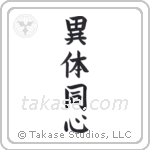
Sold as Different Bodies One Mind · Read itaidōshin · Oldest witness Tang China, of two paired guardian figures and of a body of officials · Made Japanese by 日蓮 in 1279, writing to encourage a persecuted congregation · Sense separate in body, single in mind: what people become when private interest disappears under a shared aim.
The words
Not four characters in a row but two two-character words set against each other. 異体 is different bodies — separate persons. 同心 is one mind. The hinge between them is the whole phrase: it does not say the two become one, it says they stay two and think as one.
That antithesis matters so much that the man who made the phrase Japanese never wrote it without its mirror. Against 異体同心 he sets 同体異心 — one body, different minds — and calls that the state in which nothing can be accomplished.
A history, from the earliest witness
Tang China. The four characters appear in the Tang literary collections, and the people they describe are never a married couple. In 滕邁's rhapsody on the two yellow figures that guard the sun, observe how they are different in body and one in mind, two forms with combined strength, like the offices of left and right, holding each other up and each taking its charge. In a hymn celebrating a tree whose branches have grown together, it is the prefecture's officials: the office has its clerks and the prince his retainers — different in body, one in mind — and they bring the people to good order. The poet 陸游 uses it in a funeral elegy for a friend he had met by chance in 南鄭: different in body, one in mind; in what was good we urged each other on, in what was lacking we corrected each other. 劉克莊 uses it the same way, mourning another friend.
Paired guardians, colleagues, sworn friends. That is the company these characters keep for their first six hundred years.
1279, Japan, and a letter to people in trouble. The phrase becomes Japanese in the hands of 日蓮, in a short letter that the tradition has titled 異体同心事 ever since. He is writing to a supporter about the believers at 熱原, who were then being persecuted, some of them fatally.
異體同心なれば萬事を成し、同體異心なれば諸事叶フ事なしと申ス事は外典三千餘卷に定て候。殷の紂王は七十萬騎なれども同體異心なればいくさにまけぬ。周の武王は八百人なれども異體同心なればかちぬ。
That when people are different in body and one in mind they accomplish everything, and when they are one in body and different in mind nothing they attempt succeeds — this is settled in the three thousand and more volumes of the outer classics. King Zhou of Yin had seven hundred thousand horsemen, but being one in body and different in mind he lost the war. King Wu of Zhou had eight hundred men, and being different in body and one in mind he won.
He goes on: one person, if he has two minds, will accomplish nothing; a hundred or a thousand, if they have one mind, will certainly accomplish it. And then, of his own people: my followers are different in body and one in mind, and so, though we are few, the Lotus Sutra will surely spread.
Notice that he names his own source and it is not Buddhist. The outer classics are the Chinese ones, and the passage behind him is the 尚書: Shou has ministers by the hundred million, but a hundred million minds; I have three thousand ministers, but one mind. His numbers, seven hundred thousand and eight hundred, come not from there but from the 史記's account of the battle. He is a preacher working across the whole Chinese canon from memory, and what he takes is the principle, not a quotation. The four characters themselves are not in the 尚書.
In a companion letter he gives the phrase the meaning it still carries for millions of people: my disciples and lay supporters, with no thought of self and other or this and that, forming the thought of fish and the water they swim in, and chanting Namu-myōhō-renge-kyō different in body and one in mind — that is what is called the heritage of the great matter of life and death.
1134, and four monks in 1612. Outside 日蓮, the premodern Japanese uses are few and every one that survives in the national digital collection was read for this history. There are nine premodern books in it containing the phrase; six are Chinese books held in Japanese libraries. The three Japanese ones are these:
A collection of medieval documents records a woman who spent years saving red beans, a grain at a time, to have a Buddha made, and died before it was done. Hearing this, her daughters took the clothes from their backs and the food from their mouths and, different in body and one in mind, had made a sixteen-inch Amida and a two-foot Jizō.
And in 1612 four monks finished cutting the printing blocks for a Buddhist history, and signed the colophon: the four monks gathered, different in body and one in mind, cut the blocks and sent it out into the world.
So: four monks at a press, a mother's daughters, and a persecuted congregation. In thirteen centuries of witnesses, not one married couple.
1905, and the joke. The great dictionary of Japanese dates this phrase to 1905, from 夏目漱石's I Am a Cat — which is six hundred years too late, because a dictionary's earliest example is the earliest in its own reading list, and that list is built of famous literature. 日蓮's letters are not on it; 漱石 is. But the passage is worth having anyway, because of what it says. It comes in the long speech about individuality pulling every human tie apart — parents from children, and finally husband from wife:
昔しなら文句はないさ、異体同心とか云って、目には夫婦二人に見えるが、内実は一人前なんだからね。それだから偕老同穴とか号して、死んでも一つ穴の狸に化ける。野蛮なものさ。
In the old days there was no complaint. They'd say "different bodies, one mind" — to the eye, two people, a married couple, but in substance only one person's worth. That's why they had that other phrase, "grow old together, share one hole" — dead, they turn into badgers in the same burrow. Barbaric.
That is the first time our phrase is recorded being applied to a marriage in the literary canon, and it is a character sneering at it.
The twentieth century. The national collection holds 1,563 books before 1945 with these characters in them. A sample of the modern ones was read, and roughly five in six are publications of the Nichiren schools — sermon collections, commentaries on the letters, histories of the 熱原 persecution, devotional handbooks. The phrase's modern Japanese life is largely a sectarian one. The marriage sense does appear: a 1917 book on married duty, and a 1926 book on rural life which says a couple's being different in body and one in mind depends largely on the wife's virtue — which is what the marriage sense looked like when it was new, and not a sentiment this shop would sell.
The sense across time
One idea throughout, pointed at different people. It is never about feeling alike. It is about separate persons whose private interest has disappeared under a shared aim — soldiers, officials, friends, monks, daughters, believers. What is shared is direction. What is kept is the two bodies: the phrase insists on them.
The married-couple sense is real, modern, and carried by both Japanese dictionaries, one of which lists it first. It is an extension of the older idea into the smallest possible unit of solidarity.
The text in English
This phrase, unusually, has a settled English rendering — and it comes from the religious tradition, not from translators of literature. In the standard English Writings of Nichiren Daishonin the letter is titled "Many in Body, One in Mind," and that phrase is a dictionary headword in the Nichiren Buddhism Library. Among English-speaking practitioners the romaji itai-dōshin is used untranslated.
Many in body is an interpretation rather than a translation — 異 is different, not many — and the tradition's reading, a large and varied community, is doing the work. The house's Different Bodies One Mind is the more literal of the two, and keeps the different that the phrase is built on.
How large is that English life? Larger than one might guess. The romaji itai doshin appears in 216 books in the Internet Archive's full-text index, and many in body, one in mind in 161 — almost all of them Soka Gakkai publications: the World Tribune from 1980, Seikyo Times from 1984, and Daisaku Ikeda's commentaries on the letters. This is a phrase that hundreds of thousands of English speakers use every week, and essentially none of them met it as a wedding text.
One caution on a near-miss. The phrase different in body but one in mind also occurs in English Buddhist writing, but in Theravāda sources that have nothing to do with 異体同心. It is a coincidence of English, not a second rendering. And the page reference for the Writings of Nichiren Daishonin is taken from a public mirror rather than the official text.
My reading
Signed, and offered as one voice among the ones above.
Of the three classical formulas a Japanese couple might be given, this is the one I would choose, and for a reason that only appears once you know the history.
一心同体 makes the two into one body. 偕老同穴 — the one 漱石 pairs with ours — promises to grow old together and share one grave. Both dissolve the two people into a single thing, which is exactly what 漱石's speaker was objecting to when he called the ideal barbaric: it asks a couple to count as one person's worth.
異体同心 does not do that. It is the only one of the three that keeps the two bodies in the phrase and refuses to erase them. What it asks for is not fusion but alignment — that two people who remain unmistakably two should want the same thing and pull the same way. It is the formula of comrades, and that is its strength here rather than its limitation: it was built to describe people who stay themselves while acting as one, which is a harder and more durable thing to wish on a marriage than becoming a single body.
Two things I would tell a buyer plainly. First, that its home is 日蓮 and a congregation under persecution, because that is where its weight comes from and because a Japanese friend may well say so. Second, that its most famous literary appearance is a joke at its expense — and that the joke does not land on this phrase, only on its rivals. 漱石's speaker complained that the old ideal made two people into one person's worth. These four characters were always the ones that said otherwise.
References
Each witness is cited in the account above, at the frame or entry where it was read. A linked list follows when the record for this text is completed.