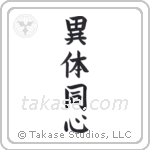
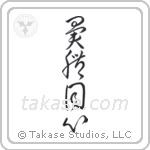
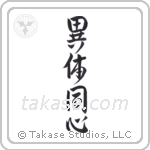
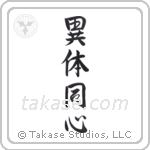
The phrase is built on a contrast, and it says the two stay two: 異体 is different bodies, separate persons, and 同心 is one mind. Its mirror image, 同体異心, one body and different minds, is the state in which nothing gets done, and the two were set against each other by Nichiren, in a letter about his persecuted followers at Atsuhara: a few people of one mind accomplish what a multitude of divided minds cannot.
Before him the four characters were Chinese, said of two cruel emperors, of two guardian figures beside the sun, of a prefecture's officials and of friends mourned by poets; and in Japan of a nun's two daughters and the deities of a Buddhist rite. Said of a couple, its modern sense, which the dictionaries carry, it wishes them alignment rather than fusion: 一心同体 and 偕老同穴 make a couple one, and this phrase keeps both people in it.
English-speaking practitioners know it as many in body, one in mind; different bodies, one mind keeps the different the phrase is built on.
異体同心 is composed of the kanji 異 (read i) meaning "uncommon; different; queerness", 体 (read tai) meaning "body; substance; object", 同 (read dō) meaning "same; agree; equal", and 心 (read shin) meaning "heart; mind; spirit".
The phrase is Chinese: the oldest use found in zh.wikisource's texts with a datable writer is 虞世南's (558–638) verdict on two cruel emperors, and Tang writers use it of two guardian figures and of a prefecture's officials; in Japan it is written from the twelfth century in Buddhist books, and Nichiren's letter on it, about his followers at Atsuhara and put by its English editions between 1275 and 1280, gave it the life it has had since.
We want you to be as happy with the meaning as you are with Master Takase's art. To learn more, visit Philology of 異体同心.