

一生懸命 · isshōkenmei · Do One's Very Best
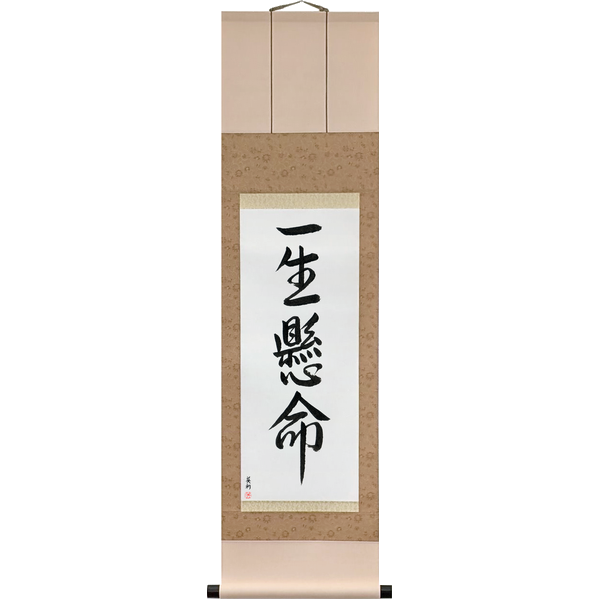
Sold as Do One's Very Best · Read isshōkenmei; the older spelling 一所懸命 reads isshokenmei, without the long vowel · Oldest witness the 古事談 of 1212–15, where a retired emperor tells a courtier to yield an estate because for the warrior who holds it, that one place is his life · Sense to give everything, as if one's life hung on it; made in Japan from 一所, one place, the single fief a warrior defended with his life, and respelled 一生, a whole life, by the Edo theaters and novelists from 1734
The words
一生 is a lifetime; 懸命 is to hang one's life on something, a word the sixteenth-century chronicles use of a fief granted for one's livelihood; 一所 is one place. The four characters are a Japanese word, not a Chinese one: neither spelling occurs in the Chinese archives. The 日本国語大辞典 defines 一生懸命 as 命がけで事にあたること。一心に骨折ること…必死, to meet a thing as if one's life depended on it, and says of its origin only that the medieval いっしょけんめい turned into this form in the Edo period. Its entry for 一所懸命 gives the older sense first: 中世、生活の頼みとして、命をかけて所領を守ろうとすること。また、その所領, to defend with one's life the fief one lived by, and the fief itself. The change is in the ear: ショ lengthened to ショウ in Edo speech, the notion of place was forgotten, and 一生 was written for the sound. Both spellings are correct and are one word.
A history, from the earliest witness
1212. One place, one life. The word's first witness is an anecdote, and it holds the whole meaning. A courtier, 顕季, and a warrior, 義光, dispute an estate, and the retired emperor 白河 will not rule. One day, alone with the courtier, he explains: without that one estate you would lack nothing; for him, I hear, that one place is his life (彼ハ只一所懸命之由聞召之). If I judged by right and title, a warrior who does not weigh such things might do something black. Better that you yield the place. The courtier weeps, calls the warrior in, tells him I have other estates; you rely on this one, and writes the deed of surrender that day. The warrior moves to the guardroom in joy. A year or two later the courtier, riding home at night with two servants, meets armed men on the road: the warrior's, guarding him. [古事談 第三, in the 国史大系 typeset of 1901, pid 991105 koma 20] That is what 一所懸命 meant: the one piece of land a man would die to keep.
The fourteenth and fifteenth centuries. A warrior's term, then a dictionary word. The 太平記 puts it in a traitor's mouth: the man who sells the hiding place of the last Hōjō heir asks, for his loyalty, the confirmation of a fief to stake my life on (一所懸命ノ地ヲ安堵仕ル様ニ). [慶長 print of 1603, pid 8943158 koma 5] The 庭訓往来, the letter-writing primer every Edo schoolboy would copy, has it in a letter on inherited land: as to the hereditary holdings, the land on which one's life is staked, there shall be no dispute (一所懸命之地者不可有相違). [pid 2532288 koma 36] And in 1444 the 下学集, the century's dictionary of three thousand words, lists 一所懸命 among its words and phrases, between ultimate and entire. [1617 print, pid 2538644 koma 74] A 節用集 of 1597 gives its kana, イッシヨケンメイ, with no long vowel, beside 一騎当千. [pid 2543886 koma 6]
The Edo period. Two spellings. The warrior's books keep the old word and the old sense: a house code of 1673, a fief is the land one stakes one's life on; service, loyalty and renown are a warrior's honor (所領は一所懸命の地也). [子孫鑑, pid 2551240 koma 37] The townsman's books keep the old spelling for the new feeling: in a 1736 novel a failing doctor faces 一所懸命の分別所, the decision everything hangs on. [江島其磧, pid 2551585 koma 19] And the puppet stage writes the new spelling two years before that: 文耕堂's 応神天皇八白旗 of 1734, 大君を殺さねば一生懸命の, and again 最早一生懸命と, with the kana いつしやうけんめい. [in the 1900 typeset, pid 1882691 komas 281 and 295] From there the 一生 spelling is the popular press's. 平賀源内's essay in praise of farting, printed 1780, has a fox's fart as 一生懸命の敵を防ぐ, a life-or-death defense. [pid 2534153 koma 6] 山東京伝's picture riddles of 1794 set 一生懸命 as a five-character puzzle, with the kana イツシヤウケンメイ. [pid 8929921 koma 8] 為永春水's romances of the 1830s have a girl run out 一生懸命, with the same kana. [pid 8942911 koma 12] The National Diet Library's pre-modern books show the split whole: 一所懸命 in ninety-two, chronicles, dictionaries, house codes and gazetteers; 一生懸命 in sixty-four, plays, comic books and novels. The warriors kept the place; the theaters wrote the life.
Meiji to now. Both spellings ran on. The primary reader of 1887 taught 一所懸命; the library's index has it in thirty-seven books of the 1880s and six hundred and fifty-seven of the 1930s, and 一生懸命 in at least four times as many in every decade, more than ten thousand before 1945. In 2000 the NHK放送文化研究所 wrote that the newspapers and magazines had mostly unified on 一生懸命, and broadcasting uses 一生懸命 too. The scroll's spelling is the press's and the broadcasters'.
The sense across time
The word has meant one thing said two ways. To the twelfth-century court and the medieval warrior it was a fief and the life bound to it, a term of land tenure with a feeling inside it. By the 1660s and the townsman's novels it was the feeling alone, as if one's life hung on it, and by 1734 the theaters were spelling the feeling as they heard it, 一生, a whole life. The dictionaries call the respelling a forgetting; the English writers of the 1980s and 90s, Watanabe Shōichi and Yamazaki Masakazu among them, made the old spelling a thesis about the Japanese bond to one plot of ground. Both are true. The emperor's sentence in 1212 was about a fief and about a man for whom one thing was everything, and the playwright who wrote 一生 was right about the feeling.
What is not a source
No Chinese text. 懸命 alone is Chinese (the 後漢書, by the 字通), but the compound with 一所 is Japanese, made in the language of land. The catalogue's derivation from 一生, one's whole life, explains the modern spelling, not the word.
The text in English
The word reaches English as a vocabulary item and stays one. 1945. Ashikaga's list of the kanji in the Naganuma readers: isshõkenmei. 1949. Uyehara, Songs for Children Sung in Japan: Issho-kenmei nigete iku, the ogre fleeing. 1973. Japanese for Today: isshō kenmei — with all one's might. 1986. Japan in the Global Community: the expression "issho-kenmei," which in current usage means "to do one's best". 1989. Watanabe Shōichi, The Peasant Soul of Japan: The way of thinking from which derives the term ISSHOKENMEI is a development of this concept. 1990. De Mente, Japan's Secret Weapon: The Kata Factor: gambaru … and issho-kenmei yaru. 1993. Tanaka Keijirō, Till the Whole Is Leavened: "Issho" means one place; Vance, Kodansha's Romanized Japanese-English Dictionary: to strive, to persevere. 1994. Yamazaki Masakazu, Individualism and the Japanese: issho kenmei, which expresses determination to stake one's life. [all Internet Archive snippets, dated from metadata] The writers who explain the word explain 一所; the ones who use it use 一生. Do one's best is in print by 1986, with all one's might by 1973.
A reading
Brush 一生懸命 and tell the story of 一所. The scroll's spelling is the word as every Japanese reader now sees it, and the page should say so rather than derive it from whole life. A buyer who learns that the word began as one place, one life, in a scene where an emperor tells a courtier to yield an estate because for the other man it is his life, has been given the word rather than a gloss. For a dojo the story is exactly right: the warrior's word for the one thing he would die to keep. The old spelling is a real second design for the buyer who wants that word; the two are one word, both correct, and the page can say which is which. Signed, 典, 2026-09-07.
How this was read
By eye: the template file. By text at the address: kotobank for 一生懸命, 一所懸命, 懸命, 下学集 and 庭訓往来; the National Diet Library's full-text index on both spellings, with its pre-modern facet walked whole for each, and seventeen scans read through the page API (lab.ndl.go.jp/dl/api/page/
References
Each witness is cited in the account above, at the frame or entry where it was read. A linked list follows when the record for this text is completed.