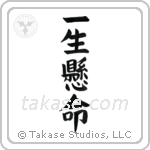
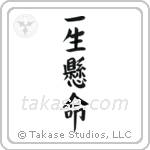
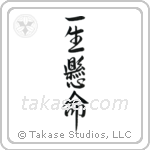
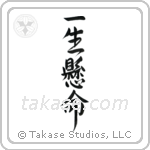
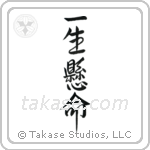
一生懸命 (isshōkenmei): to do a thing as if your life depended on it, to give everything you have. The word is Japanese, made in the language of land, and it began as 一所懸命,
one place, one life: the single fief a warrior lived by and defended with his life. Its first witness is a scene in the 古事談 of 1212. A courtier and a warrior dispute an estate, and the retired emperor 白河 tells the courtier, in private,
without that one estate you would lack nothing; for him, I hear, that one place is his life. The courtier yields the land that day, and a year later, riding home at night, finds the warrior's men on the road guarding him. The 太平記 and the schoolboys' letter primer use it as a term of land, and the 下学集 lists it as a dictionary word in 1444. In Edo speech the short
sho lengthened to
shō, the place was forgotten, and the puppet theater wrote what it heard: 一生, a whole life, first in a play of 1734. The warriors' books kept 一所 and the plays and novels wrote 一生; both are correct and are one word, and the newspapers and NHK settled on 一生懸命 in the last century. The scroll brushes the word as every Japanese reader now sees it; the story it carries is the older one, the one thing a man would die to keep, which is why it belongs in a dojo.
four-character idiom 一生懸命 is composed of the words
一生 (read isshō) meaning "one's whole life;the greatest of one's life" and
懸命 (read kenmei) meaning "eagerness; risk one's life".
This beautiful calligraphy art of 一生懸命 would be a great addition to any dojo, or any place where maximum effort is expected, as a reminder to always do one's best.