

一心同体 · isshin dōtai and 形影一如 · keiei ichinyo · two bodies, one heart
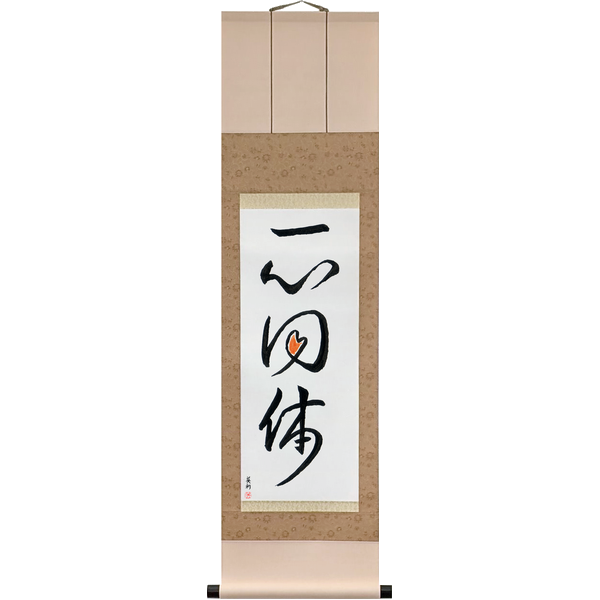
Sold as One in Mind and Body and Inseparable as Form and Shadow · Read isshin dōtai; keiei ichinyo · What they are two ways of saying that two people are one: 一心同体 is one heart, one body, a Chinese phrase for sworn brothers and for a master and his disciples, which Meiji Japan gave first to its police and its soldiers and then, under the Christian one flesh, to husband and wife; 形影一如 is form and shadow as one, a Zen image of a man and his reflection that one dictionary files under the couple · Oldest witness the 西遊記 for the Chinese phrase; 1874 for its Japanese use, a police regulation; 1883 for the couple, an Orthodox catechism; 1911 for 形影一如, a Zen book on 洞山's awakening · In the dictionaries 一心同体 everywhere, with 夫婦は一心同体 as its example; 形影一如 in one, and in four books in a century · Not Chinese for the couple: Chinese says 形影相隨 · Signed 典, 2026-09-07.
The words
一心 is one heart: the Buddhist one mind, the single-mindedness of a man at prayer, and the hundred million hearts as one of a wartime proclamation. 同体 is one body, a tenth-century Buddhist word for the Buddhas' single body. Together the dictionaries gloss them two or more people acting with one heart, bound like one person, and every one of them illustrates the phrase with husband and wife are one heart and one body. The Meiji spelling was often 一身, one person, rather than 一心, one heart; the big dictionary's own first citation is spelled that way, and its note says so. The scroll's 一心 is the ruling form.
形影 is form and shadow, the pair that never parts: a court poet of 818 wrote of the exiled princess 王昭君 that her soul goes back to the Han palace, her form and shadow face the barbarian field, and the 列子 says that when the form bends, the shadow bends. 一如 is the Buddhist not-two, the one truth under its many appearances, and then simply one and the same. Only one dictionary has the four characters together, and it gives two senses: that the good or evil of the heart shows in what a person does, and that husband and wife are close. The big dictionary has no entry.
The older Japanese word for the couple's oneness is 異体同心, bodies apart, one heart. It is Nichiren's word for his community, and by 1905 漱石's cat could laugh at it as the old way of talking about marriage.
A history, from the earliest witness
A Ming novel, a Song commentary, a secret society. Chinese Wikisource has 一心同體 in three kinds of text. In the 西遊記, chapter 32, the Tang monk had got Sun Wukong back, and master and disciples, one heart and one body, went on together toward the West; that leaf was read in the 1696 annotated edition the National Diet Library holds. A Song commentary on the 書経 says the Grand Protector and the young king were one heart and one body. And the initiation oath of the 天地會, the Heaven-and-Earth Society, as a Qing miscellany records it, runs: once in the Hong gate, be of one heart and one body, support one another, allow no distinction of you and me. The phrase names a brotherhood. The commoner Chinese phrase for the same idea, 異體同心, is older: a Tang ode on a tree whose two trunks grew into one, and a prose-poem on two yellow men guarding the sun, bodies apart and one heart, two forms joining their strength like the left and right hand, read at the page in a print of 1567. Neither is a phrase for a couple. The Chinese couple's phrase is 形影相隨, form and shadow following each other.
Nichiren's word. 異体同心 came to Japan as a Buddhist word. Nichiren's letter to the believers of Atsuhara, dated 1275 in the collected writings, says: with bodies apart and one heart every thing is achieved; with one body and hearts apart nothing is accomplished — so it stands in three thousand volumes of the outer canon. King Zhou of Yin had seven hundred thousand horse but hearts apart, and lost; King Wu of Zhou had eight hundred men but one heart, and won. Another letter makes it the definition of his community: all my disciples and patrons, with no thought of self and other, as fish think of water, chanting the daimoku with bodies apart and one heart — that is the lifeblood. Four monks who printed a Buddhist chronicle in 1612 signed their colophon four monks gathered, bodies apart and one heart, cut the blocks. This is the word the cat remembers in 1905: in the old days there was no argument; they said 異体同心, and though you saw two people you had in fact one; and so they called it "old together, one grave," and even dead turned into badgers in one hole. Barbarous.
1874: the police. The oldest dated Japanese use of 一心同体 found is a Tokyo police regulation of the seventh day of the second month of 1874, printed with its date in a police handbook of 1878: Article 3. Those on duty together shall consider themselves one heart and one body, make mildness and gentleness their rule, do their duty to one another with sincerity, and encourage one another not to slacken. The same year 西郷隆盛 wrote, in Chinese, a memorial for the volunteers who died in the Taiwan expedition: in our levied company we were one heart and one body, as when the right hand is in trouble the left hand answers without thinking. In 1877 a translator of Rousseau used it for the social contract's single body: when many men gathered together regard themselves as one heart and one body. In 1880 a translated church history had Francis Xavier write to a friend, my soul is your soul and your heart is my heart, truly a feeling of one heart and one body. Through the 1870s and 1880s the phrase belongs to the state, the army, the church and the philosophers, and the commentaries on the emperor's rescript to soldiers gloss his limbs and head with it.
1883: the couple, under "one flesh." The first use for husband and wife found is the Orthodox Church's catechism of 1883, on the sacrament of marriage: that they may obtain the grace to bear and raise children in a pure one-heart-one-body. The novels follow: a political novel of 1888, the two's love was doubled from the day before, and they felt ever more one body and one heart (spelled one person); a novel of 1891, the two grew ever closer, the one-heart-one-body of the mountain; a conduct book of 1899, the couple's affection was enviable to onlookers, always as if one heart and one body. 福沢諭吉's New Greater Learning for Women of the same year makes it the marriage contract's clause and then limits it: husband and wife being one heart and one body, the contract to share pain and pleasure may not be broken at the cost of life; yet apart from the division of household labor into inner and outer, there is no rank of high and low between them, and each should hold to equality in all things. In 1908 an English idiom dictionary printed the equation: She and I are one flesh — 一心同体だ, with (husband and wife) in brackets. 武信's Japanese-English dictionary of 1918 has to become one flesh and, for a friend, one's second self. By 1910 the proverb dictionary lists husband and wife are one heart and one body among the sayings on marriage, and the 1919 national dictionary files it under 夫婦 as a proverb. The Library's count of books goes from eighteen in the 1870s to nearly a thousand in the 1930s.
形影一如: a Zen image, four books. The Library's full-text index finds 形影一如 in four books in a century. The oldest, a 1711 print of 朱子's works, is a false hit: the leaf reads each has its form and shadow, as if it could be grasped, and the fourth character begins the next phrase. The oldest real one is a Zen book of 1911 retelling the awakening of 洞山良价, the ninth-century founder of the Caodong line: one day, crossing water, he saw his reflection and was greatly awakened, and made the verse "Do not seek from another, or you will be far from yourself; today I walk alone, and everywhere I meet him; he is now just me, I am now not him" — crossing the water, form and shadow one, here he was suddenly and greatly awakened. A Zen book of 1936 repeats the paragraph nearly word for word. The fourth, a history of children's literature of 1943, uses it of two men who for more than twenty years kept the closest friendship, form and shadow as one, striving together toward the one road of children's literature. Chinese has no such phrase: it says 形影相隨 and 形影不離 for two who are never apart, 形影相弔 for the lonely man whose only company is his shadow, and 如影隨形 for the retribution that follows a deed as the shadow follows the form, which is where the dictionary's first sense comes from. Japanese books use those Chinese idioms too, in the hundreds. 形影一如 is a four-character-dictionary word: real, listed, and nearly unused.
The sense across time
一心同体 kept one sense, many acting as one, and changed its subject: brothers and disciples in China, police and soldiers and a nation in Meiji Japan, the couple from 1883 on. The dictionaries now illustrate it only with the couple, as if it had always been theirs. 形影一如 had two senses on paper, the moral and the marital, and in print has been a monk's enlightenment and two friends' work.
What is not a source
一心同体 is not an old Japanese saying about marriage; the old one was 異体同心, which we do not sell. 形影一如 is not an idiom in the sense the page's link describes, and no source says it is often given as a wedding or anniversary gift; the phrase the page quotes is a dictionary gloss, not a saying, and magic is the page's word.
The text in English
The English of 一心同体 is one flesh, Genesis 2:24, from the 1908 idiom dictionary through 武信 to the modern 研究社 (Husband and wife are one flesh), with one's second self for a friend; the open dictionary adds being one in body and soul and two hearts beating as one. The house's One in Mind and Body renders the parts and is in no dictionary opened. For 形影一如 there is the open dictionary alone, three glosses, the third of which the page quotes. No Japanese-English dictionary in the Library's index lists it.
A reading
Sell 一心同体 as the couple's word it has become, and tell the buyer where it came from: a Ming novel's master and disciples, a police oath of 1874, Saigō's volunteers, and the Christian one flesh by which it became a marriage word in 1883. One in Mind and Body can stand; of one flesh is what a Japanese reader hears. The wedding and anniversary tags are right. Sell 形影一如 honestly: a Zen image, the man and his reflection in the water, listed by one dictionary for the couple and used in print four times in a century; a beautiful phrase, not a common one. The page should not call it an idiom, should not say it is often given, and should drop magic. If a couple wants the classical phrase for never being apart it is 形影相随; if they want the old Japanese word for two bodies and one heart it is Nichiren's 異体同心.
How this was read
By eye: both template files; eighteen pages at the scan — the 1696 Chinese novel print, the 1567 文苑英華, the 1612 colophon, the 1877 Rousseau, Saigō's memorial in its 1877 print, the 1878 police handbook, the 1880 Xavier letter, the 1883 catechism, the 1888 and 1891 novels, the 1899 conduct book, the 1908 and 1918 Japanese-English dictionaries, the 1910 proverb dictionary, the 1919 national dictionary, the 1711 朱子 leaf, the 1911 and 1943 prints of 形影一如. By text at the address: the National Diet Library's full-text index on both words pulled whole, every pre-1900 witness and every 形影一如 book windowed at the page, the classical 異体同心 set windowed and Nichiren's letters in two prints; the local harvest; kotobank for twenty entries; Chinese Wikisource on eighteen strings with three passages parsed whole; Japanese Wikisource with three texts parsed; the open dictionaries. Not read: Hepburn and Brinkley; the catechism's source; the authors of the two Zen books; the 洞山語録 at the page; 花間鶯 beyond its leaf. Every address is in the account.
References
Each witness is cited in the account above, at the frame or entry where it was read. A linked list follows when the record for this text is completed.