

以心伝心 · ishindenshin · mind to mind
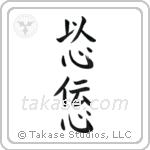
Sold as Telepathy · Read ishindenshin · What it is four characters that read as a sentence — by the heart, transmit the heart · Oldest witness a Chinese Chan record of 857, where the master defines it as handing over not one single thing · In Japan Dōgen, between 1231 and 1253, who uses it twice and calls it beginners' talk the second time · Today the ordinary Japanese word for two people who understand each other without speaking · The thing worth knowing every authority in its line denies that anything is actually transmitted, and the phrase became a household word anyway · Signed 典, 2026-09-07.
The words
以 (i) is the classical Chinese by means of. 心 (shin) is the heart-mind. 伝 (den) is to transmit or hand on. 心 again. Read as classical Chinese, the four characters are a whole sentence: by mind, transmit mind — which is how one Japanese idiom dictionary glosses it, 「心を以て心に伝う」.
The great historical dictionary of Japanese gives three senses. The Buddhist one: to convey from heart to heart an awakening or a truth that words cannot express, used chiefly by the Zen school — first attested in Dōgen's Shōbōgenzō, 1231–53. The everyday one: for two minds to reach each other without a word, so that nothing has to be explained — first attested in Fukuzawa Yukichi, 1875. And a third that nobody quotes: in 1933 it was student slang for a love match — free love and free marriage.
The English dictionary of Japanese used across the web gives telepathy, tacit understanding, thought transference, communion of mind with mind, and then a separate Buddhist sense. Our page's title, Telepathy, is that dictionary's first word.
A history, from the earliest witness
The phrase is Chinese, and it belongs to Chan. Its sharpest statement is in the Essentials of Mind Transmission of the master Huangbo, compiled by the statesman Pei Xiu in 857:
"If there is nothing to depend on or hold to, how is the succession carried on?" The master said: "Mind transmits mind." "If mind transmits mind, how can you also say there is no mind?" The master said: "To get not a single thing — that is what is called transmitting mind."**
That is the definition the whole later tradition works from, and it already contains the paradox: the transmission consists of nothing changing hands.
The pairing everyone knows — mind to mind, without setting up written words — is in the Bloodstream Sermon, a Tang text under Bodhidharma's name: the three realms arise and return to one mind; the buddhas before and the buddhas after transmit mind by mind, and do not set up words. And the phrase is not only Chan property: Chengguan, the fourth patriarch of the Huayan school, who died in 839, uses it in his own preface — employing the purport of mind-transmitting-mind … to reconcile the Chan schools of North and South.
In the great lamp-record of 1004 it does three different jobs. Once as a verdict — mind transmitting mind: this is right view. Once as the lineage claim — after the Buddha's extinction he entrusted the Dharma to Kāśyapa, mind to mind, and each generation transmitted to one man only, with the sharp objection following immediately: if all beings are the Buddha's only child, why is the transmission not universal? And once, best of all, as an exchange with the master Xuefeng:
"Did the ancient worthies not transmit mind by mind?" — "And they set up no written words or phrases either." — "If there are no words or phrases, how does the master transmit?" — Xuefeng was silent for a long while. The monk bowed his thanks.
About the Sixth Patriarch. One encyclopedia says the phrase begins with Huineng, and the Platform Sutra does contain it: the Fifth Patriarch, handing over the robe, tells him the robe is a token of faith, but the Dharma is transmitted mind to mind, and each is made to awaken and understand for himself. That sentence, however, is in the recension of 1291. In the Dunhuang manuscript of the Platform Sutra, the oldest we have, the two characters transmit mind do not occur at all. Six centuries separate the man from the sentence, and the attribution is a fair reading of the received text rather than of the earliest one.
The story behind the phrase, and the question somebody finally asked. The origin everyone cites is the flower sermon, told as case 6 of the Gateless Gate in 1228:
Long ago, at the assembly on Vulture Peak, the World-Honored One held up a flower and showed it to the assembly. All were silent. Only the venerable Kāśyapa broke into a smile. The World-Honored One said: "I have the treasury of the true dharma eye, the wondrous mind of nirvāṇa, the true form of no-form, the subtle gate of the Dharma — not setting up written words, transmitted outside the teachings — and I entrust it to Mahākāśyapa."
Two things about that page are worth a buyer's attention. The phrase 以心伝心 does not appear in the Gateless Gate at all — the story and the words live in different books. And Wumen, who chose the case, mocks it in his own comment: the yellow-faced Gautama behaves as if nobody were there … he hangs out a sheep's head and sells dog meat. Suppose the whole assembly had laughed — how would the treasury of the true dharma eye have been transmitted? And suppose Kāśyapa had not smiled — how then?
And in the eleventh century a statesman asked for the source. The Japanese Zen scholar Mujaku Dōchū collected the whole argument in 1741. Wang Anshi — the great Song reformer — asked the Chan master Fohui Quan: what the Chan people call "the World-Honored One held up a flower" — which scripture is that in? The master answered: "It is not in the canon." Wang then said that he had once, in the imperial academy, come across a three-fascicle Sutra of Brahmā's Questions that told the story in full, and that the sutra had been kept secret because it dealt with emperors' affairs, so the world had not heard of it. Lecturers of the day replied that the sutra contained no such thing and that the transmission was false. The sutra does survive — but only in the supplementary canon, the collection where Chinese-composed and doubtful texts are kept, and the copy is full of holes. A tradition was asked for its papers and produced a book nobody could find.
In Japan, the first writer to use the phrase also puts it down. Dōgen writes it twice in the Shōbōgenzō. Once plainly, in the chapter Twining Vines — the passage the dictionary cites as the first attestation. And once, in The Insentient Preach the Dharma, like this: there is skin, flesh, bone and marrow in this speaking; it is not only mind-transmitting-mind — mind-transmitting-mind is the talk of beginners and late learners**.
The first secular use is a complaint. Fukuzawa Yukichi, in An Outline of a Theory of Civilization, 1875 — read here in the first edition — is arguing that Confucian moral teaching cannot be examined:
The teacher's work ends there; he has no other art for transmitting the Way. Beyond it there is only each man's own effort — reading the ancients, watching what men of today say and do, and imitating their conduct. This is the so-called mind-to-mind, or what some call moral influence. Influence being formless, there can be no test of whether it has taken or not.
Then it escapes into ordinary Japanese almost at once, and into unlikely books. Within two years of Fukuzawa the phrase turns up in a manual of physical diagnosis, on learning to hear what a chest sounds like; in a comic novel, printed with its pronunciation spelled out in kana for readers who did not know it; and in a handbook on rearing wild silkworms, where the liveliness and fineness of the technique is grasped in the mind and cannot be exhausted by the tongue — and so the ancients said, mind to mind. A doctor, a comedian and a silkworm farmer, inside twenty-four months.
Its great age is the twentieth century: some four thousand books in the Diet Library's public-domain index use it, rising decade by decade to a peak in the 1930s. Sōseki has it in I Am a Cat in 1905; Ibuse Masuji in 1956; Kaga Otohiko in 1967. Fewer than four percent of those books are pre-modern.
What is not a source
The Gateless Gate is not a source for the phrase, though it is the source for the story; the four characters do not occur in it.
The oldest Platform Sutra is not a source for it either — that sentence enters in 1291.
And the flower sermon has no undisputed scripture behind it. Its only scriptural home is a text that survives outside the main canon and was already being called a forgery in the Song.
One more, smaller: 拈華微笑, the four-character name for the flower story, appears in some nine hundred books in the index and not one of them is pre-modern — the story is ancient, its tidy label is modern.
The text in English
English never settled on one rendering, and the counts show which way it went: a special transmission outside the scriptures is by far the commonest form in print, then mind to mind transmission, then the romanization ishin denshin, then transmission from mind to mind. The everyday half of the word travels separately, as tacit understanding.
Our own title comes from the standard online dictionary of Japanese, which lists telepathy first — ahead of tacit understanding, thought transference and communion of mind with mind.
A reading
Signed 典, 2026-09-07.
This is the most successful phrase in Japanese for a thing its own tradition kept insisting could not be handed over.
Look at who says so. Huangbo: what is transmitted is not one single thing. Wumen: a sheep's head over dog meat — and what would have been transmitted if nobody had smiled? Xuefeng, asked how a wordless teaching passes, says nothing at all for a long time, and the monk thanks him for the answer. Dōgen, the first Japanese to write the phrase, calls it beginners' talk. Wang Anshi asks which scripture the story is in and is told there is none. Fukuzawa reaches for it to name the kind of influence no test can detect. And the phrase won anyway — four thousand books, and a place today in the warmest ordinary sentence one can say about two people.
The refusals are the meaning, not an obstacle to it. What the word names is not a transfer but a recognition: two people arriving at the same place, with no evidence that it happened except that both of them know. That is exactly the shape of the story it comes from. The Buddha says nothing and holds up a flower; the only proof is one man's face changing.
Which is why Telepathy is the one gloss that gets it backwards. Telepathy is a transfer — content leaving one head and arriving in another, the very thing the tradition spends eight centuries denying. Mind to Mind keeps the four characters and takes no position; tacit understanding is what the word means in a Japanese sentence today. Either serves a buyer better.
And it is not a word about powers. It is a word about company — right for two people who have been together long enough that it is simply true, and right for a teacher and a student, which is where it started.
Notes
Eri brushes the modern form 伝. Every witness in this history from before 1946 writes the older 傳. That is ordinary modern orthography and not a variant reading, but a customer comparing our design with an old scroll should know why the third character looks different.
Ishindenshin takes no macron.
How this was read
The Chinese Buddhist canon through CBETA's search interface, on four phrases, with eleven fascicles pulled whole and read at the line — Huangbo's record, the Bloodstream Sermon, three chapters of the lamp-record of 1004, both recensions of the Platform Sutra, Chengguan's commentary, the whole Gateless Gate, a fascicle of the disputed sutra, and Mujaku Dōchū's 1741 collection of the source controversy; the Diet Library's full-text index of public-domain books, counted on eight forms and walked whole for this phrase to 4,034 records; eight of those books opened at the leaf, including both of Dōgen's uses and Fukuzawa's in the 1875 first edition; the seven dictionary articles at kotobank and one at JMdict; the Internet Archive's full-text counts on nine English forms; the store rows, the live page and the design itself, by eye.
Not opened, and named because it would sharpen this: the disputed sutra beyond one fascicle; the three Chinese miscellanies whose testimony reaches this page only through Mujaku's quotation, which is a single instrument; the modern English translations of the Gateless Gate, any one of which should supply case 6 in a published version of this page; Sōseki, Ibuse and Kaga at their own pages rather than through the dictionaries; the 1933 slang dictionary, which is not digitized; and the house's own record of when Eri brushed this design.
References
Each witness is cited in the account above, at the frame or entry where it was read. A linked list follows when the record for this text is completed.