

生甲斐 · ikigai · what makes a life worth the living
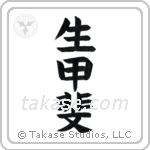
Sold as Reason For Being · Read ikigai · What it is an everyday Japanese noun, six hundred years old, for the worth there is in being alive and the thing that gives it: 生き living and 甲斐 worth, the old noun the Man'yōshū already has · Oldest witness the 太平記, late fourteenth century, in the negative, 生甲斐なき命, a life not worth the living; the modern sense of zest, 徳富蘆花's 黒潮 of 1902 · In English a 2009 talk, a 2014 diagram that is not Japanese, and a 2016 book; the house's Reason For Being is its own · Signed 典, 2026-09-07.
The words
生き iki is the stem of 生きる, to live. 甲斐 kai, voiced to gai after it, is an old native noun, かひ, that the 日本国語大辞典 derives from the verb かう, to stand in for, and defines as the sign that an act was worth doing; its effect; the satisfaction of having done it, and then the value that an act can be exchanged for. It is in the Man'yōshū, poem 3810: 我が待ちし代はさね無し, there was no worth in my waiting. The characters 甲斐 are the province's, borrowed for the sound. As a bound element it makes 働き甲斐, the worth of working, and 遣り甲斐, the worth of doing, on the same pattern.
The 日本国語大辞典 gives the compound two senses. ① 生きているだけのねうち。生きている意義: the worth of being alive at all; the point of living, first in the 太平記. ② 生きていくはりあい。生きているという実感: what makes going on living worthwhile; the felt reality of being alive, first in 1902. The 大辞泉 has 生きるに値するもの。生きていくはりあいや喜び, what makes life worth living; the zest and joy of living. The design writes 生甲斐 without the okurigana, which is the 日国's headword and the 太平記's spelling; 生き甲斐 with the き is the 大辞泉's and the commoner form in print after about 1910; 生きがい in kana is the postwar form and the one 神谷美恵子 used. They are one word. JMdict lists reason for living; something one lives for; purpose in life; raison d'être, and then ikigai, the loanword, added once English had it.
A history, from the earliest witness
Late fourteenth century, 太平記, book eleven, a war chronicle. After Kamakura falls: 況や只今まで平氏の恩顧に順て、敵陣に在つる者共、生甲斐なき命を続ん為に、所縁に属し降人に成て, and those who until now had stood in the enemy's camp on the Taira's favor, to prolong lives not worth the living, attached themselves to whomever they could and surrendered. The first attestation is the negative, 生甲斐なき命, a life with no worth in it, said of men who chose it over dying. [ja.wikisource 太平記/巻第十一, text; the 1911 typeset pid 877607 and three more by the Diet Library's index; the 日本国語大辞典's first citation.]
1646, 曽我物語, book seven, a printed edition of the revenge tale. 十郎いかりてみはやと思ひてもちたる扇さつとひらき。大きにめをみ出し。とてもかくてもいきがひなきくはしや, Jūrō, in anger, flung open his fan, opened his eyes wide: one way or the other, a life not worth the living. In kana, and again the negative. [3]
1726, 江島其磧 and 自笑, 出世握虎昔物語, an ukiyo-zōshi. 生甲斐なき命をのべ。貴公の方へ心ざして参る事, prolonging a life not worth the living, I have come to you. The 太平記's phrase, word for word, four centuries later: the idiom is fixed. [4]
1814, 曲亭馬琴, 南総里見八犬伝. 役に立けば。生甲斐もなし, if I am of no use, there is no worth in living; and elsewhere in the novel 生甲斐ありといひつべし, one may say there is worth in living. The positive form appears here for the first time in this reading, in the author who used everything. The Diet Library's classical books have the kanji form in 92 volumes and the kana in 39, the kana running through the picture-books of 1817 to 1865 as いきがひなし. [5]
1892, 樋口一葉, 別れ霜, her first novel. 生甲斐なや五尺の身に父母の恩荷ひ切れず, no worth in living: this five-foot body cannot carry its debt to its parents. [ja.wikisource, search text.]
1899, 福沢諭吉, 女大学評論. 日本の婦人は実に此世に生きて生甲斐なき者なり、気の毒なる者なり、憐む可き者なり, the women of Japan truly live in this world with no worth in the living; they are to be pitied. The old negative turned on society. [ja.wikisource, search text.]
1902 to 1905, 徳富蘆花, 黒潮, a novel. 『生命がありゃ生きて居んなけりゃなんねエから、まあ挊いで生きて居るでがすよ』『其で生き甲斐があるのかエ?』, "If you're alive you've got to go on living, so I work and I live." "And is there any ikigai in that?" The 日本国語大辞典 dates the modern sense from this exchange, the zest that makes living worthwhile, asked as a question of a working man, and this reading found nothing earlier that is clearly it. [kotobank, the 日国 entry, text; the 1903 typeset pid 886170 by index highlight.]
1906 to 1909, 夏目漱石. 草枕: 出来ぬと云わば生甲斐のない男である, a man who says he cannot is a man with no ikigai; 坑夫: これでは生甲斐がない、さればと云って死に切れない, there is no ikigai in this, and yet I cannot bring myself to die; それから: 彼はこれでこそ、生甲斐があると信じていた, he believed that this, precisely, was what made life worth living. The positive sentence, 生甲斐がある, is now a thing a novelist gives a character's happiness to; the Diet Library has 生甲斐のある in 442 books from 1906 and 生甲斐がある in 171. [ja.wikisource, search text; lab.ndl.go.jp.]
1910 to 1945, the numbers, and the halves of the century. The word is in 471 books of the 1910s, 704 of the 1920s and 652 of the 1930s in the old spelling, and 424, 976 and 904 in the spelling with き. 坪内逍遥 in 1915 gives the prewar shape: 己れ一身の爲に生きて居るのは詰らないが、自分よりも偉大な、立派な或る目的に使はれる爲に生きて居るの, to live for oneself alone is dull; to live to be used by some purpose greater and finer than oneself. The 世界大百科事典's article (栗原彬) says the prewar Japanese ikigai was 滅私奉公型, serving the country and social justice, and the postwar one 滅公奉私型, a happy home, health, a life to one's taste. [lab.ndl.go.jp; kotobank 生きがい, text.]
1966, 神谷美恵子, 生きがいについて, On ikigai, みすず書房. The psychiatrist of the leprosarium at 長島愛生園 wrote the book the later writers cite: that the word is Japanese-only and untranslatable except as worth living; that it has two uses, the source of one's ikigai (この子は私の生きがいです, this child is my ikigai) and the state of feeling it, 生きがい感; and that its kin is はりあい, zest. Reported through the Japanese and English Wikipedias, not opened. [ja.wikipedia 生き甲斐, citing 神谷 1980 pp. 14–15.]
The sense across time
One word, and one arc. For five hundred years it is mostly said in the negative, 生甲斐なき命, a life not worth the living, of men who surrendered or women who could not carry their debts; the positive form arrives with 馬琴 and the modern sense of felt zest with the novelists around 1900, when the question is there any ikigai in that? can be put to a working man. The prewar century answered it with service and the postwar one with home, health and pleasure, and by 1966 a psychiatrist could write a book on the word without defining it. The dictionaries hold both senses, the worth of being alive and the thing that gives it, and the word today is ordinary: what you get up for.
What is not a source
Not Chinese: 甲斐 is a native noun in the province's borrowed characters. Not a purpose: the word is built on 甲斐, worth, not on any noun of aim. Not the diagram: the four overlapping circles that the English word travels with, what you love, what you are good at, what the world needs, what you can be paid for, were drawn in 2011 by a Spanish astrologer for propósito, purpose, and relabeled in 2014 by an Englishman who has written that adding the word was the whole of his contribution; no Japanese source stands behind it, and the Japanese Wikipedia reproduces it as the English-language concept diagram.
The text in English
1996, Gordon Mathews, "The Stuff of Dreams, Fading: Ikigai and 'the Japanese Self'", Ethos 24(4): 718–747, and What Makes Life Worth Living? How Japanese and Americans Make Sense of Their Worlds, University of California Press. The anthropology of the word, before the English public had it; the ngram shows ikigai in lowercase from 1958 at trace levels with a small peak in 1996. Records confirmed; not read. [doi:10.1525/eth.1996.24.4.02a00060.]
2008 and 2009, the cohort studies. Sone and colleagues, Sense of Life Worth Living (Ikigai) and Mortality in Japan: Ohsaki Study (Psychosomatic Medicine 70(6)), and Tanno and colleagues in the Journal of Psychosomatic Research (67(1)), the epidemiology that gave the English books their longevity claim. Records confirmed; not read. [doi:10.1097/PSY.0b013e31817e7e64; doi:10.1016/j.jpsychores.2008.10.018.]
September 2009, Dan Buettner, TED, How to live to be 100+. The National Geographic writer's talk on the Blue Zones names ikigai as one reason the people of Okinawa live long; both Wikipedias date the word's arrival in general English from it. The transcript was not served to this reading; the claim is reported. [ted.com; en.wikipedia Ikigai.]
2011 to 2014, the diagram. Andrés Zuzunaga's page: Creado por Andrés Zuzunaga en 2011. Publicado en 2012 y en las ediciones posteriores hasta 2019 del libro de Borja Vilaseca ¿Qué harías si no tuvieras miedo?. Posteriormente, acabó asociándose al nombre de Ikigai en una charla TED, aunque dicho concepto es mucho más antiguo y no tenía ningún gráfico asociado. Marc Winn, What is your Ikigai?, 14 May 2014: An ikigai is essentially 'a reason to get up in the morning', with the diagram relabeled; and in his later note on the same page: The diagram is not mine. It began as a purpose venn diagram by the Spanish astrologer Andrés Zuzunaga … What I did was add a single word to a shape that already existed. That join is the whole of my contribution, and the picture went a great deal further than I expected. [cosmograma.com/proposito.php; theviewinside.me/what-is-your-ikigai/, text.]
2016, Héctor García and Francesc Miralles, Ikigai: The Japanese Secret to a Long and Happy Life (Spanish 2016; English 2017, Hutchinson, ISBN 9781786330895). The book that made the word a shelf: it renders the concept as the happiness of always being busy and prints Winn's diagram, per the English Wikipedia's quotation; not opened here. 2017, Ken Mogi, The Little Book of Ikigai (Quercus, ISBN 9781786489036). Record only. The ngram has capitalized Ikigai rising sixteen-fold between 2010 and 2019 and peaking in 2017 to 2019, with the books.
Today. JMdict: reason for living; something one lives for; purpose in life; raison d'être; ikigai. The house's title Reason For Being is Timothy L. Jackowski's, made for Takase Studios, the raison d'être of the dictionary list put into English, and the page's explanation is the house's own. What a rendering must keep: that it is the worth of living, not a goal one sets; the Japanese is a noun of value, and purpose is the diagram's word, not the word's.
A reading
The page is right, and it says the one thing the buyer most needs: Not a grand purpose necessarily, but the thing that gives one's days their meaning. The history under it is two histories. The Japanese word is fourteenth-century and plain, and for most of its life it was said in the negative, of a life not worth the living; the positive came with 馬琴, the zest with the novelists around 1900, and by the postwar decades it was the ordinary word for what a person gets up for, which is what 神谷美恵子 wrote about in 1966. The English word is a talk in 2009, a diagram in 2014 that a Spanish astrologer drew for purpose and an Englishman relabeled, and a book in 2016 that printed the diagram. A buyer who met the word through the diagram should know the diagram is not Japanese; the word is, and it is better than the diagram, because it does not ask what the world needs or what you can be paid for. It asks only whether living is worth it, and names the thing that makes it so. The design writes the dictionary's headword form and needs nothing changed. Romaji ikigai. Signed 典, 2026-09-07.
Notes
The page's parsing of 甲斐 as worth, value is the dictionary's; its kai, here gai is the sequential voicing. The Wayback index has the house's design image on takase.com by 8 January 2011, and the design files on disk are dated 17 March 2010. Zuzunaga's own page says 2011 for the diagram and his 2017 comment on Winn's post says 2012; the page is his and the history follows it. Weblio has no entry under 生甲斐 and serves the word under 生き甲斐.
How this was read
By eye: the outline file of the block design, M6049VB3A. By text at the address: the Diet Library's full-text index on fifteen forms, its classical facet whole on four, and a year-by-year count on three (the text of a leaf is at lab.ndl.go.jp/dl/api/page/
References
- 太平記 巻第十一 (late 14th c.) — https://ja.wikisource.org/wiki/太平記/巻第十一 (text); typesets 877607 (1911, 大町桂月) · 770203 (1913) · 3441748 (1917) · 964462 (1922) by Lab highlight; 精選版日国 ① 初出
- 万葉集 16・3810 (甲斐) (8th c.) — REPORTED — 精選版日国 甲斐 ① 初出, https://kotobank.jp/word/甲斐
- 曽我物語 巻7 (1646 print) (1646) — pid 1287976 koma 17 (OCR) ↩
- 其磧・自笑 出世握虎昔物語 (1726) — pid 2554494 koma 10 (OCR) ↩
- 曲亭馬琴 南総里見八犬伝 (1814) — pid 2551669 koma 37 (OCR); 2551689 · 2551693 by highlight ↩
- 樋口一葉 別れ霜 (1892) — https://ja.wikisource.org/wiki/別れ霜 (search text)
- 福沢諭吉 女大学評論 (1899) — https://ja.wikisource.org/wiki/女大学評論 (search text)
- 徳富蘆花 黒潮 (1902–05) — 精選版日国 ② 初出, https://kotobank.jp/word/生甲斐; typeset 886170 (1903) and 蘆花全集 1883456 (1929) by highlight
- 夏目漱石 草枕 · 坑夫 · それから (1906 · 1908 · 1909) — https://ja.wikisource.org/wiki/草枕 · /坑夫 · /それから (search text)
- 坪内逍遥 教化と演劇 (1915) — pid 954743 (Lab highlight)
- 神谷美恵子 生きがいについて (1966 (1980 ed. ISBN 4-622-08181-4)) — REPORTED — https://ja.wikipedia.org/wiki/生き甲斐 (Sfn 神谷 1980 pp. 14–15); not opened
- 精選版日国 · 大辞泉 · 世界大百科 (栗原彬) · JMdict (current) — https://kotobank.jp/word/生甲斐 · /生き甲斐 · /生きがい · /甲斐; https://jisho.org/api/v1/search/words?keyword=生き甲斐 (text)
- Mathews, The Stuff of Dreams, Fading (1996) — https://doi.org/10.1525/eth.1996.24.4.02a00060 (record; no abstract served)
- Sone et al., Ohsaki Study (2008) — https://doi.org/10.1097/PSY.0b013e31817e7e64 (record)
- Tanno et al., JACC Study (2009) — https://doi.org/10.1016/j.jpsychores.2008.10.018 (record)
- Buettner, How to live to be 100+ (Sept 2009) — REPORTED — https://en.wikipedia.org/wiki/Ikigai and https://ja.wikipedia.org/wiki/生き甲斐; https://www.ted.com/talks/dan_buettner_how_to_live_to_be_100 (transcript not served)
- Zuzunaga, the *propósito* diagram (2011 (pub. 2012)) — https://www.cosmograma.com/proposito.php (text)
- Winn, What is your Ikigai? (14 May 2014) — https://theviewinside.me/what-is-your-ikigai/ (text)
- García & Miralles, Ikigai: The Japanese Secret to a Long and Happy Life (2016 (Eng. 2017)) — REPORTED — https://en.wikipedia.org/wiki/Ikigai; Open Library ISBN 9781786330895 · 1529902401
- Mogi, The Little Book of Ikigai (2017) — Open Library ISBN 9781786489036 (record)
- NDL Lab full-text index (pre-1945) — https://lab.ndl.go.jp/dl/api/book/search (text)
- Google Books ngram (1800–2019) — https://books.google.com/ngrams/json (text)
- Wayback CDX (2011) — https://web.archive.org/cdx/search/cdx (text)
- Design M6049VB3A (2010-03-17 (file date)) — takase-images/originals/tattoos/motivational/Reason For Being (ikigai)/ (eye, the outline tif)
Books Cited
The books this article cites. Buying one supports its author.