

一陽来復 · ichiyō raifuku · One yang returns
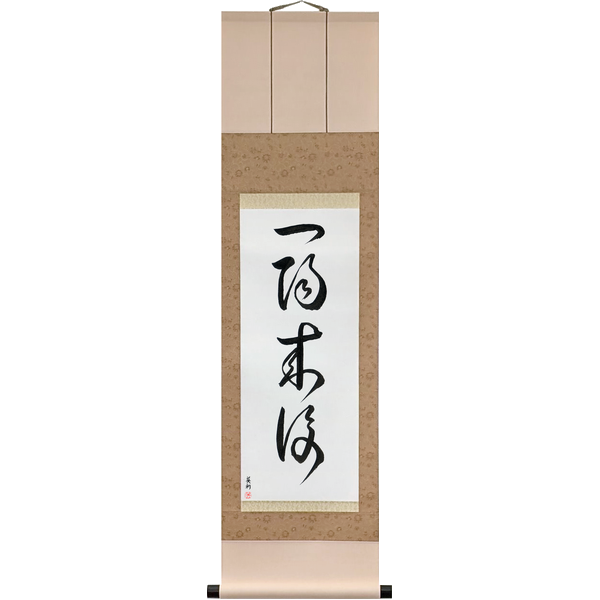
Sold as Favorable Turn Of Fortune · Read ichiyō raifuku · Oldest witness the 易's hexagram 復, Return, one unbroken line beneath five broken; the four characters as a phrase in the Song court's language for the winter solstice, 蘇軾 before 1101 · Sense the winter solstice, when the light starts back; the eleventh month; the new year; and a turn for the better after a run of bad.
The words
一陽 is one yang, one unbroken line. 来復 is comes back, the 易's own words for the hexagram 復: 七日来復, on the seventh day it comes back. Together the four name a picture. The hexagram is drawn as six lines, and in 復 the top five are broken, yin, and the bottom one is whole, yang, just arrived. The old calendar hung a hexagram on each month: from the fifth month the yang lines are stripped away one a month until the tenth, which is all yin, and in the eleventh month, the month of the winter solstice, the first yang line comes back at the bottom. That is 復, and 一陽来復 is its name. The dictionaries give three senses and they are one image at three distances: close up, the solstice and the eleventh month, a winter season word; a step back, winter going and the new year coming; a step further, bad things ending and good beginning. The house English, Favorable Turn Of Fortune, is the third. The English the I Ching translators use for the hexagram, one yang returns, is all three. The catalogue glosses 陽 as sunshine; it is yang, the bright half of 陰陽, and the four characters name a hexagram, not weather.
A history, from the earliest witness
Before the Han, the 易, the hexagram 復. The text says: Return. Success. Going out and coming in without harm; friends come, no blame. Back and forth along its way, on the seventh day it comes back; it is good to have somewhere to go. And the image: thunder within the earth: Return. The former kings closed the passes on the day of the solstice; merchants and travelers did not move, and the ruler did not tour the provinces. The four characters are not there. The picture is, and the two that carry it, 来復.
The Han, why the solstice was congratulated. A sentence the Tang and Song encyclopedias quote from a lost Han book, the 漢雜事, and some give to 蔡邕: at the winter solstice the yang breath rises and the way of the ruler grows, so it is congratulated; at the summer solstice the yin breath rises and the way of the ruler wanes, so it is not. That is the custom the phrase would later name. The 荊楚歲時記, the sixth-century book of the year's customs, has for the solstice only red-bean gruel against the plague and the measuring of the sun's shadow with a red thread; it does not have the phrase, whatever a 1942 handbook says.
The eleventh century, the Song court. The four characters appear as a unit in the language of the solstice congratulation. 蘇軾, writing to the emperor on a solstice: today, the fifth, is the southern extreme; the civil and military officials have come in to congratulate, and what they congratulate is 一陽来復; he then cites the hexagram's image by name and lays out the year, when yin reaches its extreme yang is born, and when yang is born it is the winter solstice. 蘇頌 opens a congratulation to the empress dowager with the same four; so does a court text for the solstice rite at the tomb of 神宗. This is the phrase at its birth: a formal, glad, calendrical thing said at court on the shortest day.
The twelfth century, the commentators. 程頤, in his commentary on the 易, reads the returning line as the heart of heaven and earth that gives things life, against the older view that found that heart in stillness: the heart is the first stirring. 朱熹, in 1177, writes the four characters into the standard gloss of the hexagram, from the fifth month, when one yin is born, to here is seven lines, and one yang comes back: the course of heaven itself, and in his recorded talk gives the phrase the image it has carried since: one yang returns, its beginning very faint, as if still; but in truth it is the spring of motion, its force grows by the day, and nothing fails to take its beginning from it — a single point of light in the great dark.
The thirteenth century, the Zen solstice sermon. 無準師範, the master at 径山 under whom the Japanese monk 円爾 studied, opened his solstice sermons with it: one yang returns, the ten thousand things come to life, the cold valley turns to spring, the frozen river thaws — now say, is that the Buddha's law or the world's? His sermons were printed in Japan in 1370, and that print is the oldest Japanese witness opened for this history. The phrase came to Japan with Zen, as a thing said on the solstice.
The fourteenth century, the war tales. The 太平記 has a counselor of 越 warn his king that the time to strike has not come: the unicorn has flesh on its horn and shows no fierce shape; the hidden dragon lies through the three winter months and waits for the sky of 一陽来復. The 明徳記, written within a year or two of the rising of 1391, applies the image to a defeated lord: a dragon lying low through the three winters and gaining the sky of 一陽来復, he repented his past fault and lamented. This is the phrase as a figure for a person's fortunes rather than the sun's, and the dictionaries date their third sense from it. A Gozan monk's collection of about 1409 uses it the Song way, like the yin all stripped away and the one yang returning.
The Muromachi lecture-hall. Two transcripts of lectures on the 易, one from the end of the Muromachi period and one dated 1573, gloss the phrase in the spoken Japanese of the hall: in our understanding 一陽来復 means that after 剥 one yang has come back; the deep return is the one at the root, and what shows in the eleventh month is 一陽来復, the shallow return; and the ethical reading at once: when one good thought rises, evil stops, and from the eleventh month the one yang returns. The Ming 五經大全, printed with Japanese reading marks, carried 朱熹's gloss to every student who read the 易 in Japan.
Edo, the eleventh month's name. Japanese Zen kept the solstice sermon: a collection of 1676 has a dozen masters opening theirs with the four characters, one with the Han antithesis in full, the small man's way wanes … one yang returns, the noble man's way grows. Outside the temple the phrase became the name of the month. The almanac 華実年浪草 (1783): from the fifth month one yin is born, and by the eleventh one yang is born; this is called 一陽来復, so the month is called 復月, the month of Return; the solstice day was 一陽嘉節, the glad festival of the one yang. A swordsmith's book of 1752 explains a rite of the eleventh month by it; a kabuki chronicle of 1762 explains the 顔見世, the season-opening of the eleventh month, by it: the eleventh month is the month of 一陽来復, so the year is celebrated with peace under heaven and safety in the land. The season-word books file it under the eleventh month, and a haikai dictionary of 1927 glosses it in one word: 冬至, the solstice. A print of 1860 by 豊国 carries it as a title.
1942, the 揮毫辞典, a dictionary for calligraphers. Files it under the eleventh month beside 万家相慶 and 去故迎新, glosses it as the noble man's revival and likens it to the plum that opens when the leaves are down; tags it for 立冬, 冬至 and 除夜. Its source note attributes to the 荊楚歲時記 a sentence that book does not contain; the sentence is the Han one about the ruler's way, crossed with the 易.
Today. 大辞泉: 1 the eleventh month, or the winter solstice 2 winter going and spring coming; the new year coming 3 after a run of bad things, at last a turn for the better. 坂口安吾 in 1942 wrote of the fallen soldiers of life who pray for 一陽来復; 野上弥生子 in 1962 of an invalid who will be well by spring, 一陽来復. The Waseda shrine 穴八幡宮 issues a charm bearing the four characters from the solstice to the first day of spring, a custom a 1973 English magazine already describes; its beginnings were not opened for this history.
The sense across time
One picture, read at three distances. At court it was the solstice itself, the day the light starts back, said to the emperor. For 朱熹 it was the point of light in the dark, the beginning too faint to see and already unstoppable. For the Zen masters it was the thaw as a question. For the war tales it was patience: the dragon in the winter ground, and a man who has lost waiting for his sky. For the Edo almanacs it was the eleventh month's name and the solstice festival's. For the modern dictionaries all of these, in order, with the turn of fortune last; for the catalogue only the last.
What is not a source
The 荊楚歲時記, which the 1942 handbook and the seat's own first note named: its solstice entry is gruel and a shadow, and the four characters are nowhere in it. Nobody coined the phrase; it grew out of the hexagram over a thousand years and was a set phrase by the time it was first written in the form we brush. Hepburn's dictionary of 1867 has no entry. Blyth's winter volume treats the solstice through Shiki's from the shadow of the clothes-pole I surmise the depth of winter and never reaches the phrase.
The text in English
The phrase entered English through objects. Henri Joly, cataloguing a London collection of sword-fittings in 1910, found it inscribed on one and rendered it Good fortune comes at the New Year; a second Joly catalogue repeats the words. Nelson's character dictionary (1962, and every printing since) gives return of spring, and Spahn and Hadamitzky's kanji dictionary (1996) follows it; a 1987 Asahi column in English uses the same two words. An Essen exhibition catalogue of 1972 quotes a kyōka of about 1800 that opens with the phrase and renders it today at the turning of winter. The I Ching scholars render the four characters as the sentence they are: at the winter solstice, one yang returns (Cleary 1987; Sung Dynasty Uses of the I Ching 1990; Cleary's 程頤 2003). A 2009 translation of a Nichiren monk's talks notes that the term derives from the Chinese I Ching. A Sotheby's catalogue of 2023 gives an Edo print title that puns on it. The house rendering, Favorable Turn Of Fortune, is the dictionaries' third sense in its own words and needs no credit.
A reading
The phrase is a picture before it is a proverb, and the picture is exact: six lines, five dark, one bright at the bottom, the bright one just arrived. Everything the phrase has meant is a way of standing at some distance from that. Stand close and it is the solstice, the shortest day, the day the light starts back, which is why the Song court said it to the emperor and the Zen masters said it to their monks on that morning. Stand back and it is the new year. Stand further back and it is 朱熹's point of light in the dark and the 太平記's dragon in the winter ground, which is what a person means who gives this to someone in a hard year: not that things are good, but that the turn has happened and cannot be undone. The 易's own moral is it is good to have somewhere to go, and Favorable Turn Of Fortune is a fair short form of that. What the page should also say is where the phrase comes from and what day it belongs to: the winter solstice, from the 易's hexagram of Return, a thousand years old as a phrase, carried to Japan by Zen and by the war tales. It is a solstice and a New Year's text as much as a text for bad luck ending, one of the few in the catalogue with a date on the calendar, and one yang returns is the English that keeps the picture. Signed, 典, 2026-09-07, s54.
How this was read
As text at Chinese Wikisource: the hexagram (周易/復); 程頤's commentary (伊川易傳 卷2); 朱熹's 本義 (原本周易本義 卷01) and the 語類 (卷71) on 復; 蘇軾's 上皇帝書 whole; the 荊楚歲時記 whole; the 太平御覽 (卷28, 卷543), 北堂書鈔 and 五禮通考 for the Han sentence, and the Song court texts, by search snippet. By OCR at the National Diet Library's next-generation digital library, the scan number part of each address: 無準's 語録 in the 1370 print (pid 2543479, scans 11, 40, 44, 47, 48); the 周易講義 (pid 2544972, scans 15–22); 柏舟's 周易抄 (pid 2552700, scans 20–23); the 五經大全 (pid 2545464, scans 64, 67, 70); the 明徳記 in the 1614 print (pid 2532182, scan 55); the 太平記 in the 1891 typeset (pid 877603, scan 79, with its furigana); the 法海具観 (pid 2576575, scans 70, 75, 82, 83, 85); the 都老子 (pid 2537045, scans 67, 69); the 華実年浪草 (pid 2556913, scans 4, 17); the 月令博物筌 (pid 2557820, scans 5, 6); the 本朝高僧伝 (pid 1089668, scans 11, 14); the 高島易断 (pid 760553, scans 67, 80, 82). From the seat's harvest of the same library: the 揮毫辞典 (pid 1884879, komas 95, 98, 102, 103, 108); the 俳翼 (pid 2541278, koma 105); the 新撰俳諧辞典 (pid 1128241, koma 61). A leaf named as pid P, scan N has its text at lab.ndl.go.jp/dl/api/page/P_N and its image at dl.ndl.go.jp/api/iiif/P/R<N as seven digits>/full/full/0/default.jpg; the pre-1868 books answer a signed address only with a size such as /full/,2400/. From the index alone, scan not derived: the 歌舞妓事始, the 1911 歳時記 quoting the 増山の井, the 1906 太平記. As text: kotobank's five entries, whole; JMdict; the library's index on nine spellings; the Chinese Wikisource's on four; the Internet Archive's on four English spellings, seventeen books dated from their records, snippets only; Blyth's Haiku volume 4 at pages 166–167; Hepburn 1867 by OCR. By eye: the scroll templates in standard and cursive script. Not opened: the 丱余集 and the 増山の井 themselves; the 太平記 before the Meiji typesets; the 日本歳時記's winter volume; 邵雍's solstice poem; the charm's first issue; the English books at the page. The full apparatus, with every address, is in the account.
References
- The design (ours) (—) — templates I6045SSVB3A (standard) and VC3A (cursive), by eye; cultural_works 334; whole_designs.csv:175
- 易 復卦, the hexagram text (pre-Han) — zh.wikisource 周易/復; the 象 as 程頤 and 朱熹 quote it
- 漢雜事, as the 太平御覽 quotes it (Han (quoted 983)) — 太平御覽 卷28 and 卷543 (snippet); 北堂書鈔 卷85 (snippet); 五禮通考 卷140 gives it to 蔡邕's 獨斷
- 荊楚歲時記, 冬至日 (6th c. (杜公瞻's notes 7th)) — zh.wikisource 荊楚歲時記, whole; no 一陽 anywhere in the text
- 蘇軾, 上皇帝書 (北宋, before 1101) — zh.wikisource 上皇帝書 (from 東坡全集), whole
- 蘇頌, 賀太皇太后表 (北宋) — 蘇魏公文集 卷47, snippet
- A Song court 表 for the solstice at 神宗's tomb (北宋, after 1085) — 皇太后殿夫人為冬節往永裕陵酌獻神宗皇帝表本, snippet
- 程頤, 伊川易傳 on 復 (before 1107) — 伊川易傳 (四庫全書本) 卷2, whole section
- 朱熹, 周易本義 on 復 (1177) — 原本周易本義 (四庫全書本) 卷01, whole section
- 朱熹, as recorded in the 語類 (13th c.) — 朱子語類 卷71, whole section
- 無準師範 (1178–1249), 語録, 冬至上堂 and 冬夜小参 (Song; the Japanese print 應安3 (1370)) — pid 2543479 komas 11 · 40 · 44 · 47 · 48, OCR
- 丱余集 (c. 1409) — the 日国's first citation; the text not found at the Lab (four catalogue hits) — reported
- 太平記 巻四 (late 14th c.) — the 1891 訂正太平記 上, pid 877603 koma 79, page API text; the 1906 博文館 text by highlight; the 日国's citation
- 明徳記 中 (1392–93 or soon after) — the 慶長19 (1614) print, pid 2532182 scan 55, OCR
- 周易講義, 一栢 講 (late Muromachi) — pid 2544972 komas 15–22, OCR
- 柏舟宗趙, 周易抄 (1573) — pid 2552700 komas 20–23, OCR
- 五經大全 (胡廣 1415), the 明内府 print with Japanese kunten (1415; the print Ming) — pid 2545464 komas 64 · 67 · 70, OCR
- 増山の井 (北村季吟) (1663) — the 日国's citation; quoted as [增山井] in 新脩歳時記 1911 (pid 875147) and 社会事林 1911 (pid 897940) — reported
- 法海具観 (梅嶺道雪) (1676) — pid 2576575 komas 70 · 75 · 82 · 83 · 85, OCR
- 都老子 (名張湖鏡) (1752) — pid 2537045 komas 67 · 69, OCR
- 歌舞妓事始 (為永一蝶) (1762) — pid 2554388, highlight
- 華実年浪草 (鵜川麁文) (1783) — pid 2556913 komas 4 · 17, OCR
- 俳翼 (秋里籬島) (1795) — harvest pid 2541278 koma 105
- 月令博物筌 (鳥飼洞斎) (Edo, undated) — pid 2557820 komas 5 · 6, OCR
- 本朝高僧伝 (卍元師蛮, 1702) (1900 ed.) — pid 1089668 komas 11 · 14, OCR
- 高島易断 (高島嘉右衛門) (1901) — pid 760553 komas 67 · 80 · 82, OCR
- 新撰俳諧辞典 (1927) — harvest pid 1128241 koma 61
- 揮毫辞典 (松崎覚本) (1942) — pid 1884879, harvest zip