

一撃必殺 · ichigeki hissatsu · 一拳必殺 · ikken hissatsu · One strike, certain kill
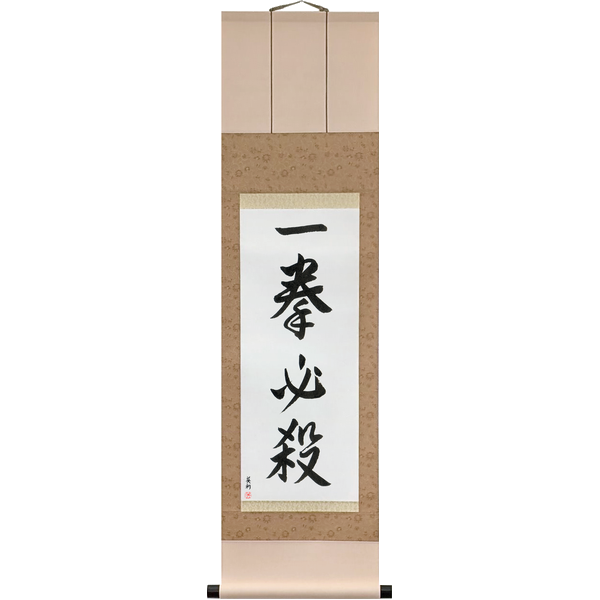
Sold as One Hit Certain Kill (一撃必殺) and Kill with One Blow (一拳必殺) · Read ichigeki hissatsu; ikken hissatsu · Oldest witness a 1941 practice report of a Japanese elementary school's kendo teaching; the army's sword drill of the same name, January 1942 · Sense that one strike must be the decisive one, and the whole self committed to it; in karate, the ideal of the single finishing technique, and the spirit that trains for it.
The words
一撃 is one strike: one blow, one attack, the word the dictionaries illustrate with to fell with a single blow. Its oldest Japanese sense is a hawk's stoop, in a twelfth-century poem, and the oldest thing like our phrase in Chinese is about the same bird: a commentator on the Book of Changes explains the character for falcon by saying the bird does not perch in pairs and its one strike surely hits. 必殺 is certain kill: 必, surely, and 殺, kill; the big dictionary defines it as killing the opponent without fail, or the resolve to, and its own example is our phrase turned round, 必殺の一撃, the killing blow. In old Chinese the two characters are a verb, will surely kill him; the noun is Japanese and modern. 拳 is fist, and 一拳 is a real word, one fist in a poem of about 900 and a blow of the fist in a novel of 1904. So the two designs say one strike, certain kill and one fist, certain kill, and the second is the first with the weapon named. Neither is in any dictionary as a phrase. The house titles are both fair: Kill with One Blow is the gloss the phrase was given when it first reached English in 1977, and One Hit Certain Kill is a plain literal, a word away from One strike, certain kill in a 1998 karate wordbook.
A history, from the earliest witness
1941, the schools. The phrase enters print in the practice reports of the new 国民学校, the wartime elementary schools created that year with martial training on the curriculum. A teacher-training school's attached school in Iwate writes, under forging the power to attack: Martial training, reduced to its essence, is the way of battle. One sword, one kill; one strike, certain kill: it is that attacking power we forge. Schools in Wakayama and Tokushima print the softer 一撃必倒, one strike, certain fall, in the same sentence about the conviction and spirit to attack all at once, then to show 残心, the alert follow-through; a Wakayama lesson plan of 1942 has the sword of one-strike-certain-kill, which kills or spares at will; a Kagoshima report of February 1942 has a teacher demonstrate a thrust with the spirit of ichigeki hissatsu, and a Hiroshima report of 1945 makes it the mark of Japanese martial arts against foreign ones: the bout is decided the instant one meets the enemy. Nothing older carries the four characters; the library's index has the 1930s well covered and finds the family's older members there, the killing sword in 1933, certain death, certain kill in 1936, one strike, certain hit for the navy's dive-bombers in 1937, but not this.
January 1942, the army. The Toyama military school, which taught the army its sword, published in the officers' journal that month a short-course sword training outline (one strike, certain kill) for men with no fencing behind them, to give them, in the school's own later words, the confidence of ichigeki hissatsu with the issue sword; the catalogue record of that issue carries the four characters, and the school's 1944 handbook dates the outline in its preface.
1942 to 1945, the war. From 1942 it is the correspondents' word: tank crews with pistols in Malaya, an air unit in Burma, a poem on the nine midget-submarine crew of Pearl Harbor, the navy's night actions, and the 1944 naval war record's the ship now burns with the fighting spirit of ichigeki hissatsu; miss the first strike and the chance will not come again. A haiku poet, writing in 1942 about a novelist's Musashi, calls the swordsman's essence the lightning ichigeki hissatsu: the earliest use of the phrase for the old sword found, and a modern writer's. In the same year a model essay for civil-service candidates in Manchukuo lists among the aims of training one sword, certain kill; one fist, certain kill; and beyond them the spirit of the divine warrior who does not kill. That is the only Japanese witness for 一拳必殺 found anywhere.
After the war, karate. The open library sees nothing between 1945 and 1976 but one popular magazine, and then the phrase belongs to karate: 大山倍達's Kyokushin publishes Karate Is My Life: Ichigeki Hissatsu in 1976, the first book so titled; the national karate federation's entry on the Shōtōkan style describes it as characterized by ichigeki hissatsu from long range, and the Japan Karate Association is described as prizing the destructive power of ichigeki hissatsu and zanshin over accumulated points. Japanese encyclopedic writing today also attaches the phrase to the Satsuma sword school 薬丸自顕流 and its rule doubt not the first cut; the second is defeat; the description is modern even where the school is old. No Japanese dictionary has taken the phrase in; Japanese readers now meet it as often in manga and video games, where 必殺技 is the special move, as in a dojo.
Today, in two forms. 一撃必殺 is the Japanese phrase: thirteen wartime books, sixty-two titles in the national catalogue since 1976, the federations' own word. 一拳必殺 has its one witness of 1942 and no Japanese life since, no title, no page, no dictionary. Where it lives is English, as ikken hissatsu, the romaji of the Shōtōkan books since 1977, known by ear to every student of that line abroad. Which characters the Japanese original of those books prints under the romaji I could not see; the reading ikken is 一拳, one fist, and that is what the design writes.
The sense across time
One idea, two registers. In 1941 the phrase is an attitude to be drilled into schoolchildren with bamboo swords and into new officers with steel ones: conviction, spirit, attacking power, the bout decided at the first contact. After the war it is karate's, and the schools that took it up were at pains to say what it does not mean. The teacher who gave it to English, 中山正敏, wrote in 1978 that long ago there was the expression ikken hissatsu, meaning "to kill with one blow," but to assume from this that killing is the objective is dangerous: the aim is to finish in the shortest time with one decisive technique. 金澤弘和 added in 1987 that one attack is generally not enough against an equal, which is why one trains for the one that is. Japanese encyclopedic writing says the same in its own words: an ideal and a spirit, not necessarily one blow, with 多撃必倒, many strikes, certain fall, as its opposite. The catalogue's the martial arts ideal when the objective is to kill with a single blow is the literal the teachers warn against, and the page should say what they say.
What is not a source
The samurai; no text before 1941 carries the phrase, and the 1942 essayist who applies it to Musashi is a modern writing modern Japanese. The Chinese classics; neither form occurs, and the nearest neighbor is a falcon. The dictionaries; none has either form, and the big one dates 必殺 itself to 1965, thirty years after the library's furigana witness. The sniper's One shot, one kill, which the catalogue and Japanese encyclopedic writing both compare it to: a fair comparison, and no ancestor in either direction that I could establish.
The text in English
Ōyama's English books from 1959 carry the idea in every one, knock down any man with one blow, and the romaji in none. The phrase itself arrives with Nakayama's Best Karate (1977, glossary: ikken hisatsu: to kill with one blow; 1978, the warning quoted above), and the Shōtōkan books keep it: Oui magazine in 1981 (Victory with one punch), Black Belt in 1985, Rielly's histories from 1985 (One-punch death-blow), Kanazawa's Kumite Kyōhan in 1987 ("To kill with one blow"), Morris 1994 (one deadly blow), Stevens 1995 (a single blow must decide all), Umezawa's wordbook 1998 (One strike, certain kill), Durbin 2001 (one strike, certain death), Lowry 2002 (one strike decides all). Kanazawa's 2006 course is the first English karate book found to write ichigeki hissatsu; Gottschall's 2015 book on fighting gives Ōyama's creed as the Japanese warriors' maxim Ichigeki hissatsu, which is the tradition's belief about its own age. From 1998 Ichigeki Hissatsu is also the English name of the instant-kill moves in the Guilty Gear games, and most printed uses of that spelling are in game magazines. The house's Kill with One Blow is Nakayama's 1977 gloss in his words and should be credited to him; One Hit Certain Kill is the house's own literal.
A reading
The honest history of this pair is a date and a lane. 一撃必殺 is a phrase of 1941, born in the wartime school curriculum and the army's sword course, carried through the war by the correspondents, and inherited by postwar karate, which made it its own and, to its credit, immediately began explaining that it does not mean what it says. It is not classical, not Chinese, not the samurai's. The idea it names is older than the words, and the falcon in the Chinese commentary and the 1936 novelist's certain death, certain kill show the words gathering; but the four characters together are a product of their year, and a buyer should know that the year was 1941. What redeems the phrase for a scroll is what the karate teachers did with it: the single decisive technique, the whole self behind it, the refusal to hedge. That is a real ideal, and Nakayama's sentence is its best commentary. The two designs are one phrase in two forms. Japanese writes 一撃必殺; the English-speaking Shōtōkan world hears ikken hissatsu, and a student who trains in that line abroad will want the second and should have it, told plainly that it is the karate world's form. Signed, 典, 2026-09-07, s55.
How this was read
As text at the National Diet Library's next-generation digital library, the scan number part of each address and derived from the library's OCR bundle, not from its search records: the 1941 Iwate report (pid 1450886, scan 112); the 1941 Wakayama and Tokushima reports (pids 1454840 scan 8, 1450618 scan 80); the 1942 Wakayama plan (pid 1278652 scan 52); the Kagoshima report (pid 1455193 scans 143, 146); the Manchukuo essays (pid 1266899 scan 92); the Toyama school's handbook (pid 1460369 scans 5, 10, 13); the war books of 1942 to 1944 (pids 1908888 scan 42; 1908409 scan 151; 1130492 scans 203, 205; 1043583 scan 119; 1041283 scan 233; 1907184 scan 101); the haiku poet's essay (pid 1128223 scan 76); the 1945 Hiroshima report (pid 1460919 scans 170, 180, 182); the 1936 novel (pid 1222128 scan 67). A leaf named as pid P, scan N has its text at lab.ndl.go.jp/dl/api/page/P_N and its image at the library. By the library's index on twenty spellings, the classical facet read on each. As text: kotobank's entries for 一撃, 必殺, 一拳 and 必殺技 whole, and the dead addresses for the phrases; JMdict; Weblio; the Chinese Wikisource count on five spellings and the Changes commentary at the leaf; the national catalogue by title and by any field; the Japanese Wikipedia article and seven related pages as wikitext; the karate federations' pages. By the Internet Archive's index on seven English spellings, every book dated from its record and read as snippets; targeted reads in Nakayama, Kanazawa, Rielly, Umezawa, Ōyama and Funakoshi. By eye: both templates. Not opened: Nakayama's Japanese original; Rielly's kanji plate; the January 1942 journal article; any Japanese book of 1946 to 1975; the 1976 Kyokushin book; Funakoshi's Japanese; the Satsuma school's own literature; the templates at full resolution. The full apparatus, with every address, is in the account.
References
- The designs (ours) (—) — templates by eye; cultural_works 475 · 481; whole_designs.csv:365 · :477
- 岩手県女子師範学校附属国民学校『国民学校実践研究』第5輯 (1941) — pid 1450886 koma 112, OCR layer; the earliest 一撃必殺 found
- 和歌山県師範学校附属国民学校『体錬科武道(剣道・柔道・薙刀)の実践』 (1941) — pid 1454840 koma 8, OCR; 徳島『本校教育の実際:道の修練』(1941) pid 1450618 koma 80 has the sentence near-verbatim
- 和歌山県師範学校附属国民学校『国民学校各科授業形態の研究』理数科、体錬科、実業科篇 (1942) — pid 1278652 koma 52, OCR
- 鹿児島県教育研究会『研究録』第37回 (1942-02) — pid 1455193 komas 143 · 146, OCR (both spellings of 撃 on one leaf)
- 満洲司法協会『満洲帝国常識模範論説全集:文官考試問題対照 日文』 (1942) — pid 1266899 koma 92, OCR; the only Japanese 一拳必殺 before 1946, and the only one found at all
- 陸軍戸山学校『軍刀の操法試斬』, 序 (1944 (the drill 1942-01)) — pid 1460369 komas 5 · 10 · 13, OCR (OCR reads 〓育 for 敎育); the catalogue's 偕行社記事 (808), 1942-01
- 松本たかし『えごの花:随筆』 (1942) — pid 1128223 koma 76, OCR (OCR layer reads 妻さ; read as 凄さ)
- 高須芳次郎『愛国詩文二千六百年』 (1942) — pid 1130492 komas 203 · 205, OCR
- 朝日新聞社『マレー作戦』· 同盟通信社『ビルマ作戰』· 『軍神加藤少将正伝』· 中川一男『現代世界史概説』· 大本営海軍報道部『大東亜戦争海軍戦記』第4輯 (1942–44) — pids 1908888 koma 42 · 1908409 koma 151 · 1043583 koma 119 · 1041283 koma 233 · 1907184 koma 101, OCR
- 広島高等師範学校附属国民学校『国民学校戦力増強の教育』 (1945) — pid 1460919 komas 170 · 180 · 182, OCR
- 国際空手道連盟極真会館編著『空手いのち:一撃必殺』 (1976 (repr. 1977)) — NDL catalogue, 講談社
- 中山正敏, *Best Karate* 1 and 3 (1977 · 1978) — archive.org bestkarate0000naka · karatebestkarate03kumite011978, snippets
- 金澤弘和, *Kumite Kyōhan* · *Black Belt Karate* (1987 · 2006) — archive.org shotokan-shotokan-karate-international-kumite-kyohan · isbn_9784770027757, snippets
- 梅澤塁, *The Empty Hand: A Karate Wordbook* (1998) — archive.org emptyhandkaratew0000umez, snippet