

誇りと喜び · 子供の為に · hokori to yorokobi · kodomo no tame ni · Pride and joy · For the sake of the children
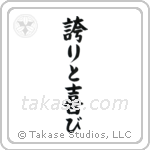
Sold as Pride And Joy · For The Sake Of The Children · Read hokori to yorokobi · kodomo no tame ni · Register plain standard Japanese, both phrases; neither is a set expression, both are what the words say · Oldest witness 子供の爲に in a Chikamatsu puppet play of 1718, in an 1891 edition, and in the 1891 translation of Little Lord Fauntleroy; 誇りと喜び in a soldier's memoir of 1911, the year after the dictionary's first citation for the noun 誇り itself · Sense what a parent feels, and what a parent does.
The sense: a feeling and a reason
誇りと喜び is two nouns joined by and, pride and joy, and the Japanese, like the English, is most often said of a person: a child, a pupil, a returning son. It does not name the person, so it works on a wall. 子供の為に is a reason without a verb, for the children's sake, and Japanese leaves the verb off as English does; for the children is the whole of what the scroll says, and what one does for them is the buyer's. Both phrases are older in Japanese print than the house, and the older of the two is old indeed: a mother in a Chikamatsu play of 1718 who feigns illness for her children's sake, and, in the same year of print, 1891, a Meiji translator's Little Lord Fauntleroy.
The words
誇り hokori: デジタル大辞泉 誇ること。名誉に感じること。また、その心, to be proud; to feel as an honor; and that feeling, with 一家の誇り, the pride of a family. 精選版日本国語大辞典 gives the noun as the nominalized verb 誇る and dates it late: its first citation is Shimazaki Tōson's 家 of 1910–11, where the word is written 矜持 and read ホコリ. The noun is Meiji in the dictionary's record, though the verb is old. 喜び yorokobi: よろこぶこと。うれしく思うこと, rejoicing; feeling glad, opposed to 悲しみ, with second senses of a congratulation and a celebration; cited from a glossed sutra of about 850 and from the 源氏物語. と to is and, joining nouns. [kotobank.jp/word/誇り · /word/喜び, text; read by the investigator]
子供 kodomo: 年のいかない幼い者。児童, a young person; a child, and the children one has, 親がもうけた子; the dictionary notes that ども was a plural ending and the word now serves for one child or many. Its first citation is the 日本書紀 of 720, 児息 read コトモ. 為 tame: 利益があること。役立つこと, benefit, use, with the dictionary's own example 子供の為を思う, to think of the children's good; then cause; then 目的や期待の向かうところ, the object toward which purpose or hope is directed, 健康の為に運動をする, to exercise for the sake of health. 子供の為に is the third sense, purpose, with the first, benefit, behind it. [kotobank.jp/word/子供 · /word/為, text; read by the investigator]
The English fits. Pride and joy and 誇りと喜び are the same two nouns in the same order, and both languages use the pair of a person; the one difference is that English has made pride and joy a fixed idiom for a beloved person or thing, and Japanese has not, so the Japanese reads as two feelings rather than one phrase. For the sake of the children is 子供の為に exactly, and 子供 answers to child or children alike, which the catalogue's three English titles for the design already show. [jisho.org/word/誇り · /word/子供, text]
A history, from the earliest witness
1718, printed 1891. Chikamatsu. In 曽我会稽山, the Soga brothers' mother, in a speech on a mother's love: 子供の爲にと病を作り思ひ設けし母が慈悲い仇と成, the mercy of a mother who, for her children's sake, feigned illness and planned ahead, has turned to harm; the OCR's い is the printed は. The play is Chikamatsu's of 1718; the library's text is an 1891 reprint, and the phrase is what a mother says in the oldest Japanese voice the corpus lets us hear. [近松門左衛門『曽我会稽山』武蔵屋叢書閣 1891, NDL pid 876698, koma 28, OCR]
1889 and 1891. A concordance, and Little Lord Fauntleroy. A Bible concordance of 1889 lists, under prayer, 祈禱, the heading (子供の爲に), for children, with its references, one of them Matthew 15:22, the Canaanite woman who prays for her daughter. And Wakamatsu Shizuko's translation of Burnett has the phrase in Cedric's mother's mouth: 仰の通り、子供の爲にい結構なとで御座りませう, as you say, for the child's sake it is a fine thing, as the OCR reads it; read 爲には and ことで. The Meiji phrase is a parent's, and a praying one. [上田貞次郎編『旧新約両全書聖語類聚』上田済生堂 1889, NDL pid 825559, koma 18, OCR; バアネット『小公子』若松賤子訳 1891, NDL pid 1168359, koma 34, OCR]
1911. 誇りと喜び, a soldier home. A one-year volunteer's memoir opens with his homecoming: 僕は男兒當然の義務を果したに過ぎぬと思ひ、此の過分の歡迎に對して心中聊か忸怩たるものもあつたが、それでも幾分の誇りと喜びとを禁じ得なかつたのである, I thought I had only done what a man must, and felt some embarrassment at the excessive welcome; and yet I could not keep down a certain pride and joy. The pair appears with the と repeated, 誇りと喜びと, which is the older way of writing A and B and the reason the design's single と reads as modern. [水暮『奮闘記』厚生堂 1911, printed p. 1, NDL pid 888121, koma 4, by eye]
1913 and 1918. A book on prenatal care promises the mother who has done well 滿足と共に勝利の誇りと喜び, satisfaction, and the pride and joy of victory; and Tanizaki, in 金と銀, gives the pair to a painter who feels 世界を征服した王者のやうな誇りと喜び, the pride and joy of a king who has conquered the world, with fear taking root beneath it. The library holds 164 books with the phrase to 1946, and these three are what it is for: a homecoming, a birth, a triumph with a shadow. [下田次郎『胎教』実業之日本社 1913, NDL pid 937405, koma 92, OCR; 谷崎潤一郎『金と銀』春陽堂 1918, NDL pid 959424, koma 27, OCR, which reads 張り切つだ]
What is not a source
Neither phrase has an author. The Chikamatsu line is the oldest page and not the origin; a mother's for the children is older than any book. The 1937 school-law digest that a first search returned for 誇りと喜び matched the two words on a page, not the phrase, and is not a witness.
The phrases in English
Pride and joy has no source the house names; in English it is an idiom for a person or thing one is proudest of, and the encyclopedia's page for the words is a list of songs, the first of them Marvin Gaye's of 1963. The house's page says the Japanese is used in the same way as the English, and that is right, with the one shade above: Japanese has not frozen the pair into an idiom. For the sake of the children is the house's own English, and its three variants, my children, our children, are all inside 子供の為に. What a rendering must keep is the repeated feeling in 誇りと喜び, both nouns, in that order, and in 子供の為に the purposive に, for the sake of, not the possessive. [en.wikipedia.org/wiki/Pride_and_joy, text]
A reading
Two family phrases, and both older than a buyer would guess. I would put the Chikamatsu mother on the page for 子供の為に, because a phrase that a puppet-play mother says in 1718 and a Meiji translator gives to Cedric's mother in 1891 has earned the right to be called Japanese, whatever the English on the order form. 誇りと喜び is the younger and the Japanese record says so: the noun 誇り itself is first cited in 1910, and a year later a soldier home from his service could not keep the pair down. The house's English for both is right, and the pages need only tell the buyer that the Japanese was here first. Signed, the philologist, 2026-09-06.
Notes
- 誇りと喜びと. The 1911 and 1918 witnesses repeat the particle, the old written form; the design's single と is modern and correct.
- The Lab's dates. The first hits the API returns for 子供の為に are dated 1800, the API's value for an undated book; the dated witnesses begin with the 1870 manuscript of 近頃河原達引 and the 1887 八犬伝 edition, whose OCR is too broken to quote, and the history quotes 1889 and 1891.
- Romaji. Both phrases' romaji on the page match the seat's standard; nothing to migrate.
How this was read
A bracket that names a National Diet Library leaf as pid and koma resolves at lab.ndl.go.jp/dl/api/page/<pid>_<koma> for the OCR text and at dl.ndl.go.jp/api/iiif/<pid>/R<koma, seven digits>/full/2400,/0/default.jpg for the image. By eye at the page: 奮闘記 at p. 1 (pid 888121, koma 4). By OCR, own-hand at the koma: the five other books in the brackets. By the Lab's full-text search, own-hand, the whole result set of each phrase sorted by year (164 · 1,684). By text: the kotobank entries for 誇り, 喜び, 子供 and 為, read whole by investigate-ten on 2026-09-05 and quoted from its reading files, not re-opened by the seat; the EDRDG entries at jisho; the English Wikipedia disambiguation page for Pride and Joy. Not opened: the 1870 manuscript and the 1887 八犬伝; the other 160 pages with 誇りと喜び and 1,680 with 子供の爲に; Tōson's 家 for the 1910 矜持; an English dictionary for pride and joy.
References
- 129 誇りと喜び (164 books; 1937) — F0056
- 164 子供の為に (1,684 books; 1912) — F6000
- 222 家族は永遠 (2 books; 1924) — F6058
- 291 自分を信じる (39 books; 1946) — I6002
- 295 精一杯生きる (0) — I6006
- 299 強く生きる (207 books; 1937) — I6010
- 319 希望は最大の宝 (0) — I6030
- 327 自由に生まれて (0) — I6038
- 331 新たな始まり (1 book; 1948) — I6042
- 415 永遠に心の中に (1 book; 1927) — L5033
- 418 永遠に私の心に (3 books; 1935, 1941) — L5036
- 566 危険を冒す (2,388 books; 1897 among the first five) — M6013
- 961 生きる笑う愛する (0) — S0000
- 968 誕生日おめでとうございます (0) — S0007
- 988 有難う御座います (1,739 books; 1914 among the first five) — S0030
- 1010 ゴルファー (50 books; 日国 初出 1930) — S5009
- 392 禁じられた愛 (1 book; 1924) — L5010
- 834 永遠の若さ (202 books) — P4103
- 627 母なる自然 (85 books) — N4014