

我武者羅 · gamushara · Reckless
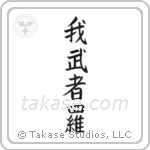
Sold as Reckless · Read gamushara, four graphs, all four borrowed for their sound · Register Edo slang, standard by the 1940s; blame that has become praise · Sense one: charging at a thing without thought for before or after.
The words
None of the four characters means what the word means. The dictionaries derive the base, gamusha, with a question mark, from an older word for self-greed, and say plainly that 武者, warrior, was borrowed for its sound; ra is a suffix and 羅 the character borrowed to write it. The word is usually written in kana. The base is the harsher word: the national dictionary defines it as hot blood; heedless violence; doing a thing any old how, and the 1922 dictionary that lists it labels it slang. The suffixed word is softer and has kept softening: forcing a thing through without thought for before or after, with the examples an all-out attack and to work flat out, and a synonym list that is the vocabulary of effort, single-minded, undistracted, giving one's all. The modern idiom dictionary files it under to devote oneself and to give one's all. English reckless is heedless of consequences and is a verdict; headlong and hell-for-leather are the same speed without the verdict. The Japanese word has moved from the first toward the second over the last century.
Where it comes from
The word is Japanese through and through; the Chinese corpus has no such string. Its oldest witness is a haikai verse of 1658, a New Year's pun on a hothead pulling armor on over his head. Chikamatsu used it on the puppet stage around 1700, and two of his uses were read here at the page: the hotheads, hot with the chase, crying leave none alive, and, of a fierce mother, a hothead true to her name; the dictionaries cite three more of his plays. It was a person-word, a gamusha fellow, and Edo popular fiction kept it for the lawless hothead. The suffix arrived in the nineteenth century. By 1896 a dictionary was using gamushara to explain a word that had gone out of use, glossing a Genroku-era term as gamushara, helter-skelter, violent; two years later a novelist spelled it with the character for et cetera and glossed it the sort who thinks of neither before nor after. The spelling on this design, with 羅, is in a storytellers' magazine of 1911, a dictionary headword in 1915, a girls' school reader's vocabulary in 1926, listed among the dialect words of two Mikawa towns in the early 1930s, and in the national broadcaster's pronunciation dictionary of 1943. The translators of the 1920s reached for it: for Dostoevsky's Varvara Petrovna, for Sophocles' Creon, who insists I am not a gamushara tyrant, for Drinkwater's Lincoln. The poet Kitahara Hakushū used it in 1925 as a reproach.
The text in English
There is no nineteenth-century English for this word. Hepburn's three dictionaries and Brinkley's do not carry it, which fits its label as slang; the missionaries did not take the word down. The English it has is the modern dictionaries': reckless; daredevil; frantic; foolhardy, and, for the person, daredevil, madcap, hothead, swashbuckler. The house's Reckless is the first of those glosses. Japanese today uses the word on the other side of the ledger. Japanese Wikipedia's articles on it are led by a heavy-metal album and a run of song titles, a sumo writer in 1962 uses it for a headlong pursuit, and the dictionary's synonyms are words of admiration. A rendering must choose which end to stand on: headlong or all-out stands nearer the living word, reckless nearer the Edo one. The page's second gloss, proceeding single-mindedly without regard to consequences, stands in the honest middle.
A reading
Signed 典, 2026-09-08. This is an Edo slang word dressed in Meiji characters, and both halves of that sentence are to its credit. The thing itself is on Chikamatsu's stage: the man who rushes a fight. The characters came later, once a spoken word needed writing, and they are on the dictionary's page by 1915, which is old enough for a brush. What has changed is the verdict. The Edo word was blame; the word in a broadcaster's list, a sumo report and a rack of song titles is praise, the all-out effort Japanese admires and names without irony. English reckless keeps only the blame. So the design is exact for the word, and its title is exact for the word's older half. A buyer who means I go all out has the living sense, and the page's second gloss is the sentence that tells them so; I would lead with it, which is 照's call. No per-character line belongs on this page, since three of the four characters mean nothing here. No question for Eri: the reading, the spelling and the drift are all on the record.
How this was read
By eye: the template; six pages at the National Diet Library's image host, two Chikamatsu plays in the 1896 and 1897 collected editions, the entries in the 1915 and 1922 national dictionaries, the 1896 dictionary's gloss, and the 1943 accent dictionary. By text: two dictionary pages at kotobank; the etymology dictionary and the idiom dictionary; the Chinese Text Project for the null; Weblio; the Japanese Wikipedia search. By OCR: the local harvest archive of 9,873 prewar books on twelve forms, and the four shelf dictionaries for the word's absence. Not opened: the 1658 verse and the 1898 novel the national dictionary cites; three of Chikamatsu's five plays; the Library's own index, which waits on Tim's run. Every address is in the account, marked by eye, OCR or text.
References
- ctext post-Han for 我武者 (—) — ctext.org/post-han?searchu=我武者
- 俳諧 鸚鵡集 一 (日国) (1658) — kotobank 我武者-466712
- 近松 最明寺殿百人上臈, 近松時代浄瑠璃集 (c. 1700; 1896 print) — pid 876715 k222 pp. 8–9, by eye
- 近松 薩摩歌, 近松世話浄瑠璃集 (early 18th c.; 1897 print) — pid 1883006 k52 p. 90, by eye; 1919 集成 pid 959523 k84 我武者者, OCR
- 近松 国性爺合戦 · 曾我虎が磨 · 祇園女御九重鏡 (1915 · 1922 dictionaries) (early 18th c.) — pid 954645 k488 · 969159 k430, OCR
- 為永春水 いろは文庫 (1886 print) — pid 877755 k110, OCR
- 宮崎三昧 塙団右衛門 (1893) — pid 887838 k9, OCR
- 藤井乙男・草野清民 帝国大辞典 (1896) — pid 2387590 k229 p. 446, by eye
- 小栗風葉 恋慕ながし 二〇 (日国) (1898) — kotobank 我武者羅-466714
- 講談倶楽部 侠客殿様源次 (1911) — pid 889858 k57, OCR
- 上田万年・松井簡治 大日本国語辞典 (1915) — pid 954645 k488 pp. 950–951, by eye; wording OCR
- 広津和郎 神経病時代 (日国) (1917) — kotobank 我武者羅-466714
- 有島武郎 或る女 (大辞泉) (1919) — kotobank 我武者-466712
- ドストイェーフスキー全集 · 中村吉蔵 訳 希臘悲劇六曲 · ドリンクウォーター エブラハム・リンカーン (1921 · 1922 · 1924) — pid 958992 k156 · 968163 k207 · 977319 k47, OCR
- 落合直文 言泉 (1922) — pid 969159 k430 pp. 834–835, by eye; wording OCR
- 北原白秋 季節の窓 (1925) — pid 1016715 k28, OCR
- 女子副読本備考 (1926) — pid 925539 k6, OCR
- 岡崎市史 · 刈谷町誌 (1930 · 1932) — pid 1240764 k40 · 1209008 k261, OCR
- 日本放送協会 日本語アクセント辞典 (1943) — pid 1126379 k81 p. 145, by eye
- 村松梢風 両国の川風 (1962) — pid 1648988 k128, OCR
- Hepburn 1867 · 1872 · 1886 · Brinkley 1896 (—) — papers/ OCR texts
- JMdict · WordNet (Weblio; gokanji.db) (current) — ejje.weblio.jp/content/我武者羅 · gokanji.db 1196910
- gogen-yurai · jitenon (current) — gogen-yurai.jp/gamusyara · yoji.jitenon.jp
- ja.wikipedia full-text (current) — ja.wikipedia.org search
- The local archive, twelve forms (to 1962) — search_ndl_archive.py, local_archive_counts.txt